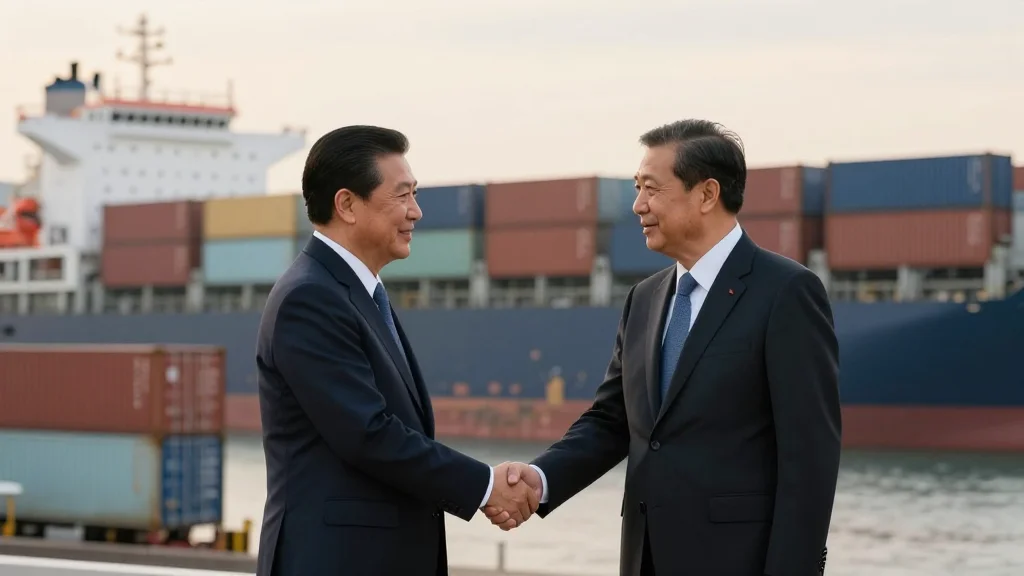
Japan‑South Korea Hometown Summit Targets Supply‑Chain Resilience Amid Geopolitical Strains

Why It Matters
Stabilizing the Japan‑South Korea partnership directly influences the broader East‑Asian supply‑chain ecosystem, which underpins a significant share of global electronics, automotive, and petrochemical production. A coordinated approach to energy security and raw‑material sourcing can reduce the risk of sudden shortages that ripple through multinational manufacturers. Moreover, the summit signals to multinational corporations that the two largest economies in the region are willing to align on trade facilitation, potentially encouraging foreign direct investment and prompting other regional players to adopt similar cooperative frameworks. In an era where geopolitical tensions can instantly disrupt logistics, the Andong talks may become a reference point for how diplomatic engagement can safeguard critical supply‑chain nodes.
Key Takeaways
- •Japanese PM Sanae Takaichi and South Korean President Lee Jae‑myung met in Andong, the first hometown visit by sitting leaders.
- •Agenda focused on economic, energy cooperation and addressing supply‑chain vulnerabilities.
- •Both countries have pledged hundreds of billions of dollars in U.S. business investments.
- •Leaders emphasized cooperation over historical disputes, aiming to keep logistics channels open.
- •A follow‑up working group on logistics and energy is expected within the next quarter.
Pulse Analysis
The Andong summit reflects a pragmatic shift in East‑Asian diplomacy, where supply‑chain resilience has moved from a peripheral concern to a central bargaining chip. Historically, Japan‑South Korea relations have been punctuated by episodic flare‑ups over wartime history, often spilling into trade negotiations. By framing the dialogue around concrete economic outcomes—such as joint semiconductor initiatives and synchronized energy procurement—the two governments are effectively insulating critical industries from political volatility.
From a market perspective, the meeting could catalyze a modest re‑balancing of supply‑chain risk assessments. Investors tracking semiconductor and battery manufacturers may begin to price in a lower probability of abrupt export curbs between the two nations, potentially narrowing the discount on firms heavily reliant on cross‑border component flows. Additionally, the pledge of “hundreds of billions” in U.S. investments suggests a continued alignment with Washington’s strategic vision of a resilient, diversified supply chain that reduces dependence on China.
Looking ahead, the real test will be the implementation of joint mechanisms discussed in Andong. If Tokyo and Seoul can launch interoperable customs platforms or co‑fund strategic mineral stockpiles, they will set a template for regional supply‑chain governance that could be replicated across ASEAN and beyond. Failure to translate diplomatic goodwill into operational frameworks, however, would leave the status quo—periodic disruptions and lingering mistrust—largely unchanged.
Japan‑South Korea Hometown Summit Targets Supply‑Chain Resilience Amid Geopolitical Strains
Comments
Want to join the conversation?
Loading comments...