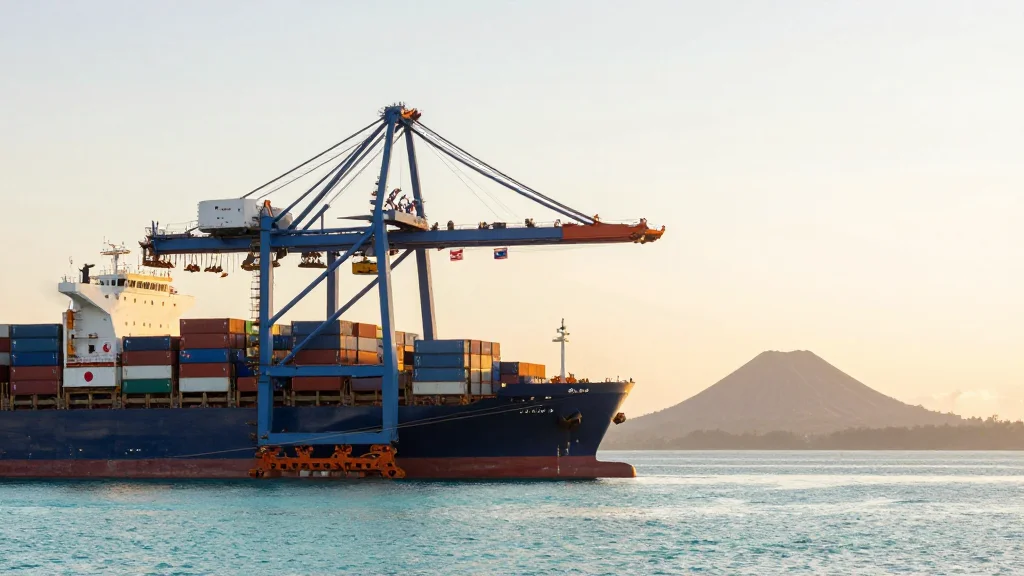
Quad Launches New Port Infrastructure Partnership in Fiji to Strengthen Pacific Supply Chains

Why It Matters
The Fiji port initiative directly addresses three critical vulnerabilities in global supply chains: geopolitical risk, climate‑induced disruption, and over‑reliance on a narrow set of hub ports. By creating a resilient Pacific gateway, the Quad not only safeguards the flow of critical minerals essential for renewable‑energy technologies but also offers an alternative route for goods that might otherwise be delayed by congestion or political tension in the Strait of Hormuz. The project also serves as a diplomatic counterweight to China’s expanding Belt and Road footprint, giving Pacific island nations a diversified set of partners for infrastructure development. If successful, the pilot could catalyze a wave of similar investments across the region, encouraging private‑sector participation and fostering standards for digital customs integration. This would lower logistics costs, shorten delivery windows, and improve the predictability of supply‑chain planning for manufacturers in the United States, Japan and Australia, ultimately strengthening the resilience of global trade networks.
Key Takeaways
- •Quad foreign ministers announce pilot port infrastructure project in Fiji, the strongest Quad commitment to Pacific logistics.
- •Penny Wong emphasizes secure and reliable supply chains as a precondition for economic and strategic stability.
- •Project will modernize cargo handling, expand berth capacity, and integrate digital tracking to streamline customs.
- •Initiative aims to diversify trade routes for critical minerals and reduce dependence on congested Asian hubs.
- •Construction slated for early 2027 with operational target of 2029, potentially setting a template for other island nations.
Pulse Analysis
The Quad’s Fiji port partnership marks a decisive pivot from ad‑hoc aid to strategic infrastructure that intertwines security and commerce. Historically, Pacific islands have been peripheral to global supply‑chain planning, serving mainly as waypoints rather than nodes. By investing directly in a high‑capacity, digitally enabled port, the Quad is re‑positioning the region as a proactive conduit for critical‑mineral flows and a buffer against supply‑chain shocks.
From a competitive standpoint, the move challenges China’s Belt and Road dominance in the Pacific. While Beijing has poured billions into ports across the region, its projects often lack transparent governance and can be vulnerable to debt‑distress scenarios. The Quad’s approach—combining public funding with private‑sector expertise and emphasizing climate‑resilient design—offers a more sustainable model that could attract multinational shippers wary of geopolitical risk.
Looking ahead, the success of the Fiji pilot will hinge on execution speed, local stakeholder buy‑in, and the ability to integrate with existing maritime networks. If the port can demonstrably cut vessel turnaround times and lower logistics costs, it will likely become a magnet for ancillary services—logistics firms, warehousing, and even data‑analytics providers—spurring a broader ecosystem of supply‑chain innovation in the Pacific. Conversely, delays or cost overruns could reinforce skepticism about multilateral infrastructure projects and embolden rival initiatives.
In the longer term, the Quad’s investment could reshape global supply‑chain topology, creating a more distributed network that reduces systemic risk. As manufacturers worldwide grapple with the twin pressures of climate change and geopolitical volatility, the emergence of a resilient Pacific hub may prove to be a critical piece of the puzzle, ensuring that the flow of essential components for everything from electric vehicles to renewable‑energy systems remains uninterrupted.
Quad Launches New Port Infrastructure Partnership in Fiji to Strengthen Pacific Supply Chains
Comments
Want to join the conversation?
Loading comments...