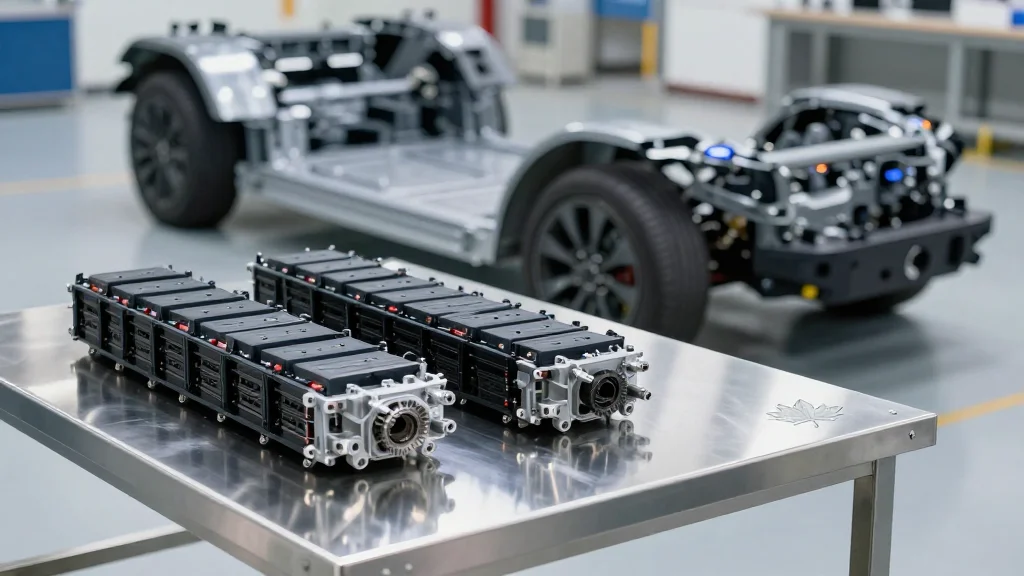
Why Chinese 'Knock-Down' Car Kits Could Spell Catastrophe for Canadian Automakers
Companies Mentioned
Why It Matters
CKD imports threaten thousands of well‑paid auto jobs and erode Canada’s parts‑supply ecosystem, challenging the country’s industrial policy and trade balance.
Key Takeaways
- •CKD kits could cut Canadian auto jobs by thousands
- •Stellantis may reopen Brampton plant using Chinese knock‑down kits
- •Volvo’s 1963‑1998 PKD plant created only 200 direct jobs
- •BYD eyes Canadian dealerships despite 6.1% duty on imports
- •Economic output of a full plant ≈ $2.1 B USD vs $11 M CKD
Pulse Analysis
Chinese EV manufacturers are poised to enter Canada, but the mode of entry matters. While Prime Minister Mark Carney touts affordable Chinese cars, industry insiders warn that shipping vehicles as complete knock‑down (CKD) kits sidesteps local assembly, stripping Canadian factories of the high‑value work that fuels thousands of jobs. The federal duty of 6.1% on 49,000 imported EVs adds a modest cost barrier, yet it does little to compel domestic content, leaving policymakers to grapple with how to protect the auto supply chain.
Economic modeling by the Auto Parts Manufacturers’ Association shows a full‑scale Canadian plant processing 150,000 vehicles can generate about $2.1 billion USD in output and employ roughly 2,000 workers at an average compensation of $106,000 USD per year. Spin‑off employment multiplies this impact, creating up to 8,000 ancillary jobs. By contrast, a CKD facility with 300 staff would produce only $11 million USD in activity, dramatically reducing wage spillovers and tax revenue. These figures underscore the stark disparity between genuine manufacturing and low‑value assembly, highlighting the risk of a hollowed‑out auto sector.
History offers cautionary tales. Volvo’s partial‑knock‑down plant in Nova Scotia (1963‑1998) never exceeded 200 direct jobs, and its Canadian content dwindled despite modest production volumes. Toyota’s brief foray into knock‑down assembly produced similar limited gains. As Canada negotiates trade rules and considers incentives for Chinese EVs, the lesson is clear: without robust local‑content requirements, CKD imports could erode the country’s manufacturing base, diminish high‑skill employment, and weaken the broader economic ecosystem.
Why Chinese 'knock-down' car kits could spell catastrophe for Canadian automakers
Comments
Want to join the conversation?
Loading comments...