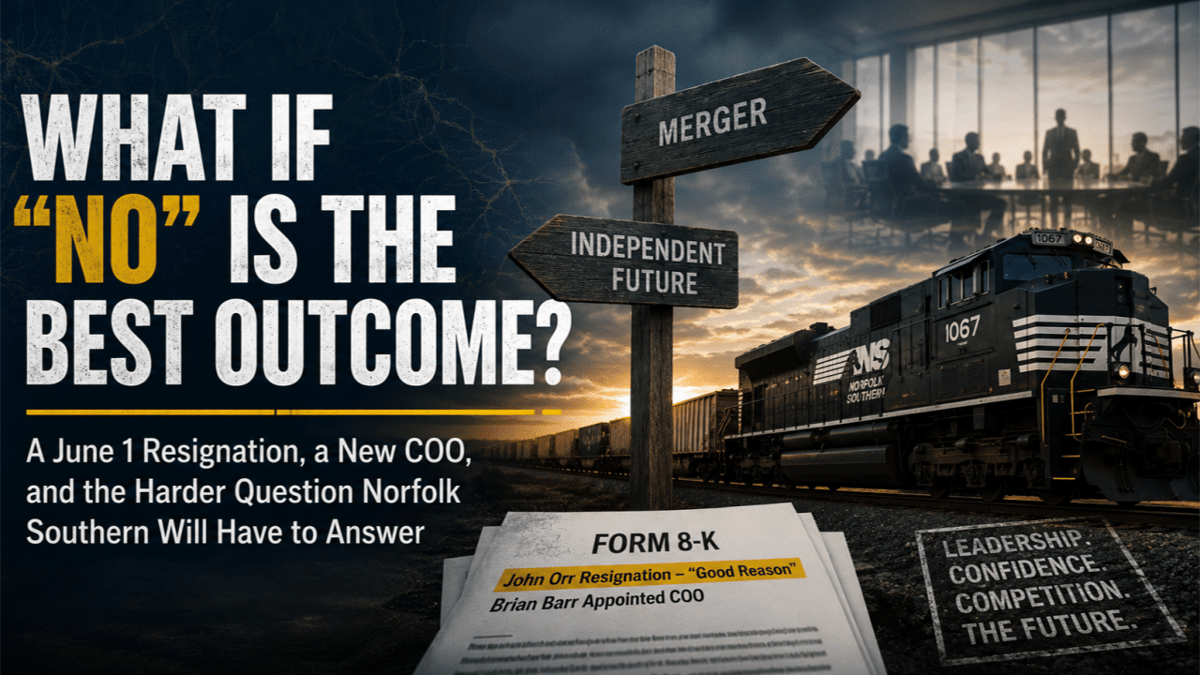
A June 1 Resignation, a New COO, and the Harder Question Norfolk Southern Will Have to Answer
Companies Mentioned
Why It Matters
The leadership shake‑up and merger‑linked compensation expose Norfolk Southern’s operational uncertainty and could affect shippers’ confidence in the railroad’s independence and regulatory scrutiny.
Key Takeaways
- •COO John Orr resigns citing reduced responsibilities, effective May 31
- •Brian Barr, former UP executive, promoted to NS COO June 1
- •NS leadership turnover hits ten VP of Transportation appointments in eight years
- •Retention packages assume merger completion, totaling $2.25M for Orr, $2M for Barr
- •Merger uncertainty raises antitrust and shipper contract credibility concerns
Pulse Analysis
The abrupt departure of John Orr, Norfolk Southern’s chief operating officer, underscores a deeper strategic shift within the railroad. Orr’s "good reason" resignation—triggered by a contraction of his responsibilities—signals that the company is already reshaping its operating model ahead of the pending Union Pacific merger. By installing Brian Barr, an outsider with a background at Union Pacific and CSX, NS is aligning its leadership with the integration blueprint, even as the Surface Transportation Board continues its rigorous review. This pre‑emptive restructuring suggests the firm is betting on a successful merger, embedding the future combined network into its current governance.
Beyond the executive carousel, the filing reveals a pattern of rapid turnover at the highest operational levels. Ten different individuals have held the Vice President of Transportation role in roughly eight years, reflecting ongoing attempts to find a stable operating philosophy. The removal of the senior vice president layer and the reassignment of sourcing to finance further streamline the organization for a post‑merger environment. However, such moves also risk destabilizing the workforce and eroding institutional knowledge, especially if the merger is ultimately blocked.
For shippers and investors, the stakes are high. Retention packages totaling over $4 million for the departing and incoming COOs are predicated on the merger’s completion, creating a financial incentive tied to regulatory outcomes. If the Surface Transportation Board rejects the deal, Norfolk Southern will need to pivot from an integration narrative to a transformation story, redefining its identity, growth strategy, and competitive posture. This uncertainty could affect long‑term contract negotiations, pricing dynamics, and the railroad’s credibility in the market, making the next few months critical for all stakeholders.
A June 1 Resignation, a New COO, and the Harder Question Norfolk Southern Will Have to Answer
Comments
Want to join the conversation?
Loading comments...