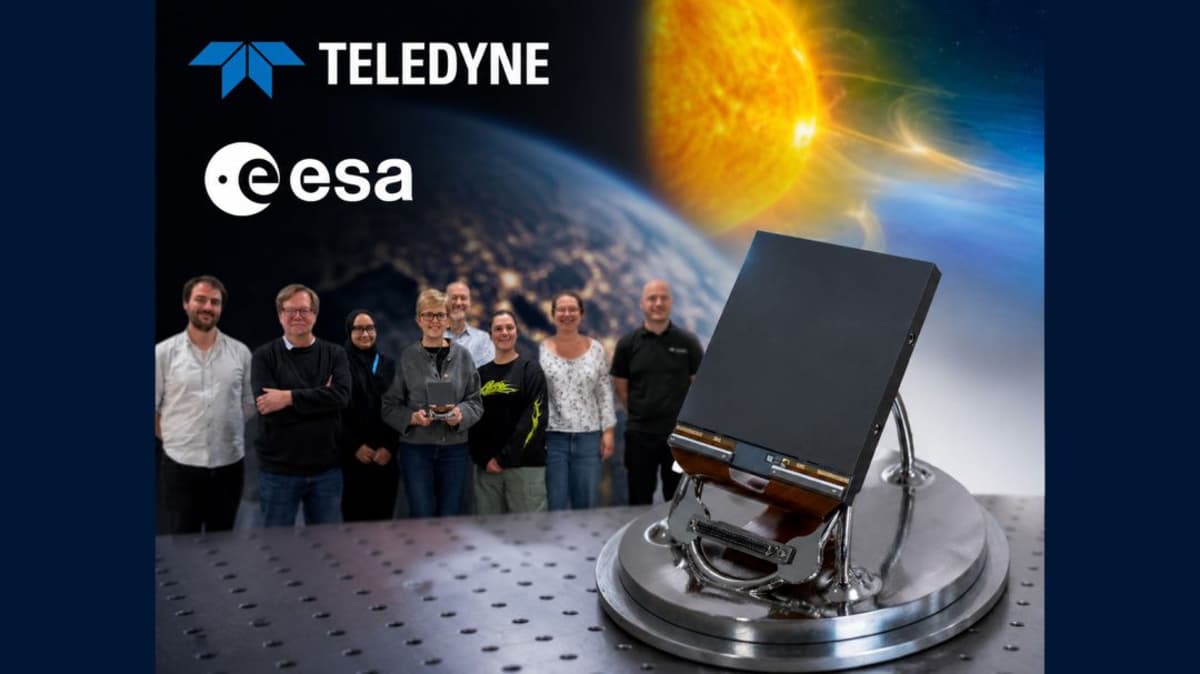
Teledyne CCD370 Sensors Launch on SMILE Mission
Why It Matters
The data will sharpen space‑weather models, helping protect satellites, navigation and power grids, while showcasing Teledyne’s role as a key supplier of space‑qualified imaging technology.
Key Takeaways
- •Teledyne supplied two CCD370 sensors for SMILE’s Soft X‑ray Imager.
- •Sensors detect 0.2‑2.0 keV photons to map Earth’s magnetosphere.
- •Built in Chelmsford, UK; part of 250+ space project heritage.
- •SMILE’s orbit ranges 5,000 km to 121,000 km, covering polar regions.
- •Data will improve models of solar storms and space‑weather impacts.
Pulse Analysis
The European Space Agency’s Solar wind Magnetosphere Ionosphere Link Explorer (SMILE) represents a rare UK‑China‑EU collaboration aimed at visualising the invisible interaction between the solar wind and Earth’s magnetic field. By placing Teledyne’s CCD370 sensors on the Soft X‑ray Imager, the mission gains a high‑resolution, radiation‑tolerant detector capable of imaging soft X‑ray emissions that traditional particle instruments miss. This capability opens a new window onto large‑scale magnetospheric structures, complementing in‑situ measurements from other spacecraft and delivering a more holistic picture of space‑weather dynamics.
Technically, the CCD370 combines deep‑depletion silicon with low‑noise readout electronics, enabling detection of photons as low as 0.2 keV while maintaining fast frame rates needed for dynamic phenomena. The sensors’ heritage—validated on over 250 prior space missions—reduces risk for SMILE’s demanding polar orbit, which swings from 5,000 km to 121,000 km altitude. Their UK‑based design and qualification underscore the growing importance of European manufacturing in a market historically dominated by U.S. firms, positioning Teledyne as a strategic partner for future multinational science missions.
Beyond scientific discovery, the mission’s outcomes have tangible commercial relevance. Accurate space‑weather forecasts mitigate disruptions to GNSS, satellite communications, and power‑grid operations—sectors worth billions of dollars annually. As models integrate SMILE’s imaging data, operators can anticipate geomagnetic storms with greater lead time, reducing costly outages. For Teledyne, the successful flight of CCD370 sensors not only validates its product line but also strengthens its credibility with defense, aerospace, and commercial customers seeking reliable, space‑qualified imaging solutions.
Teledyne CCD370 sensors launch on SMILE mission
Comments
Want to join the conversation?
Loading comments...