
Blog•Mar 2, 2026
AI Solves a Key Barrier to Making Hydrogen Cars More Affordable
Korean researchers at KAIST and Seoul National University used artificial intelligence to redesign hydrogen fuel‑cell catalysts, discovering that zinc directs platinum and cobalt atoms into a high‑performance intermetallic structure. The AI‑predicted Zn‑mediated catalyst outperforms commercial platinum catalysts in activity and durability while requiring lower‑temperature processing. This breakthrough cuts material costs and extends catalyst life, addressing two major barriers to affordable hydrogen vehicles. The findings, published in Advanced Energy Materials, suggest a new AI‑driven paradigm for next‑generation fuel‑cell materials.
By Nanowerk

Blog•Mar 2, 2026
Anastasia Boyko on Advisor Mode, Training Lawyers for the Post-Pyramid Firm
Anastasia Boyko, a Yale‑trained tax lawyer and legal futurist, argues that law firms are stuck in precedent‑driven habits while AI reshapes market rules. She urges firms to abandon copy‑cat strategies and adopt intentional, outcome‑focused planning. Boyko warns that in‑house legal...
By 3 Geeks and a Law Blog

Blog•Mar 2, 2026
Models Represent XOR with 100% Accuracy
Researchers Miras Seilkhan and Adilbek Taizhanov compared a two‑qubit variational quantum classifier (VQC) against logistic regression and a multilayer perceptron on synthetic XOR data. A depth‑2 quantum circuit achieved perfect test accuracy, matching the classical neural network, while a depth‑1...
By Quantum Zeitgeist

Blog•Mar 2, 2026
Which Al Model Suits Your Workflow : ChatGPT vs Gemini vs Claude & More
The article breaks down AI models into five categories—flagship, mid‑tier, light, open‑source, and specialized—to help professionals match tools with workflow needs. Flagship models like OpenAI ChatGPT 5.2 and Google Gemini 3 Pro offer multimodal capabilities and deep context but carry higher costs and...
By Geeky Gadgets

Blog•Mar 2, 2026
A First in Fintech: The AI-Native Options Intelligence API
Trading Volatility launched an AI‑native options intelligence API, the first of its kind in fintech. The service delivers derived market‑structure data—gamma levels, regime diagnostics, call pressure, skew and IV metrics—in deterministic, agent‑readable schemas. Built for machine consumption, it lets large...
By Trend & Trigger, by Trading Volatility
Blog•Mar 1, 2026
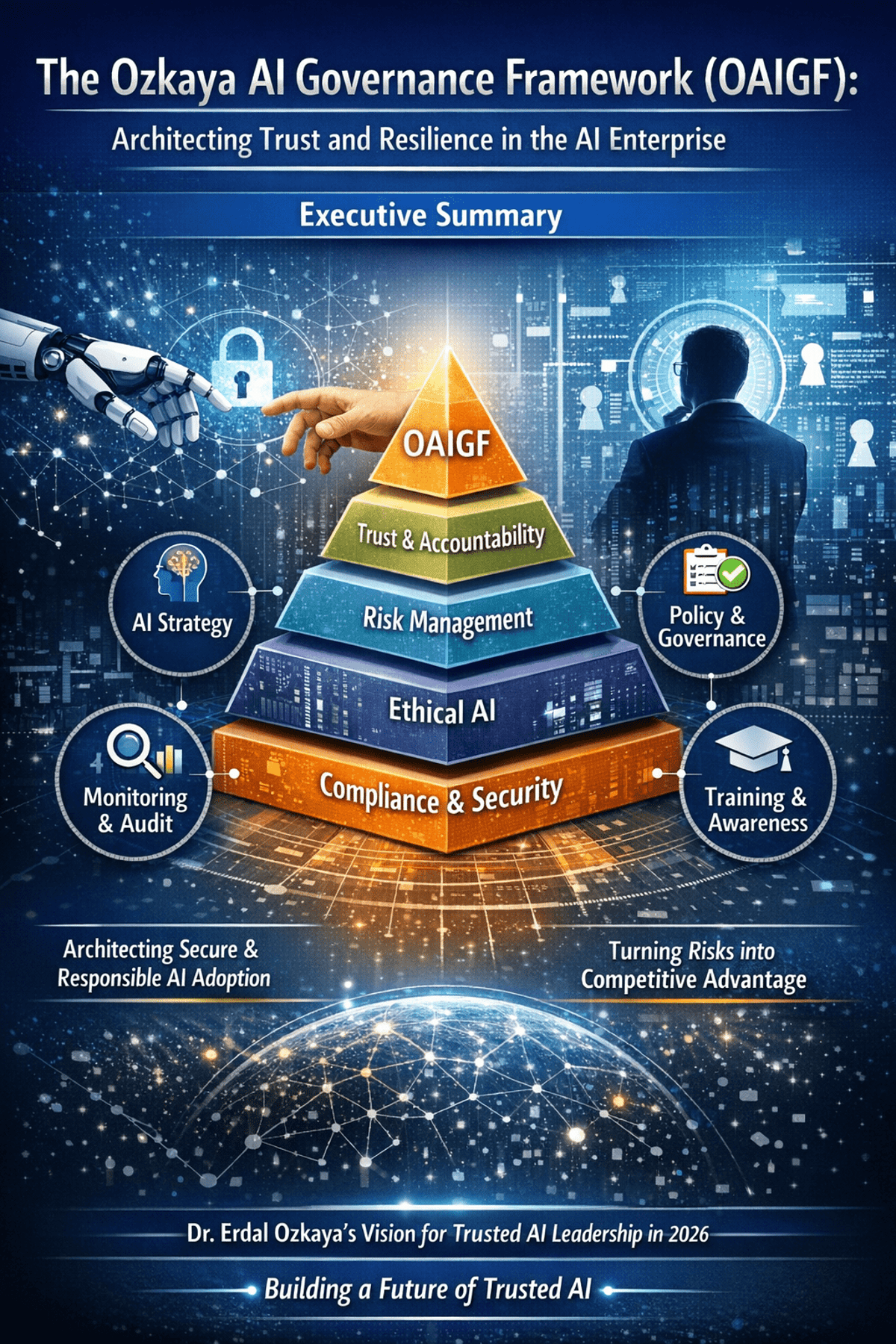
The Ozkaya AI Governance Framework (OAIGF): Architecting Trust and Resilience in the AI Enterprise
The Ozkaya AI Governance Framework (OAIGF) is a practitioner‑driven methodology that equips CISOs with a comprehensive blueprint for secure, ethical, and compliant AI deployment at enterprise scale. Building on standards such as NIST AI RMF and ISO/IEC 42001, the framework defines...
By Erdal Ozkaya’s Cybersecurity Blog

Blog•Mar 1, 2026
HighRadius Bets on Results, Not Licenses
HighRadius announced an Outcome Based Pricing (OBP) model for its Office of the CFO platform, eliminating implementation and subscription fees until the solution is live and then charging a share of verified financial gains. The approach stems from a 24‑month...
By Trade Credit & Liquidity Management

Blog•Mar 1, 2026
Breaking Down Our "Red October" Moment for AI
The article warns that the Department of War’s rush to embed frontier AI models in national‑security systems mirrors the "Red October" fiasco, where safety mechanisms were disabled and catastrophic failure followed. It argues that without a mission‑aligned, fit‑for‑purpose evaluation framework,...
By The Cipher Brief

Blog•Mar 1, 2026
The Pricing Pulse: Generative AI-Assisted Review Insights From the Winter 2026 eDiscovery Pricing Survey
The Winter 2026 eDiscovery Pricing Survey of 53 professionals reveals a fragmented market for generative AI‑assisted review pricing. Hybrid and per‑document models each account for 28.3% of responses, while per‑GB, per‑token, subscription and outcome‑based models remain niche. When per‑document rates...
By ComplexDiscovery

Blog•Mar 1, 2026
The AI Medical Services Act: What It Gets Right, Where It Falls Short, and Why It Matters for the Next...
The AI Medical Services Act (AMSA) creates a new licensure category for AI-driven clinical tools, mandating tiered risk oversight, physician supervision, and a regulatory sandbox for limited deployments. It embeds bias monitoring, adverse‑event reporting, and a framework for Medicaid and...
By Thoughts on Healthcare Markets & Tech

Blog•Mar 1, 2026
Moody’s Signals Rethink Of CRE Risk Exposure As Off-Book AI Data Center Leases Top $662B
Moody’s latest ratings report reveals that the five largest U.S. hyperscalers have amassed $662 billion in future AI data‑center lease commitments that remain off their balance sheets under current GAAP. These leases, slated to commence between 2025 and 2031, represent 113 %...
By Allwork.Space

Blog•Mar 1, 2026
Why GenAI-Based Coding Agents Are a Complex Domain in Cynefin - and What that Means for Adoption
The piece frames generative‑AI coding agents as a complex problem space within the Cynefin framework, emphasizing that prompt‑to‑output behavior is inherently unpredictable. Unlike traditional developer tools that sit in clear or complicated domains, LLM‑driven agents require safe‑to‑fail experiments, rapid feedback,...
By Microservices.io (Chris Richardson)

Blog•Mar 1, 2026
Tesla FSD (Supervised) Fleet Passes 8.4 Billion Cumulative Miles
Tesla announced that its Full Self‑Driving (Supervised) system has now accumulated 8.4 billion cumulative miles, as shown on the company’s safety dashboard. The mileage grew from roughly 6 million in 2021 to 4.25 billion in 2025, with an additional 1 billion miles logged in...
By Teslarati

Blog•Mar 1, 2026
From the Microsoft Dynamics 365 CE/CRM Blogs: Service Request Management; Sales Best Practices; Useful AI in Dynamics 365 CE; Customer...
Microsoft’s Dynamics 365 Customer Engagement suite is highlighted across recent blog posts for its evolving service request management, AI capabilities, and sales automation best practices. Vidit Gholam emphasizes moving from email and spreadsheets to a centralized request system to meet...
By MSDynamicsWorld

Blog•Feb 28, 2026
The 2 ½ Minute Opening Statement: Why Aren’t You Using GenAI?
Trial lawyers can leverage generative AI to condense opening statements, improving juror engagement. A recent example shows ChatGPT rewriting the 15‑minute, 2,300‑word opening from the Derek Chauvin trial into a 360‑word, 2½‑minute version, which was then rehearsed using a realistic...
By TechLaw Crossroads