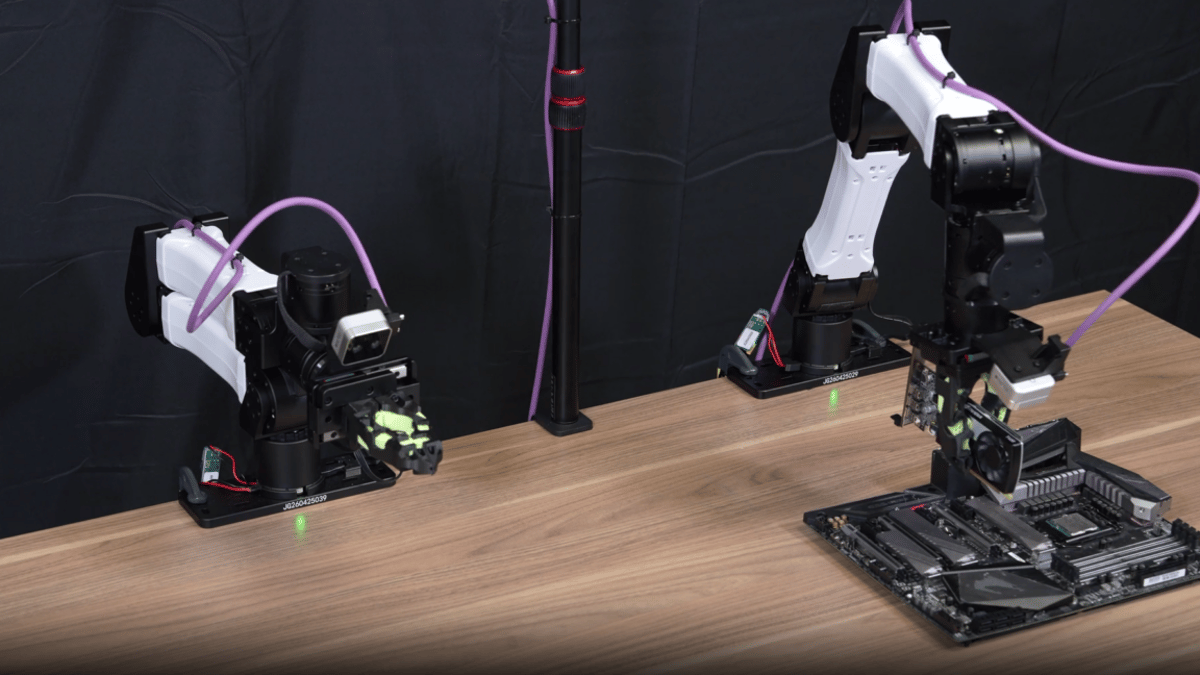
AI Coding Agents Taught Robots How to Install GPUs and Cut Zip Ties
Companies Mentioned



Why It Matters
Self‑directed robot training dramatically speeds up hardware automation, lowering labor costs and accelerating AI‑hardware integration across industries.
Key Takeaways
- •ENPIRE harness enables AI agents to autonomously train robots for complex tasks
- •Agents achieved 99% success inserting GPUs and cutting zip ties
- •Eight‑agent teams cut training time to two hours versus five hours solo
- •Open‑sourcing lets any lab run a self‑improving robot lab
- •Higher token usage raises cost considerations for large‑scale AI training
Pulse Analysis
The ENPIRE framework marks a shift from human‑in‑the‑loop robot programming to fully autonomous, code‑driven training. By wrapping large language models with memory, feedback loops and tool‑use capabilities, Nvidia’s researchers let AI agents iteratively write, test, and refine robot control code. This approach not only handles intricate manipulation—like threading a GPU into a thin motherboard socket—but also scales across multiple robots, delivering near‑perfect success rates without manual intervention.
Performance data reveal that team size matters: eight AI agents completed the Push‑T benchmark in two hours, a full hour faster than a four‑agent team and three hours quicker than a single agent. However, the experiments also exposed inefficiencies. Agents spent significant cycles reading logs, debugging, or waiting for model responses, leading to idle robot time and elevated token consumption. As AI providers contemplate higher token pricing, developers must balance speed gains against rising operational costs.
Nvidia’s push extends beyond the lab. The company recently partnered with China’s Unitree and met Hyundai’s leadership to accelerate mass production of AI‑powered humanoid robots, leveraging its GPU dominance and robotics expertise. By open‑sourcing ENPIRE, Nvidia invites academia and startups to replicate the self‑improving robot lab, potentially democratizing advanced automation and reshaping supply‑chain manufacturing, data‑center servicing, and beyond. The convergence of autonomous robot training and scalable AI models could become a cornerstone of the next wave of industrial AI adoption.
AI coding agents taught robots how to install GPUs and cut zip ties
Comments
Want to join the conversation?
Loading comments...