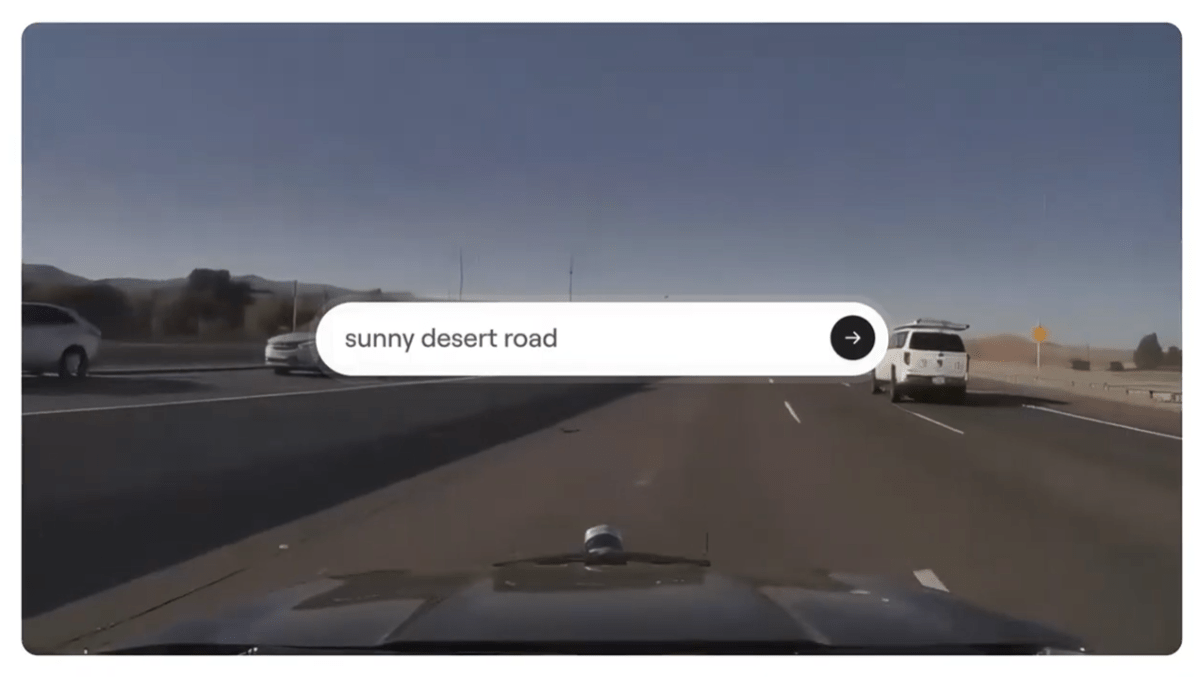
Decart’s New World Model Can Simulate Hours of Photorealistic Driving — with some Caveats

Companies Mentioned

Why It Matters
Oasis 3 could dramatically lower the cost and scale of autonomous‑vehicle testing, while a developer‑first API may spark a new ecosystem of AI‑driven simulation applications.
Key Takeaways
- •Oasis 3 offers real‑time photorealistic driving scenes via API
- •Priced at $0.02 per second, cheaper than rivals
- •Decart raised $300 M, valuation near $4 B, investors include Toyota
- •Model degrades after extended runs, limiting long simulations
- •Lack of object awareness leads to unrealistic physics collisions
Pulse Analysis
Decart’s Oasis 3 arrives at a pivotal moment for autonomous‑vehicle (AV) development, where the need for massive, high‑fidelity simulation data outpaces traditional rendering pipelines. By exposing a real‑time, photorealistic world model through a simple API, Decart mirrors the developer‑centric approach that propelled large language models into mainstream use. The pricing model—$0.02 per second—positions Oasis 3 as a cost‑effective alternative to in‑house simulation stacks, especially for startups that lack deep hardware expertise. Early adopters can generate endless edge‑case scenarios, from rare weather events to complex urban layouts, without the overhead of building custom environments.
Technically, Oasis 3 leverages Decart’s Optimization Stack (DOS) to run efficiently on Nvidia, Amazon and Google hardware, claiming an order‑of‑magnitude cost advantage over competitors like Google’s Genie 3 or World Labs’s Marble. However, the model’s auto‑regressive architecture introduces memory constraints: each frame consumes roughly 8,000 tokens, causing context windows to fill quickly and leading to visual drift after extended runs. Reviewers observed that scenes lose geographic fidelity and that vehicle physics remain rudimentary, with cars passing through obstacles. These shortcomings highlight the broader research challenge of maintaining long‑term consistency in generative video models.
From a business perspective, Decart’s recent $300 million raise—anchored by automotive and creative‑industry giants—signals strong market confidence in physical AI. The infusion of capital not only fuels further model refinement but also underwrites the cultivation of a developer community that could unlock unforeseen applications, from robotics training to virtual production. If Decart can resolve the consistency and physics gaps, Oasis 3 may become a cornerstone tool for AV firms seeking scalable, realistic simulation, potentially reshaping safety validation pipelines across the industry.
Decart’s new world model can simulate hours of photorealistic driving — with some caveats
Comments
Want to join the conversation?
Loading comments...