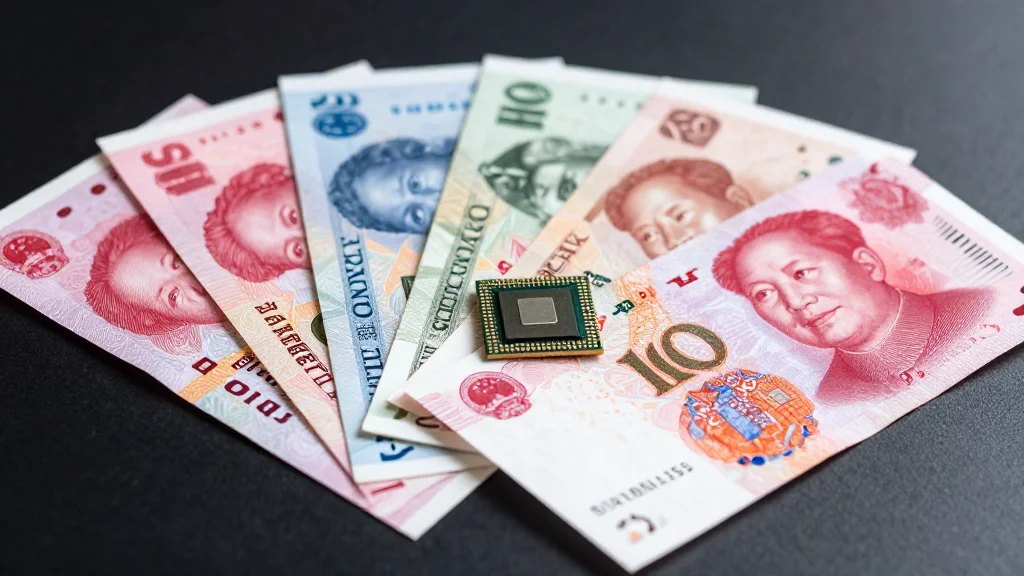
Asian Currencies Rise on Weak Dollar and AI‑Driven Export Surge, MUFG Says

Companies Mentioned
Why It Matters
The rally in Asian currencies signals a shift in regional risk sentiment, offering investors new opportunities to capture yield differentials as the US dollar weakens. A sustained export boom, especially in AI‑related sectors, could cement the yuan and ringgit as preferred vehicles for capital flows, reshaping portfolio allocations across emerging‑market assets. Conversely, the underperformance of the rupee, dong and peso highlights the importance of country‑specific fundamentals, reminding investors that a one‑size‑fits‑all approach to Asian FX is no longer viable. Moreover, the divergence underscores the broader macroeconomic interplay between geopolitical events, commodity pricing and technology demand. As the Middle East conflict eases, the dollar’s retreat may persist, but any reversal in US policy or a slowdown in AI demand could quickly erode the gains, making the current environment a critical inflection point for traders and policymakers alike.
Key Takeaways
- •Asian currencies rose as the US dollar weakened after the Iran conflict, per MUFG.
- •Export momentum, especially in AI and DRAM, surged in March, with South Korea reporting a 28% YoY price rise.
- •MUFG favors the Chinese yuan (CNY) and Malaysian ringgit (MYR) over the Indian rupee (INR), Vietnamese dong (VND) and Philippine peso (PHP).
- •Dollar weakness has lifted risk‑on sentiment, but FX outcomes remain dispersed across the region.
- •Future direction hinges on upcoming export data and US monetary policy signals.
Pulse Analysis
MUFG’s assessment captures a pivotal moment where currency fundamentals are being reshaped by technology‑driven trade flows rather than traditional commodity cycles. The AI boom has turned export data into a leading indicator for FX performance, a trend that could persist as global firms continue to offshore high‑performance computing and semiconductor production to Asia. This structural shift benefits economies with deep tech ecosystems—China, South Korea and Malaysia—while leaving those reliant on less‑dynamic sectors, such as India and the Philippines, lagging.
Historically, a weaker dollar has been a boon for emerging‑market currencies, but the current rally is amplified by a clear export narrative. Should US inflation pressures prompt a hawkish Fed response, the dollar could rebound, testing the resilience of the yuan and ringgit’s gains. Investors should therefore monitor both macro‑policy cues and micro‑level export trends to gauge the durability of the upside.
In practice, portfolio managers may consider overweighting CNY‑denominated assets and ringgit‑linked bonds while maintaining a cautious stance on INR, VND and PHP exposures. The divergence also opens arbitrage opportunities in cross‑currency pairs, especially where AI‑related export data diverges sharply from broader regional performance. Ultimately, the interplay between geopolitical stability, US monetary policy, and the pace of AI adoption will dictate whether the current FX uplift translates into a longer‑term rebalancing of Asian capital markets.
Asian Currencies Rise on Weak Dollar and AI‑Driven Export Surge, MUFG Says
Comments
Want to join the conversation?
Loading comments...