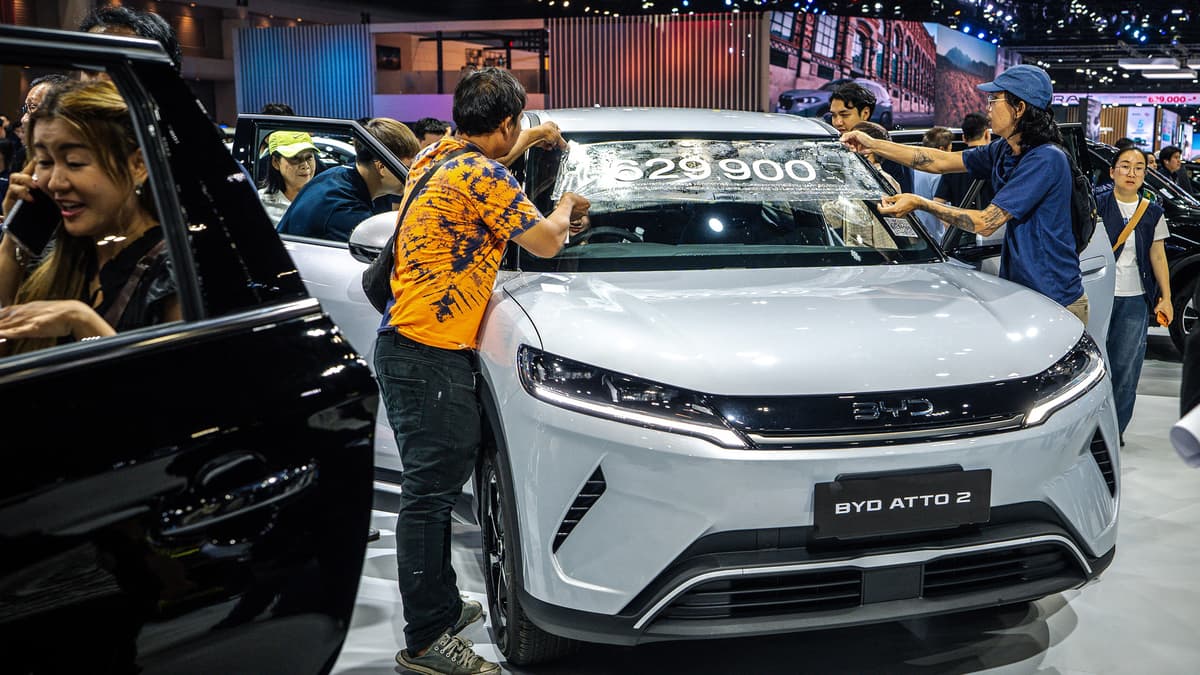
South-East Asia’s Electric Vehicle Race Heats Up
Companies Mentioned
Why It Matters
The rapid EV shift reshapes regional automotive supply chains, creates new export opportunities, and positions Southeast Asia as a pivotal market for Chinese auto tech and global investors.
Key Takeaways
- •Indonesia targets EVs as 20% of new car sales by 2025
- •BYD's $1 bn West Java plant aims 150k cars per year
- •Thailand's EV exports rose to $478 mn in 2025
- •Proton uses Geely expertise to launch local electric models
- •VinFast's US factory plans stalled, raising growth concerns
Pulse Analysis
Southeast Asia’s electric‑vehicle boom is no longer a niche trend; it reflects a coordinated policy push that has lowered ownership costs and spurred infrastructure development. Indonesia’s expanded tax breaks tied to local content have attracted Chinese giants like BYD and Wuling, prompting the country’s first‑ever $1 bn assembly hub in West Java. This domestic focus not only fuels consumer uptake—projected at 20% of new sales by 2025—but also lays groundwork for a regional supply chain anchored by Chinese components and expertise.
Thailand, long known for vehicle exports, is leveraging similar incentives to transition from internal combustion engines to battery‑electric models. With a $490 mn BYD factory in Rayong delivering 150,000 cars annually, the kingdom has shifted from a primarily domestic market to an export‑oriented EV producer, as evidenced by a surge in overseas shipments valued at $478 mn in 2025. Meanwhile, Malaysia’s strategy hinges on its national champion Proton, which taps Geely’s technology to roll out locally assembled EVs, though the overall market share remains modest at 5%.
The divergent paths underscore a broader regional realignment: Indonesia capitalizes on its large consumer base, Thailand exploits export potential, and Malaysia blends imports with homegrown production. Across all markets, Chinese automakers and supply‑chain partners dominate, reinforcing Beijing’s influence over Southeast Asian mobility. For investors, the fast‑growing EV ecosystem offers exposure to high‑growth manufacturing, battery technology, and cross‑border trade, while firms like Vietnam’s VinFast face heightened risk as they pursue ambitious but uncertain expansion plans.
South-east Asia’s electric vehicle race heats up
Comments
Want to join the conversation?
Loading comments...