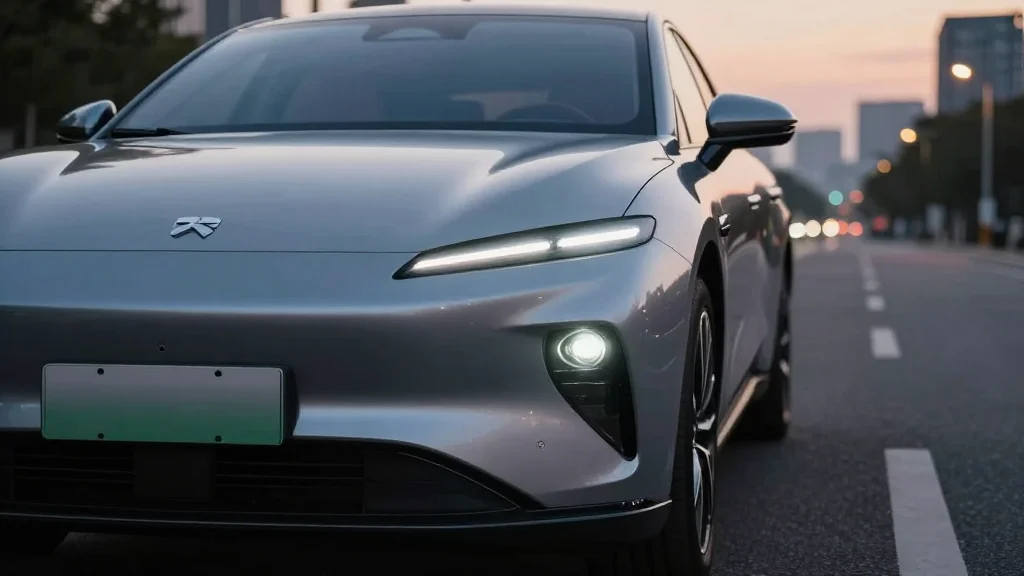
BYD Offers Full Liability for Crashes While Its God’s Eye Driver‑Assist Is Active

Companies Mentioned
Why It Matters
BYD’s decision to assume full liability for crashes while its God’s Eye system is active could redefine the risk calculus for both consumers and manufacturers in the autonomous‑driving arena. By removing financial uncertainty, the policy may accelerate adoption of higher‑level driver‑assist features, pushing the market closer to true Level‑4 autonomy. It also puts pressure on competitors, especially Tesla, to address liability gaps that have already sparked lawsuits in China and elsewhere. Regulators may look to BYD’s model when drafting future standards for autonomous vehicle safety and insurance, potentially leading to a more uniform liability framework worldwide. Beyond the immediate commercial impact, the move signals a shift in how OEMs view responsibility for autonomous functions. If manufacturers begin to internalize crash costs, insurance products could evolve, and the overall cost of ownership for autonomous vehicles may decrease, making the technology more accessible to a broader audience.
Key Takeaways
- •BYD will cover all at‑fault crash costs while God’s Eye is active, with no payout cap.
- •Guarantee applies to new God’s Eye B buyers (12,000 yuan/$1,800) and upgrades to version 5.0, for one year.
- •Usage of BYD’s Level‑4 parking rose from 21 % to 93 % after a similar liability offer last year.
- •Tesla’s Assisted Driving in China costs 64,000 yuan ($9,400) and does not assume liability.
- •The policy is currently limited to China and could influence global autonomous‑vehicle liability standards.
Pulse Analysis
BYD’s liability guarantee is a strategic gambit that leverages risk transfer to drive adoption of its God’s Eye suite. Historically, manufacturers have shied away from assuming crash liability because of the unpredictable nature of autonomous software failures and the potential for massive financial exposure. BYD’s confidence likely stems from two factors: a robust data‑driven safety record in China’s densely populated urban environments, and a competitive need to differentiate in a market where Tesla’s FSD has become a legal liability quagmire.
The policy also serves as a market‑testing platform for broader regulatory reforms. By voluntarily shouldering liability, BYD creates a de‑facto benchmark that regulators can reference when drafting mandatory standards. If the guarantee proves financially sustainable, it could encourage a shift from the current model—where insurers and owners bear most of the risk—to a hybrid model where OEMs share or fully assume liability for certain ADAS functions. This would likely lower insurance premiums for consumers, making autonomous features more attractive and accelerating the path to Level‑4 deployment.
Competitors will have to decide whether to follow BYD’s lead or double down on traditional liability structures. Huawei’s ADS Max, for example, already offers subscription‑based pricing but does not promise full liability coverage. Should BYD’s approach boost sales and market share, we may see a wave of similar guarantees, especially in China’s fiercely competitive EV sector. Internationally, the move could spark policy debates in the EU and US, where liability for autonomous systems remains fragmented. In short, BYD’s bold step could reshape the economics of autonomy, turning liability from a barrier into a catalyst for broader adoption.
BYD Offers Full Liability for Crashes While Its God’s Eye Driver‑Assist Is Active
Comments
Want to join the conversation?
Loading comments...