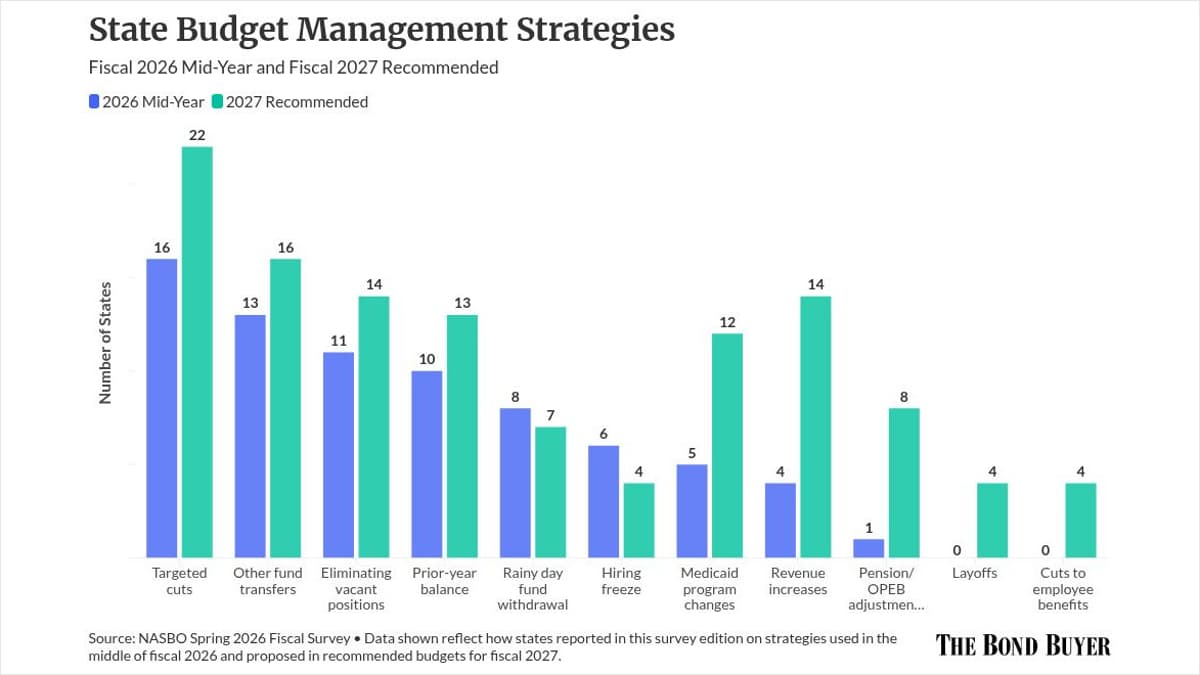
How State Budgets Are Addressing Constraint with Restraint
Why It Matters
The constrained budgets and modest revenue outlook pressure state credit fundamentals, yet ample liquidity and diversified revenue bases help preserve high credit ratings. Investors should monitor spending cuts, tax policy shifts, and rainy‑day fund trends as early signals of fiscal stress.
Key Takeaways
- •2027 general‑fund spending projected flat, 0.6% growth median
- •Revenue growth expected 2.5% median in FY2027, slowing trend
- •Rainy‑day fund balances stay above historic highs but median falls
- •Governors propose mixed tax changes, net impact near zero
- •Mid‑year budget cuts rose to five states in FY2026, likely increase
Pulse Analysis
The latest NASBO Fiscal Survey underscores a transition from pandemic‑fuelled surplus to disciplined austerity across the 50 states. With federal stimulus largely exhausted, state treasuries are relying on cash‑management tools, reserve draws, and targeted spending cuts to meet debt obligations. General‑fund expenditures for fiscal 2027 are projected to decline modestly from 2026, and the median growth rate hovers at just 0.6%, reflecting the elimination of one‑time surplus spending and tighter fiscal discipline.
Revenue dynamics add another layer of nuance. While personal‑income tax collections remain robust, overall revenue growth is expected to slow to a median 2.5% in FY2027 after a period of double‑digit gains in 2021‑22. Governors’ budget proposals feature a blend of tax hikes and reductions that net out to near‑zero impact, signaling political balancing acts rather than substantive fiscal expansion. Rainy‑day fund balances, though still high in nominal terms, are seeing their median share of general‑fund spending dip from 14.9% in FY2024 to an anticipated 13.5% in FY2025, suggesting reserves may be tapped more frequently as revenue forecasts tighten.
From a credit perspective, states retain strong fundamentals: low debt burdens, diversified revenue streams, and access to deep capital markets. However, the rise in mid‑year budget cuts—five states in FY2026—and the projected modest spending growth raise caution flags for rating agencies. Investors should watch for proactive remedial actions, such as pension reforms or targeted expenditure reductions, that can mitigate emerging gaps. Overall, while the risk of rating downgrades remains limited, the evolving fiscal landscape warrants close monitoring of budgetary adjustments and reserve management strategies.
How state budgets are addressing constraint with restraint
Comments
Want to join the conversation?
Loading comments...