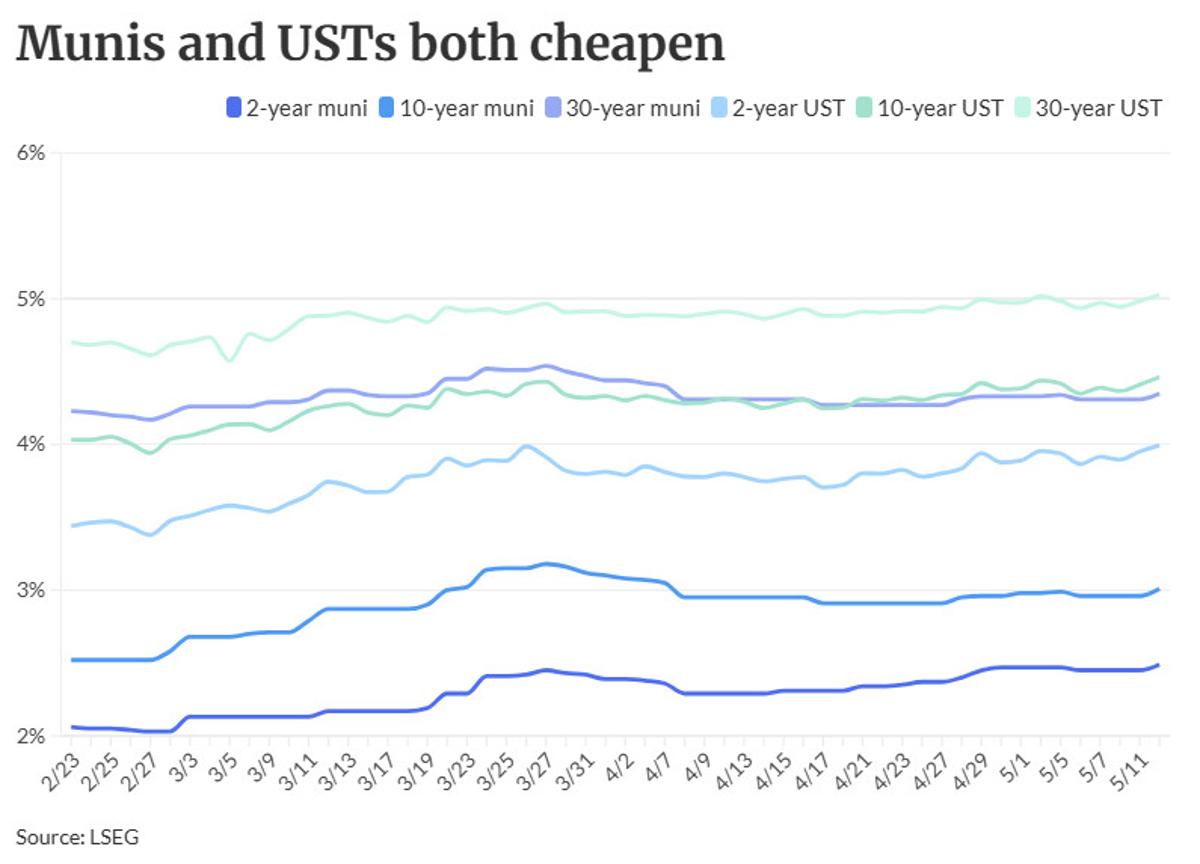
Munis Succumb to Macro Pressure, USTs Weaken Further After CPI
Companies Mentioned
Why It Matters
Rising muni yields and sticky inflation signal tighter financing conditions for state and local governments, while higher Treasury rates raise borrowing costs across the economy. The trend underscores heightened market sensitivity to supply dynamics and persistent price pressures, influencing investor allocation and fiscal budgeting.
Key Takeaways
- •Municipal yields rose up to 5 bps, front end hit hardest.
- •Elevated supply and slowing fund flows pressure muni performance this year.
- •Core CPI shows sticky inflation, keeping Fed rate‑cut expectations low.
- •Treasury 2‑yr and 10‑yr yields hit 4.00% and 4.45% after CPI.
- •New‑issue market priced $2.5 bn of revenue bonds at 2.5‑4.5% yields.
Pulse Analysis
The latest CPI report revealed core inflation spreading beyond energy and food into services and housing, nudging the core number to its highest level since 2023. That data jolted Treasury markets, with the two‑year and ten‑year yields climbing to 4.00% and 4.45% respectively, and pushed municipal yields higher across the curve. Investors are now weighing the prospect of a prolonged period of elevated rates, as the Federal Reserve may hold or even consider a rate hike later in the year if price pressures persist.
At the same time, the municipal market is grappling with an unprecedented supply surge. Over the past weeks, issuers have flooded the market with revenue and refunding bonds, totaling roughly $2.5 billion in new issues. Analysts at Charles Schwab note that fund flows, a proxy for demand, are decelerating, creating a supply‑demand mismatch that could suppress price appreciation and keep yields elevated. The front end of the muni curve is especially vulnerable, reflecting investors’ heightened sensitivity to short‑term financing costs.
For investors, the confluence of sticky inflation, higher Treasury rates, and abundant muni supply reshapes risk‑return calculations. While the tax‑adjusted yields remain attractive for retail investors, the potential for further rate sell‑offs could erode total returns, especially for those holding longer‑duration securities. Portfolio managers may tilt toward higher‑quality, shorter‑duration munis or diversify into inflation‑linked instruments to hedge against continued price pressures. Monitoring the Fed’s policy stance and upcoming supply pipelines will be critical for navigating the evolving fixed‑income landscape.
Munis succumb to macro pressure, USTs weaken further after CPI
Comments
Want to join the conversation?
Loading comments...