Panthalassa Secures $140 Million to Deploy Wave‑Powered Floating Data Centres

Companies Mentioned
Why It Matters
Decarbonising the exponential growth of AI compute is one of the most urgent challenges in climate tech. Panthalassa’s wave‑powered floating data centres offer a pathway to meet rising demand without adding to grid strain or relying on scarce minerals. By leveraging the ocean’s kinetic energy, the solution could dramatically lower the carbon footprint of high‑performance computing, a sector projected to consume a sizable share of global electricity by 2030. Beyond emissions, the approach could reshape supply‑chain dynamics. Using only steel—a material with mature, globally distributed production—reduces reliance on rare‑earth elements that are geopolitically sensitive and environmentally costly to mine. If the model scales, it may also open new markets for maritime infrastructure, creating jobs in shipbuilding, offshore engineering, and renewable energy services, while prompting regulators to develop frameworks for sustainable ocean‑based tech deployments.
Key Takeaways
- •Panthalassa raised $140 million in a round led by Peter Thiel, valuing the startup at ~ $1 billion.
- •Funding will finance a pilot manufacturing plant and first commercial deployments slated for 2025.
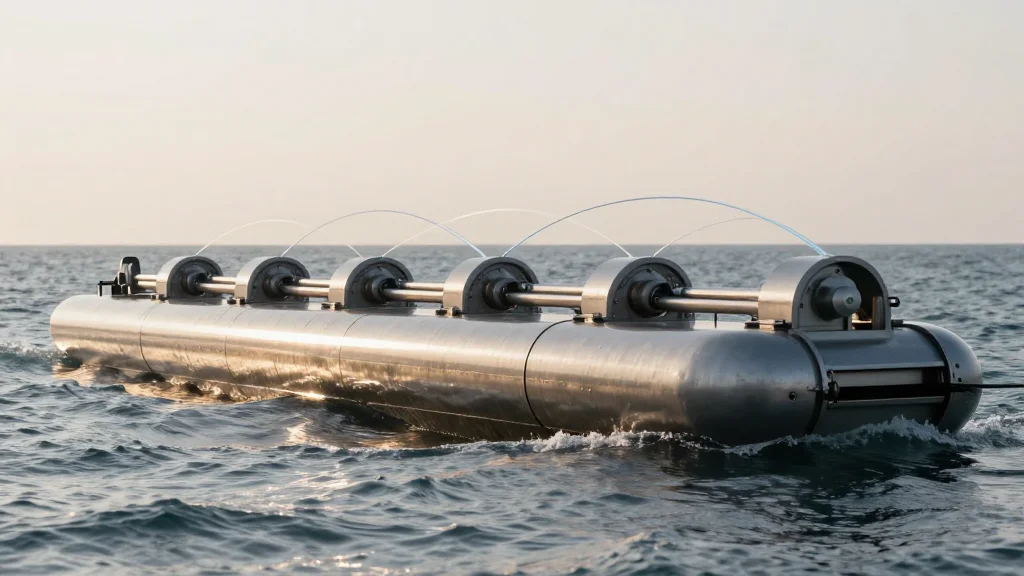
- •Each floating node is an 85‑metre steel structure that generates power from wave motion and cools AI chips with deep‑sea water.
- •Design tolerates 15‑metre waves and Category 5 hurricanes, using no hinges, flaps or gearboxes.
- •If successful, the technology could offset a portion of the projected 30 % annual growth in data‑centre energy use through 2030.
Pulse Analysis
Panthalassa’s financing marks a rare convergence of deep‑tech hardware, renewable energy, and AI infrastructure—a trio that has historically evolved in separate silos. The $140 million injection not only validates the commercial viability of offshore wave energy for compute but also underscores a shifting investor appetite toward climate‑aligned, high‑margin tech assets. Traditional data‑centre operators have long relied on grid electricity and large‑scale cooling towers; the ocean‑based model flips that paradigm by turning the sea into both power plant and heat sink.
Historically, offshore renewable projects have struggled with high capex and uncertain revenue streams, often requiring long‑term power purchase agreements. Panthalassa sidesteps some of those hurdles by bundling generation and consumption in a single asset, potentially offering customers a predictable, carbon‑neutral compute service without the need for separate energy contracts. However, the model introduces new risk vectors: maritime regulatory compliance, marine‑environment impact assessments, and the logistical complexity of deploying and maintaining massive steel hulls in remote ocean zones.
Competitive dynamics will intensify as other climate‑tech firms explore floating solar, offshore wind‑coupled compute, and even submerged data‑centre concepts. Panthalassa’s advantage lies in its integrated design—no external turbines, no moving parts vulnerable to corrosion—yet scaling will demand massive shipyard capacity and a skilled workforce accustomed to offshore oil‑platform standards. If the pilot demonstrates reliability and cost parity, the wave‑powered node could become a new benchmark for sustainable AI compute, prompting incumbents to either partner with or acquire similar capabilities. The next 12‑18 months will be decisive: a successful live demo could unlock a wave of follow‑on capital, while technical setbacks could re‑anchor the industry to more conventional renewable pathways.
Panthalassa Secures $140 Million to Deploy Wave‑Powered Floating Data Centres
Comments
Want to join the conversation?
Loading comments...