
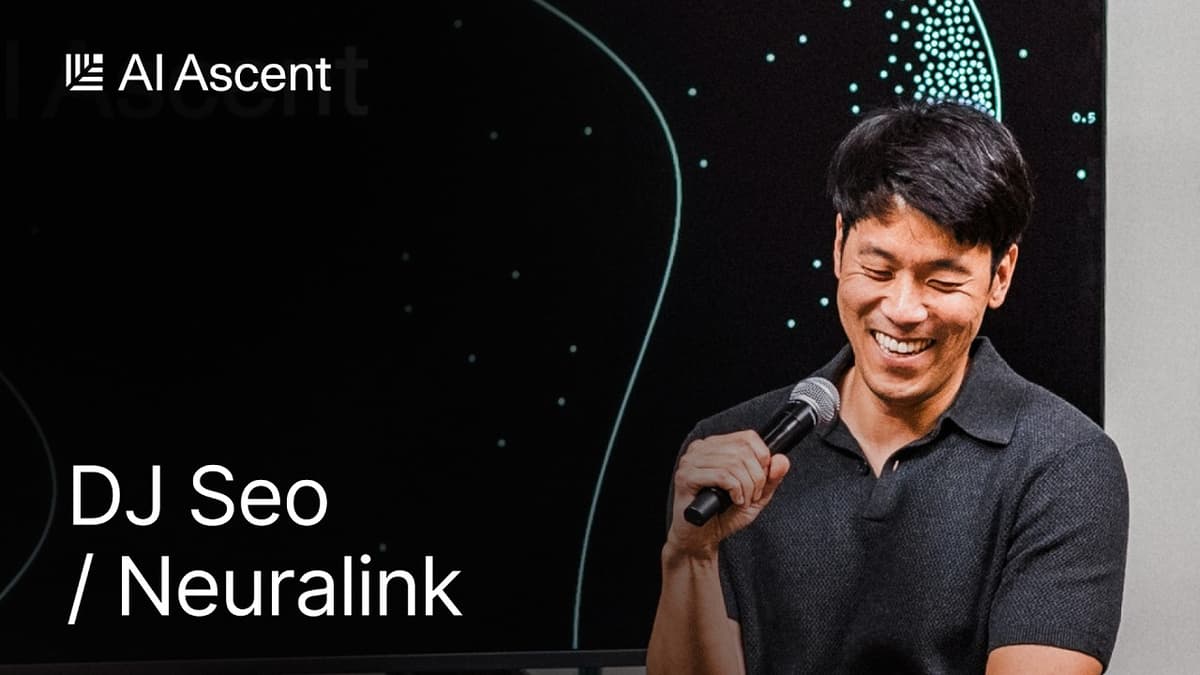
Neuralink's DJ Seo: Inside the Race to Connect Brains and AI
The video showcases Neuralink co‑founder DJ Seo discussing the company’s flagship brain‑computer interface (BCI) products—Telepathy, which lets locked‑in ALS patients control a computer with thought, and the upcoming BlindSight system that could restore vision by stimulating the visual cortex with data from an external camera. Seo emphasizes that the original motivation was to bridge the I/O bottleneck between human intent and artificial intelligence, and that scaling the technology from the outset—through vertical integration of chip design, surgical robots, and manufacturing—has been a core strategic advantage. Key insights include the tangible clinical impact of Telepathy on over twenty patients, the technical roadmap for BlindSight that hinges on increasing electrode density to generate high‑resolution phosphenes, and the emerging “neural foundational model” where large‑scale AI transformers are fine‑tuned on neural data to decode intent directly. Seo stresses that scale, both in participant numbers and hardware production, is the catalyst that will shift BCIs from keyboard‑mouse proxies to true high‑bandwidth exocortical extensions. Notable remarks from Seo highlight the underappreciated role of caregivers—family members who enable trial participation—and the relentless “all‑green‑light” schedule inspired by Elon Musk, which strips away administrative bottlenecks to accelerate engineering cycles. He also frames AI as an exocortex, suggesting future BCIs could bypass conventional interfaces and enable direct, multimodal concept transfer. The implications are profound: if Neuralink’s scaling strategy succeeds, BCIs could become a mass‑market medical device, reshaping care for paralysis, blindness, and potentially augmenting cognitive function. The convergence of high‑density neural hardware with large‑scale AI models promises a new layer of human‑machine symbiosis, raising both commercial opportunities and regulatory, ethical, and societal challenges.
How Cursor Trained Composer on Fireworks: Distributed Infrastructure for High-Performance RL
Cursor unveiled Composer 2, an agentic coding model designed for long‑horizon programming tasks. Unlike earlier versions that relied mainly on reinforcement learning, Composer 2 is built on a two‑axis training regime that couples continual pre‑training with massive RL, aiming to allocate every...
The Hard Part of Enterprise AI Isn't Reasoning | Jake Stauch, Serval
The video introduces Serval’s two‑layer AI architecture, distinguishing an admin agent that creates tools and skills from a help‑desk agent that interacts directly with end users. This separation is designed to give enterprises granular control over what the AI can...

Notion’s Ivan Zhao: The Refounder
In a candid conversation, Notion co‑founder and CEO Ivan Zhao describes himself as the company’s “refounder,” recounting two pivotal resets – a 2015 move to Kyoto that secured product‑market fit, and a 2023 AI‑centric off‑site in Cancun that re‑engineered Notion...
Employees Want Autonomy. Organizations Don't. | Jake Stauch, Serval
The video highlights a growing clash between employee expectations for autonomous AI agents and enterprise demands for strict control. Workers want cloud‑based agents that can act independently, accessing data and executing tasks without gate‑keeping. Conversely, IT and security teams worry such...
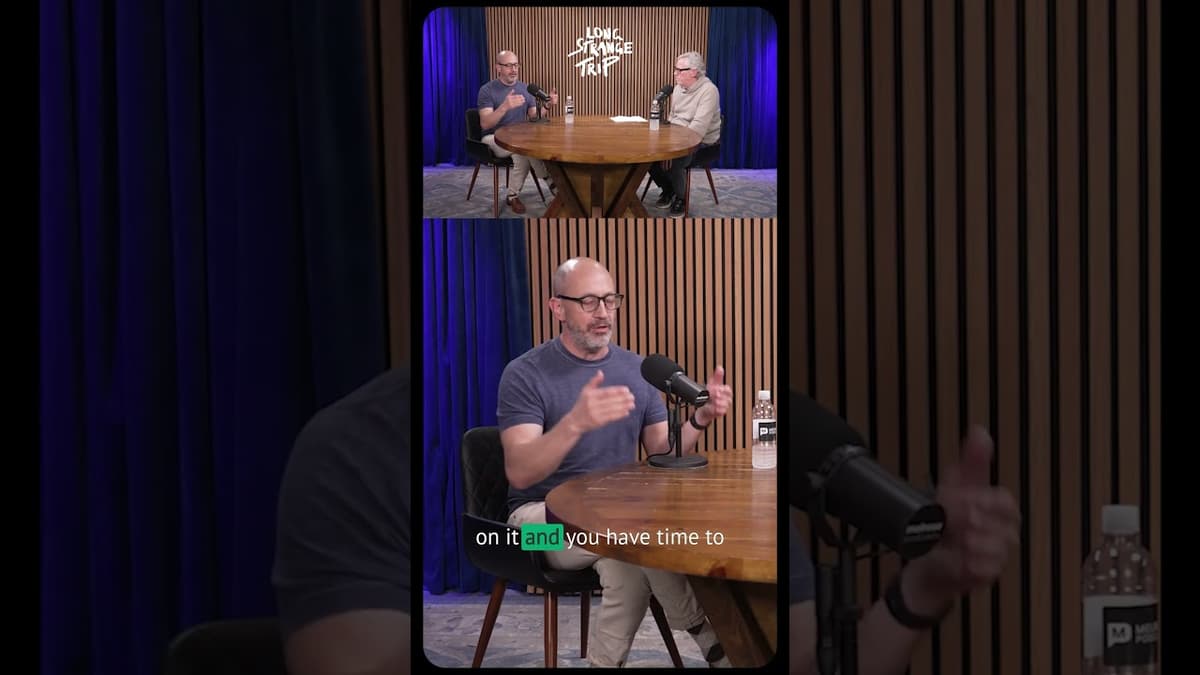
Twitter's CEO Banned Cross-Team Approvals. Here's What Happened Next. #podcast #shorts
Twitter CEO Elon Musk scrapped the company's cross‑team approval maze, instituting a "bias to yes" framework that lets only a direct manager—or legal when law or privacy is at stake—to block initiatives. The move mirrors Jeff Bezos' Amazon practice of...
Rebuilding IT From the Ground Up for the AI Age: Serval's Jake Stauch
In this interview, Jake Stauch, founder and CEO of Serval, explains how his company is rebuilding enterprise IT for the AI age with an AI‑native service management platform that delivers instant employee support. The solution replaces traditional ticket‑based help...
"Creation Is Actually the Entertaining Bit." Suno's Mikey Schulman
Suno, an AI‑driven music platform, is redefining how people interact with sound by shifting the focus from passive listening to active creation. According to co‑founder Mikey Schulman, roughly 90 % of daily users generate original tracks, treating the act of making music...
"Let's Throw Away Everything We Know About Music" Suno Founder Mikey Schulman
Suno founder Mikey Schulman explains the startup’s approach to AI music generation: user prompts are expanded via language models into lyrics and stylistic cues, which are then fed into generative audio models that produce raw sound. Rather than encoding conventional...
Suno's Mikey Shulman: Everyone Can Make Music Now
Suno, led by physicist‑turned‑entrepreneur Mikey Shulman, is building a consumer‑focused AI music platform that lets anyone generate songs from text prompts. The company’s core breakthrough is treating audio as a continuous 48 kHz float waveform rather than a discrete set of...
Surviving Twitter's Growing Pains: Ex-CEO Dick Costolo
The interview with former Twitter CEO Dick Costello centers on the chaotic, hyper‑growth phase of Twitter and the leadership choices he made to steer the company toward sustainable scale. Costello recounts stepping into the role amid board turmoil, a dysfunctional...
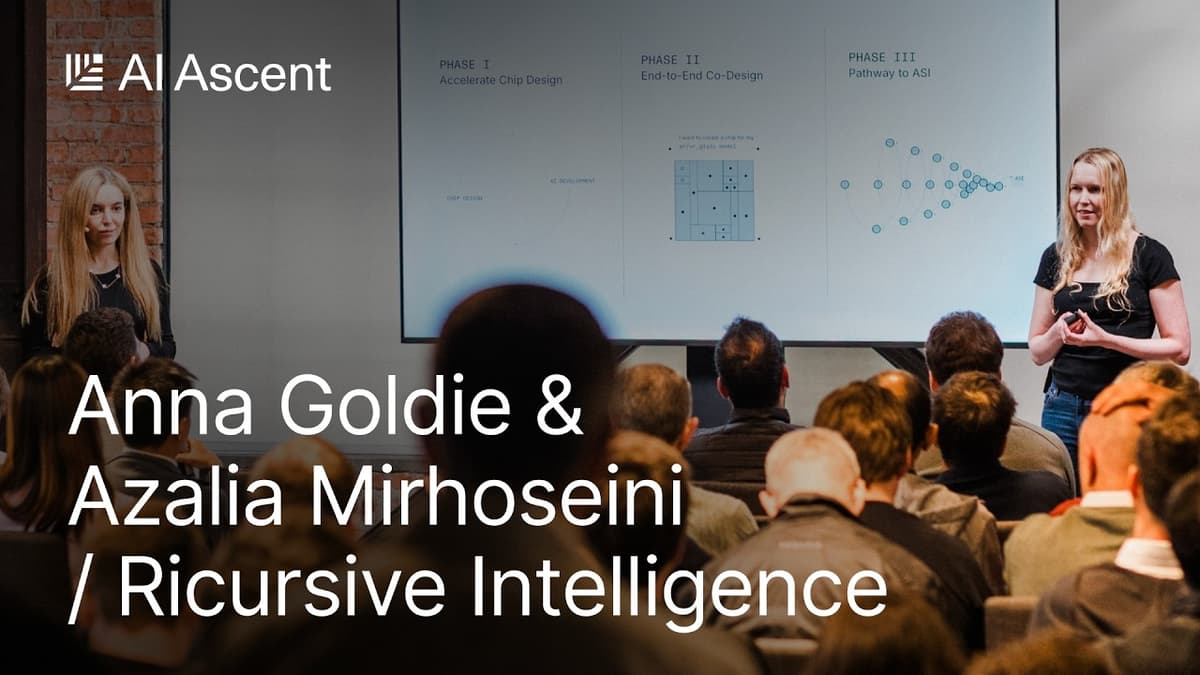
AI That Designs Its Own Chips: Ricursive's Anna Goldie and Azalia Mirhoseini
Recursive Intelligence, founded by former Google Brain researchers Anna Goldie and Azalia Mirhoseini, is building AI systems that design semiconductor chips. Their flagship technology, AlphaChip, demonstrated that deep reinforcement‑learning agents can produce chip layouts that surpass human experts and has...
Inside the Rise of Autonomous AI Hackers: XBOW's Oege De Moor
The presentation highlighted the emergence of fully autonomous AI hackers, focusing on Xbo, a system built by XBOW that can locate, exploit, and report vulnerabilities without human input. Xbo’s most notable achievement was discovering a remote code execution flaw in...
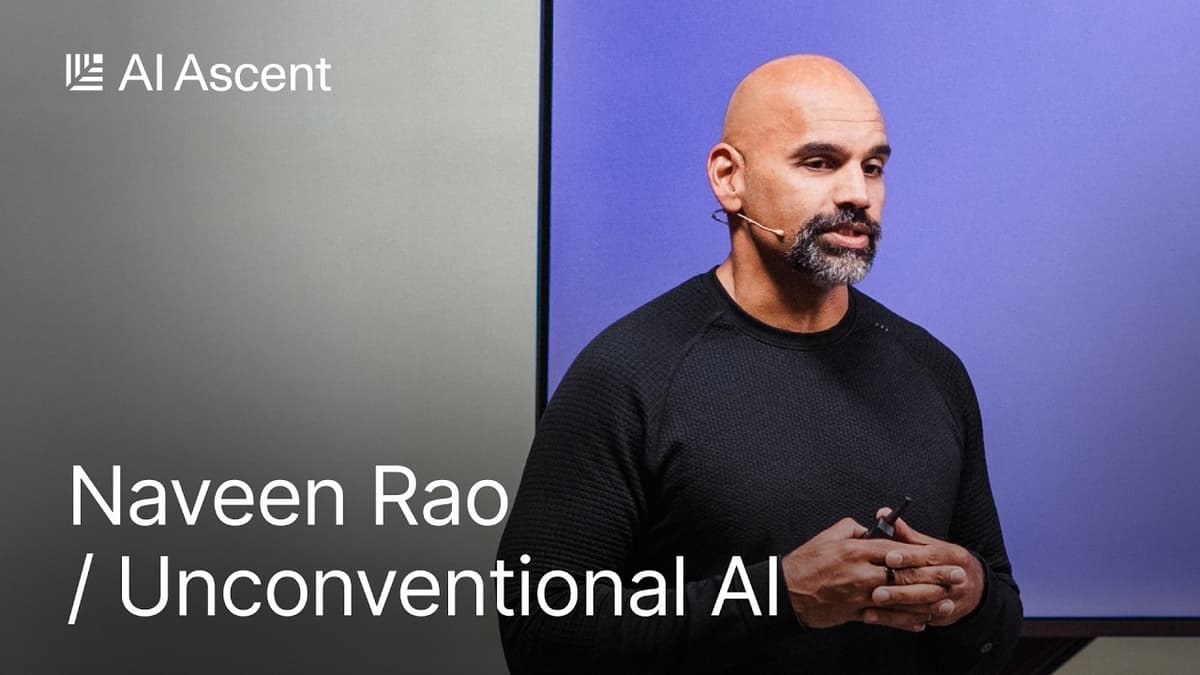
Rebuilding the Computer for the AI Age: Unconventional AI's Naveen Rao
Naveen Rao, CEO of Unconventional AI, argued that the AI boom is hitting a hard energy wall and that the century‑old von Neumann architecture is fundamentally ill‑suited for intelligence‑scale computing. He framed the problem in terms of physical substrate efficiency, noting...
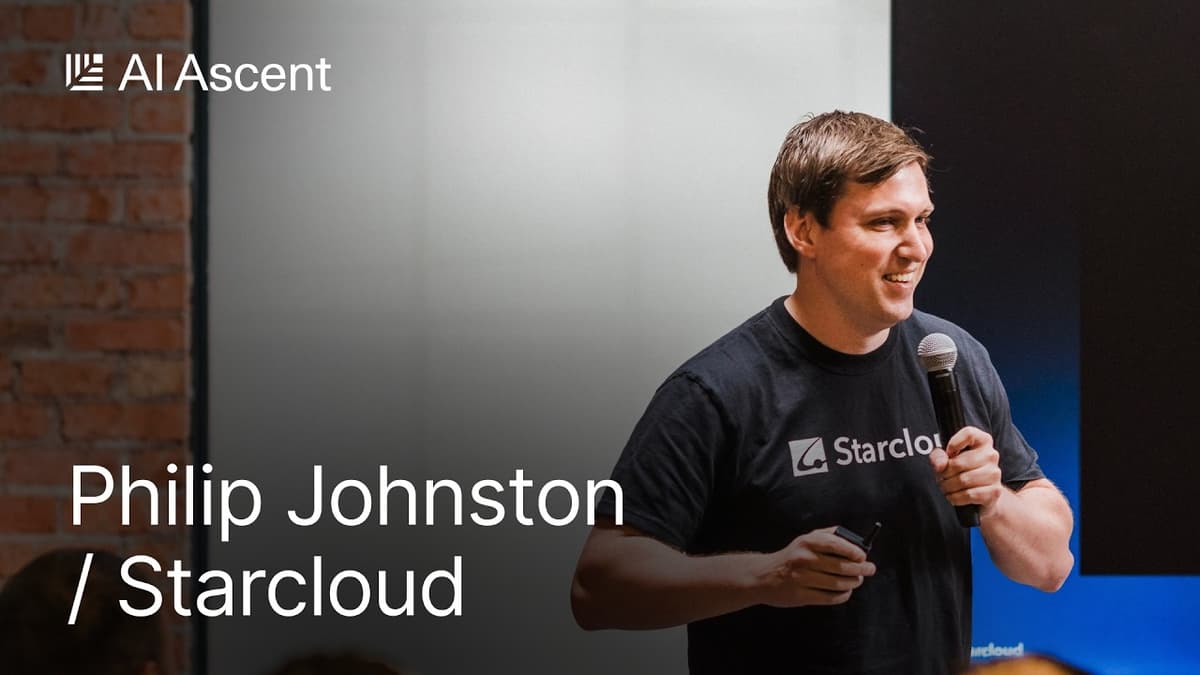
Starcloud's Philip Johnston: Why the Cheapest Compute Will Be in Space
At the recent conference, Philip Johnston, co‑founder and CEO of Starcloud, outlined the company’s vision of building data centers in space, arguing that orbital compute will soon become cheaper than terrestrial facilities. Johnston explained that space‑based solar panels produce eight times...