

Israel's Escalating War in Lebanon: What's at Stake?
The CSIS round‑table examined the rapid escalation of hostilities in Lebanon after Hezbollah launched drone, missile and rocket attacks on Israel on March 1, following the assassination of Iran’s supreme leader. Israel responded with a coordinated campaign targeting southern Lebanon, Beirut’s central districts and infrastructure, turning the conflict into a second front in the broader Iran‑Israel confrontation and reigniting a decades‑long rivalry. Panelists highlighted the staggering humanitarian toll: more than 1,000 Lebanese killed, roughly 3,500 injured, and an estimated 1‑1.5 million people displaced from a population of five million. Israeli operations have expanded beyond military sites to strike Hezbollah’s financial arm, Al Qard al‑Hassan, and even civilian businesses linked to the group, while the Lebanese government struggles to provide shelter, schools and basic services. Paul Salem emphasized the scale of displacement, noting families sleeping on sidewalks and in cars, while Rhonda Sleem described a fractured Shia community—about 30 % hard‑line supporters, a small anti‑Hezbollah minority, and a large, wavering middle that questions the war’s necessity. David Schenker added anecdotal evidence of non‑Shia landlords refusing to rent to displaced Shia families, underscoring rising communal friction. The discussion warned that unchecked sectarian tension could spill into broader Lebanese conflict, threatening the fragile balance among Christians, Sunnis, Druze and Shia. Regionally, the war deepens the Iran‑Israel proxy struggle, risks further Israeli incursions, and complicates international humanitarian assistance, making the trajectory of Lebanon’s crisis a critical barometer for Middle‑East stability.

Military Planning, Intelligence, and Algorithmic Warfare in the Iran Campaign
The video recounts the 1947 incident where a moth caused a malfunction in the Harvard Mark II computer, marking the origin of the modern “bug” metaphor. Engineers discovered the insect lodged in a relay, taped it into their logbook, and labeled it...

The Resurgence of Measles in the United States | CommonHealth Live!
The United States is seeing a sharp rise in measles, with over 3,000 confirmed cases since January 2025 and nearly 1,000 reported in South Carolina alone during the first two months of 2026. Pertussis cases also surged to about 30,000...

Pulse Check: The New U.S-Africa Health Deals
By early 2026, more than a dozen African countries have signed nearly $20 billion in bilateral health agreements under the Trump administration’s America First Global Health Strategy. The initiative shifts U.S. assistance from multilateral channels to direct country‑to‑country deals, promising rapid...

From Cairo to Kabul: A Conversation with Admiral William J. Fallon (Ret.)
The video is a conversation between a host and retired Admiral William J. Fallon, discussing his recently published memoir, his unconventional career path, and the strategic moments that defined his service. Fallon recounts early presence missions in the North Arabian Sea...

Russian Elite Perceptions of China: A Conversation with Witold Rodkiewicz
The ChinaPower Podcast hosted senior fellow Witold Rodkiewicz to explore how Russia’s political and security elites assess the strategic partnership with China. The discussion highlighted that Russian elites view Beijing’s growing power as a counterbalance to U.S. influence and a...

Who Is Iran's New Leader?
Less than a week after an Israeli airstrike killed Supreme Leader Ayatollah Ali Khamenei, his son Mojtaba Khamenei was appointed as Iran's new Supreme Leader. Mojtaba, a longtime hard‑line figure with deep ties to the Revolutionary Guard, has previously operated...

Is Cuba Next?
President Trump warned that the Cuban government will fall "pretty soon" and hinted that any transition might not be a friendly takeover. In a televised discussion, analysts Ryan Berg and Carrie Filipetti examined Trump’s objectives in Cuba, outlining a spectrum...

When Maduro Called for Help, Russia and China Didn't Answer | The High Top
The video examines why Russia and China declined to intervene when Venezuela’s Maduro pleaded for assistance, highlighting the diplomatic isolation he faced. It draws lessons about the limits of patronage for embattled authoritarian regimes. The discussion then shifts to a...

Introducing Gen. Joseph Dunford as the Next CEO of CSIS
On March 12, 2026, the Center for Strategic and International Studies announced retired General Joseph F. Dunford as its next chief executive officer, succeeding John Hamre after a 26‑year tenure. Dunford, the former 19th chairman of the Joint Chiefs of...

Anthropic Goes to Court While Claude Goes to War in Iran
The episode centers on the escalating showdown between Anthropic and the U.S. Department of War, where the company’s Claude model is simultaneously tangled in court battles and reportedly deployed in high‑stakes cyber operations against Iran. After Secretary of War...

Why Use Long-Range Weapons on Small Targets?
The video examines why the U.S. military deploys ultra‑long‑range Tomahawk missiles against low‑value, insurgent targets such as Houthi forces and ISIS affiliates, questioning the efficiency of expending scarce strategic assets on relatively minor objectives. Analysts note that recent statements by Gen....
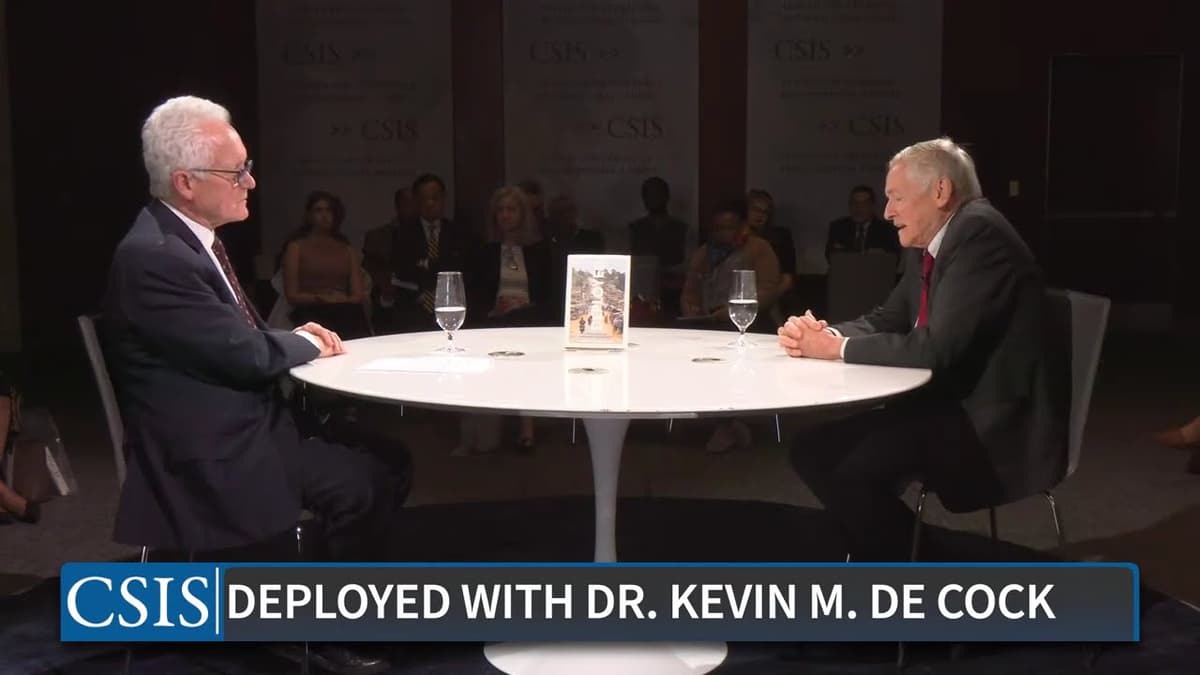
Deployed by Kevin De Cock
The video emphasizes that the most vulnerable often remain unheard, arguing that society’s instinct to respond to the loudest pleas can leave silent sufferers overlooked. It points out that attention bias leads to disproportionate resource allocation, urging stakeholders to develop metrics...

What Is the Trump Administration's Cybersecurity Strategy? | Asked & Answered
The White House unveiled the 2026 National Cyber Security Strategy, marking the Trump administration’s first comprehensive cyber policy since taking office. While the document is framed in distinctly Trump‑style rhetoric, its structure and six priority pillars echo the 2023 strategy...

Russia’s War Economy, Explained
The video dissects Russia’s war‑driven economy, arguing that despite surface resilience, hard data reveal a near‑collapsed productive base. GDP is projected to grow a meager 0.6 % in 2025, and the system now leans almost entirely on oil, gas and a...

Economic Strength and Military Power for Deterrence
The video reviews 2025’s remarkable advances in critical mineral supply chains, innovative government tools, and new partnerships, framing them against the backdrop of rising geopolitical tension with China. Committee member Jeremy underscores the need to measure 2026’s success by how...
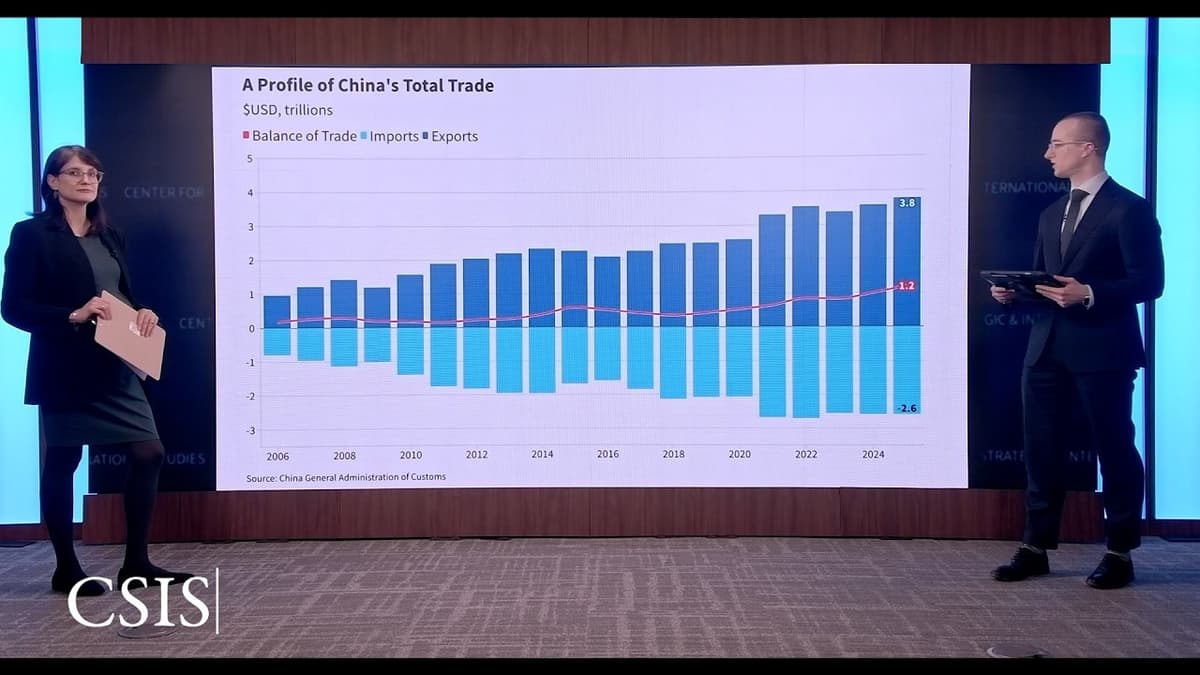
Takes Two to Tango: China's Record Exports and Shifting U.S. Imports in 2025 | China Pulse
The China Pulse episode examines China’s unprecedented trade performance in 2025, highlighting a record $3.8 trillion in exports and a widening trade surplus despite ongoing tariffs and export controls. The discussion notes that China achieved its targeted 5 percent growth, with roughly...

Tech Edge: A Framework for U.S. Technology Leadership
The video outlines a new framework for sustaining U.S. technology leadership, emphasizing that durable advantage stems from robust ecosystems rather than isolated inventions. It argues that the ability to translate laboratory discoveries into large‑scale manufacturing quickly is the true engine...