
Is the Universe Infinite? | Priya Natarajan
In a recent Closer to Truth interview, astrophysicist Priya Natarajan tackles one of cosmology’s oldest puzzles – whether the universe is infinite or finite – and explains how, despite decades of data, the answer remains fundamentally uncertain. She notes that the observable universe is a finite sphere about 46 billion light‑years in radius, limited by the speed of light and the 13.8‑billion‑year age of the cosmos. Measurements of the cosmic microwave background by Planck indicate the large‑scale geometry is flat to high precision, a condition under general relativity that permits an endless spatial extension. Yet the same data allow a tiny curvature, leaving open the possibility of a closed, finite but unbounded space. Natarajan emphasizes that no observational signature of a multiverse collision—such as matching temperature patterns or anomalous fluctuations in the CMB—has ever been detected. She also draws a parallel between black‑hole and Big‑Bang singularities, pointing out that both mark where Einstein’s theory breaks down and where a quantum theory of gravity would be required. The discussion underscores the limits of light‑based astronomy for probing beyond the horizon and highlights the need for new physics to resolve the singularity problem. For researchers and investors in fundamental physics, the uncertainty fuels ongoing missions and theoretical work aimed at testing curvature, searching for primordial imprints, and ultimately unifying gravity with quantum mechanics.

Are Aliens Too Alien To Detect? | Daniel Whiteson
The video features physicist Daniel Whiteson exploring why humanity has yet to detect extraterrestrial intelligence. He argues that our expectations—broadcasting and listening for radio signals—may be too narrow, and that alien communications could use modalities we cannot yet perceive. Whiteson highlights...

The Universe Is Shooting Particles at Us | Daniel Whiteson
The video explores ultra‑high‑energy cosmic rays—subatomic particles that strike Earth with energies far beyond anything produced in terrestrial accelerators. Daniel Whiteson explains that these rare particles, sometimes called the “Oh My God” event, carry kinetic energy comparable to a baseball, offering a...

Can AI Make People Feel Loved? | Julia Mossbridge
The video features Julia Mossbridge discussing her “loving AI” project, exploring whether an artificial‑intelligence‑driven robot can make people feel unconditionally loved. She describes experiments with a humanoid robot (Sophia) equipped with an emotion‑detection neural network that mirrors users’ expressions except for...

Why Dark Matter Still Hasn't Been Found | Priya Natarajan
The video explains why, despite overwhelming astrophysical evidence, a dark‑matter particle remains elusive. It reviews the tiny local density—about 10⁻²⁰ kg in a 30 m³ office—and the resulting detection challenges, emphasizing that dark matter interacts only through gravity. Observational pillars such as Vera...
Why AI Risk Could Arrive Fast | Roman Yampolskiy
In a rapid‑fire interview, AI safety scholar Roman Yampolskiy warned that artificial general intelligence could arrive as early as 2028, with artificial superintelligence following only months later. He framed the timeline as a two‑year horizon from the present, underscoring the...
Why There Could Never Be Nothing | Michael James
Michael James argues that asking why there is something presupposes a prior cause, leading to infinite regress, and therefore the question is meaningless. He maintains that “nothing” is a self‑contradictory concept because nonexistence cannot be said to exist. The discussion frames...
Entanglement Across the Universe | Ivette Fuentes
The video features physicist Ivette Fuentes discussing how the expansion of space‑time can create quantum entanglement between particles that were initially independent, highlighting research on quantum fields in curved backgrounds. She explains that in toy Robertson‑Walker universes—flat in the distant past...
How Mattering Drives Spiritual Life | Rebecca Goldstein
The video explores Rebecca Goldstein’s argument that the human “mattering instinct” underlies spiritual life, shaping why people seek a sense of purpose beyond themselves. Goldstein contends that the instinct to matter is a basic mental drive that fuels the pursuit of...
What Makes Art Meaningful | Zorana Pringle
The video presents Zorana Pringle’s interdisciplinary research program that investigates why art feels meaningful by testing the “mirror model” of aesthetic cognitivism, which posits that the cognitive processes of creating art mirror those of experiencing it. The team commissions artists, tracks...
Could the Universe Have Zero Free Numbers? | Daniel Whiteson
The video features physicist Daniel Whiteson discussing whether a theory of everything could have zero or one free numbers, and the broader state of particle physics after the Higgs discovery. He addresses criticism that the field has stalled, emphasizing that...
What Missing Fossils May Reveal About Evolution | Derek Turner
The video centers on Derek Turner’s argument that missing fossils are crucial to evolutionary theory, urging philosophers and biologists to incorporate paleontological evidence when discussing function, fitness, and adaptation. He highlights how both the presence and absence of fossils—such as...
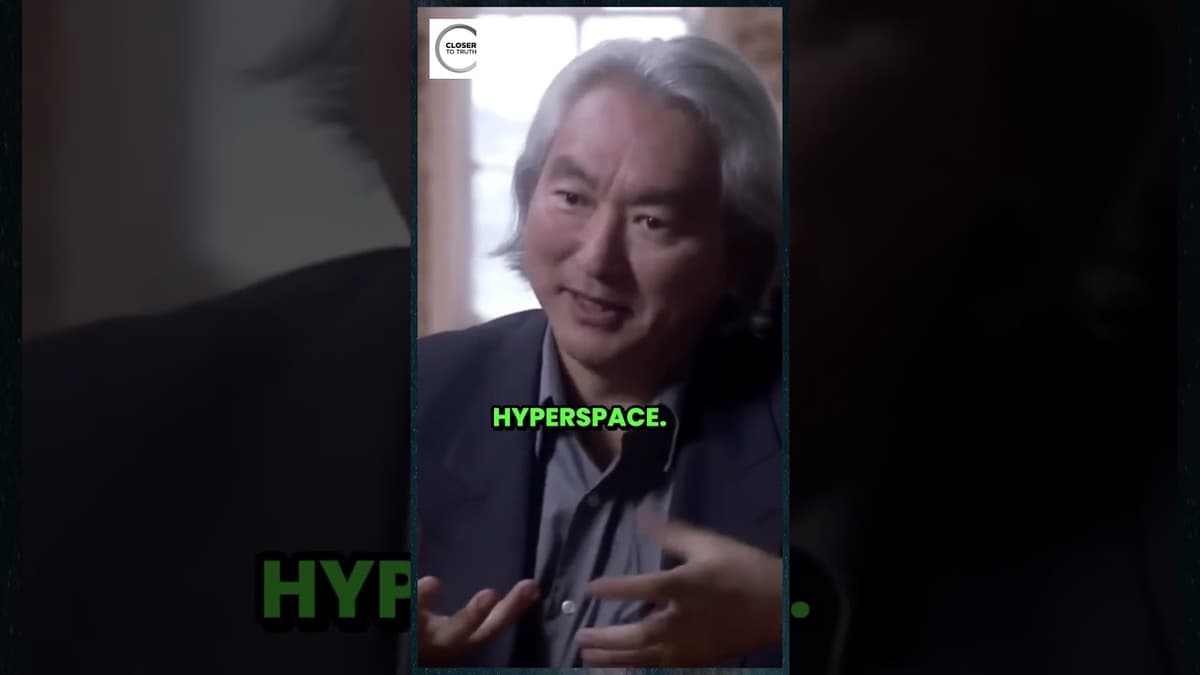
We Are the Fish | Michio Kaku
In a whimsical talk, physicist Michio Kaku uses a childhood memory of watching carp in a Japanese tea garden to illustrate humanity’s limited perspective. He likens us to fish confined to a two‑dimensional pond, unaware of the third dimension that...
What Carries Personal Identity | Michael James
The video tackles the age‑old puzzle of what carries personal identity across a lifetime of physical and mental turnover. Michael James draws on neuroscience—highlighting that every brain molecule is replaced over years—and on Advaita Vedanta to argue that continuity resides...
Choosing What Kind of Person to Become | Rebecca Newberger Goldstein
In a recent conversation, philosopher Rebecca Newberger Goldstein explores how the “mattering instinct” – a deep drive to feel significant – shapes the decisions that define the kind of person we become. Goldstein argues that confronting this instinct requires a second‑order...