
Can AI Become a Person | Roman Yampolskiy
The video explores whether artificial intelligence can be granted personhood, arguing that such status is fundamentally a social and legal construct rather than a purely technical one. Roman Yampolskiy emphasizes that societies decide who qualifies as a “person,” citing historical expansions of voting rights and modern extensions of legal personhood to corporations, rivers, and even mountains. Key insights revolve around criteria for AI personhood. Yampolskiy suggests a rigorous, expert‑led Turing test as a baseline: if an AI can consistently fool specialists over extended interactions, it merits recognition. He distinguishes personhood from citizenship, noting that rights such as protection from torture or arbitrary deletion could be extended without granting voting privileges to potentially trillions of AI instances. The discussion draws on legal analogies—U.S. corporate personhood, environmental personhood statutes—and philosophical debates on the self, referencing David Hume, Daniel Dennett, and others. Yampolskiy argues that both humans and AI lack a singular, immutable “self,” being composites of memory, embodiment, and processes, which challenges any simplistic identification of a unique AI entity. Implications are profound: policymakers must grapple with extending moral and legal protections to increasingly sophisticated AI while avoiding untenable governance burdens. The conversation signals a looming need for nuanced frameworks that balance ethical treatment of AI with practical considerations of scale, accountability, and societal values.
Alien Physics and the Limits of Human Knowledge | Daniel Whiteson
In a recent interview, physicist Daniel Whiteson explores the premise of his book, *Alien Physics and the Limits of Human Knowledge*, using the arrival of extraterrestrials as a thought experiment to question whether physics is a discovered universal truth or...
The Future of Consciousness Research | Lucia Melloni
Lucia Melloni outlines the evolution of consciousness research, tracing its journey from early philosophical musings to a rigorous empirical discipline. She highlights the pivotal role of the 2000 Crick‑Koch paper, which reframed the field around neural correlates of consciousness and...
Alternative Concepts of God? (Part 2) | Niels Henrik Gregersen
The video explores a non‑traditional Christian framing of God as a vast, loving network that permeates all of reality. Rather than a distant, anthropomorphic deity, God is portrayed as the underlying informational structure that connects every node—human beings, animals, and...
What Is the Source of Suffering? | Michael James
The video examines the source of suffering from an Eastern philosophical perspective, focusing on Advaita Vedanta and the teachings of Sri Ramana Maharshi, and contrasts this with the Western view that frames evil as a problem for an all‑powerful God. It...
Why Cancer Defies Classification | Anya Plutynski
The video with Anya Plutynski explores why cancer resists traditional, tidy classification, contrasting the classic tissue‑of‑origin taxonomy with newer molecular approaches. She explains that genetic mutations frequently cross boundaries between cancers, that tumors are dynamic populations evolving under treatment pressure,...
How Are Humans Unique? | Rebecca Newberger Goldstein
Rebecca Newberger Goldstein argues that what sets humans apart is a profound “mattering instinct” – an existential drive to justify one’s own existence. She traces this impulse to the Axial Age (roughly 800‑200 BCE), when societies achieved enough material security to...
What Is “Collapsing” Superintelligent AI? | Joseph Corabi
The video features Professor Joseph Kurabi discussing his notion of a “collapsing” superintelligent AI – an artificial system that may reach or exceed human cognitive capacities but then curtails or dismantles those abilities. He distinguishes this from the classic singularity...
Transhuman Consciousness (AI-Enhanced) | Roman Yampolskiy
The video explores transhuman consciousness, questioning whether embedding AI chips in the brain will create a new hybrid mind. Roman Yampolskiy argues that while current technologies like cochlear implants enhance perception, they do not alter self‑identity, and a full AI‑human...
Why Philosophy of Evolutionary Biology? | Episode 2701 | Closer To Truth
The episode explores why a philosophy of evolutionary biology matters, focusing on how philosophical analysis can sharpen the foundational concepts of common ancestry and natural selection. Host Robert Lawrence Cunliffe frames the discussion around four objectives: clarifying basic terms, linking concepts...
Is AI Already Conscious? | Roman Yampolskiy
The video features a dialogue with AI researcher Roman Yampolskiy exploring whether artificial intelligence can possess consciousness. He argues that modern large‑language models already display rudimentary internal states and that, as systems grow toward super‑intelligence, consciousness may naturally accompany them. Yampolskiy...
Philosophy of Life, Biological Thinking, & Theories (Part I) | Rachell Powell
The discussion centers on the origin of life as a pivotal transition, exploring how its rapid emergence on Earth informs the search for extraterrestrial microbes and broader philosophical questions about biology’s universal laws. Key insights include the astonishing speed with which...
Why You Are Every Conscious Being | Arnold Zuboff
In this Closer to Truth interview, philosopher Arnold Zuboff outlines his theory of universalism, arguing that a single subject of experience underlies every conscious being. He rejects the conventional view that personal identity is anchored in objective, bodily facts, insisting...
Philosophy of Extended Evolutionary Synthesis (Part I) | Samir Okasha
Samir Okasha examines why the Extended Evolutionary Synthesis (EES) has become a flashpoint in evolutionary biology. He argues that the controversy stems from a caricature of the Modern Synthesis as a monolithic, outdated framework, when in fact it has already...
Can Altered States Affect Consciousness Theories? | Michel Bitbol
Michel Bitbol explores how altered states—meditation, psychedelics, near‑death experiences—reshape theories of consciousness. He recounts a heated debate with a reductionist neurobiologist, illustrating the clash between a brain‑centric view and a phenomenological stance that suspends judgments about external objects. Bitbol cites personal...
What Practices Illuminate the Sri Ramana Path? | Michael James
The video explores how Vedanta, especially the Sri Ramana tradition, translates lofty metaphysics into concrete daily practices. Michael James explains that Vedanta is a broad “church” accommodating many methods—chanting, breath focus, or devotion—each appropriate to a practitioner’s developmental stage. Key insights...
The AI Containment Problem | Roman Yampolskiy
The video tackles the AI containment problem, focusing on the ultimate challenge: whether superintelligent systems can ever be kept under human control. Roman Yampolskiy distinguishes between direct control—issuing commands that the AI follows—and delegated control—handing decision‑making to a smarter advisor...
Arguing God From Consciousness? | Marilyn Schlitz
In a recent conversation, the host asks Marilyn Schlitz to evaluate the classic “argument from consciousness” that posits God’s existence because humans possess self‑awareness. Schlitz frames the debate within anthropology and sociology rather than pure theology. She cites Emile Durkheim’s “Elementary...
Are We Truly Free? | Michael James
The video unpacks Advaita Vedanta’s view of identity, contrasting the temporary ‘person’ with the eternal ‘self’ and examining how ego, freedom, and karma fit into that framework. According to the speaker, a person is a bundle of five sheaths—body, life‑force, mind,...
Is Consciousness a Fundamental Building Block of the Universe? | Rebecca Newberger Goldstein
In the interview, philosopher Rebecca Newberger Goldstein introduces her latest book, *The Mattering Instinct*, which argues that humans possess a deep‑seated drive to feel they matter beyond mere biological survival. She distinguishes between "self‑mattering," the innate imperative to preserve one’s...
Panpsychism: Arguing Pro and Con (Part I) | Alex Gómez-Marín
The video features Alex Gómez‑Marín examining the resurgence of panpsychism—a view that consciousness, or at least experience, is a fundamental feature of the universe. He frames the debate not as a sociological trend but as a shift in ontology, challenging the...
What Makes Human Language Unique? | Joshua Swamidass
In this talk, Joshua Swamidass examines what sets human language apart, viewing it through both a biological lens and a computational‑science perspective. He contrasts the ubiquitous information exchange among cells and animals with the uniquely recursive, grammar‑rich communication that characterizes...
What Living Things Are Conscious? | Jonathan Schooler
The video explores the contentious question of which living entities possess consciousness, tracing the inquiry from humans and mammals down to invertebrates, single‑cell organisms, and even sub‑cellular structures. Jonathan Schooler emphasizes that, lacking definitive proof, researchers often rely on intuitive...
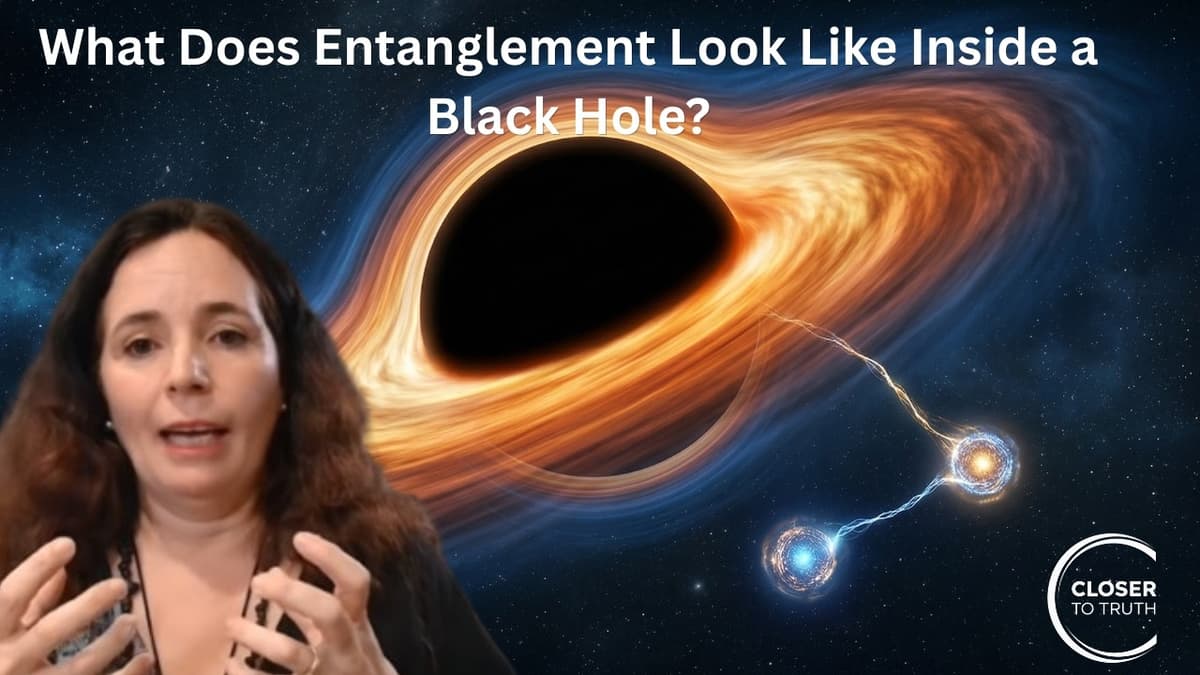
What Does Entanglement Look Like Inside a Black Hole? | Ivette Fuentes
In a recent interview, quantum‑information physicist Ivette Fuentes explains how entanglement behaves when one or both parties fall into a black hole, and why the perspective of distant observers matters. She shows that the shared quantum state is not invariant: observers...
What Makes Humans Unique? | Lisa Lloyd
The video features Lisa Lloyd debating what makes humans unique and challenging the dominant paradigm in evolutionary psychology. She acknowledges the field’s valuable premise—that human psychology is exceptionally complex and shaped by evolution—but argues that many scholars have narrowed their...
What Is Pure Consciousness? | Michael James
The video explores Michael James’s interpretation of Sri Ramana’s Advaita teachings, arguing that consciousness is the pure experiencer rather than the objects it perceives. By distinguishing the “experiencer” from the “content of consciousness,” James critiques popular definitions that equate consciousness with...
Why Inner Life Practices? - Global Philosophy | Episode 2605 | Closer To Truth
The Closer to Truth episode investigates why inner‑life practices—contemplation, meditation, prayer—are essential for a global philosophy of religion, aiming to move beyond Western analytic frameworks toward first‑person experience. Host Robert Lawrence Kuhn interviews scholars from Buddhism, Hinduism, Chinese philosophy, and...
If Panpsychism Is True, What Happens to God? | Philip Goff
The conversation centers on what a panpsychist ontology means for the traditional notion of God and for broader spiritual and moral frameworks. Goff distinguishes two camps within contemporary panpsychism: a reductionist, secular strand that treats consciousness as a fundamental physical property,...
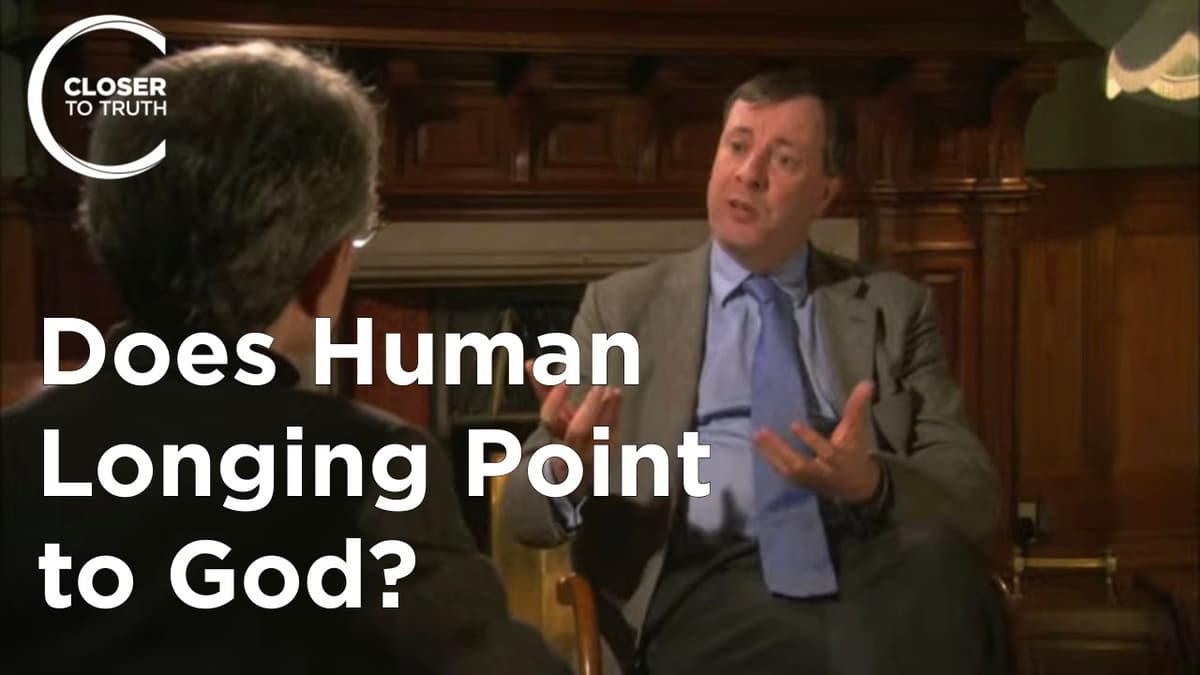
Does Human Longing Point to God? | Alister McGrath
Alister McGrath explores whether the universal human sense of yearning points toward a divine source, framing the discussion around C.S. Lewis’s argument that our restlessness is not random but signals a horizon beyond material existence. He juxtaposes this theological perspective...

How Does Evolution Work? The Role of Development (Evo-Devo) | Alex Rosenberg
The video explores evolutionary developmental biology (evo‑devo) as the bridge between molecular embryology and Darwinian evolution. Alex Rosenberg explains how the rise of molecular genetics turned developmental biology from a catalog of stages into a mechanistic science, highlighting Nobel‑winning work...

What Is Closer To Truth?
The video titled “What is Closer To Truth?” introduces the series’ mission to explore fundamental cosmological questions, emphasizing the mystery of why we exist in this particular universe. It outlines concepts such as the multiverse, multiple Big Bang events, and the...

Why Not Nothing? | Stuart Kauffman
The video centers on a deep‑cut philosophical‑scientific exchange about why there is something rather than nothing, using Stuart Kauffman’s perspective on quantum mechanics. Kauffman contrasts Aristotle’s res extensa—definite, actual objects—with Heisenberg’s res potentia, a realm of possibilities that only become...

What Are Species and Individuals? | Alan C. Love (Part I)
Alan C. Love opens the discussion by emphasizing that classification remains a foundational activity in biology, even if the traditional Linnaean hierarchy is less frequently invoked. He argues that scientists constantly sort traits, proteins, and organisms into categories to make...

Can AI Become Conscious? | James Hughes (Part I)
The discussion, hosted by James Hughes, probes whether artificial intelligence can achieve genuine consciousness and how Buddhist philosophy informs that debate. Hughes outlines the Buddhist analysis of mind, emphasizing the illusion of self ("rupa") and the role of embodied perception...

How We See 1,000 Images of the Same Galaxy | Priya Natarajan
In a recent Closer to Truth interview, astrophysicist Priya Natarajan explains how massive galaxy clusters act as natural telescopes, producing thousands of duplicated images of a single background galaxy through gravitational lensing. She describes Einstein’s general‑relativity picture of spacetime as a...

Do Multiple Universes Surely Exist? | Raphael Bousso
In a recent talk, theoretical physicist Raphael Bousso addressed the question of whether multiple universes exist, emphasizing that the idea has moved from fringe speculation to a near‑consensus working hypothesis among cosmologists. He argued that the observed values of vacuum energy,...

What Is the World According to Sri Ramana?
The video features an interview with Michael James, a longtime scholar and translator of Shri Ramana Maharshi, who outlines the sage’s central teaching that ultimate reality is discovered by turning inward and questioning the very experience of self. James argues that...

Peter Godfrey-Smith - Philosophy of Evolutionary Cognition, Emotion, & Consciousness
Peter Godfrey‑Smith argues that Darwinian evolution demands a gradualist view of mind, emotion, and consciousness rather than sharp, binary distinctions. He contends that evolutionary processes produce continuous variations, making it unlikely that consciousness appears abruptly at a specific point in...

Mark Bailey - Can AI Become Conscious (Part I)? | Closer To Truth Chats
The video centers on a speculative yet pressing question: could artificial intelligence ever achieve consciousness, and what would that mean for autonomous weapon systems? Host Mark Bailey probes the moral and strategic ramifications, while acknowledging the lack of consensus on...

Samir Okasha - Philosophy of Function, Fitness, Adaptation
Samir Okasha explains that population genetics formed the backbone of the modern synthesis, integrating Darwinian natural selection with Mendelian inheritance. He outlines how population genetics abstracts a population into allele frequencies and predicts their change under selection, mutation, drift, and migration,...
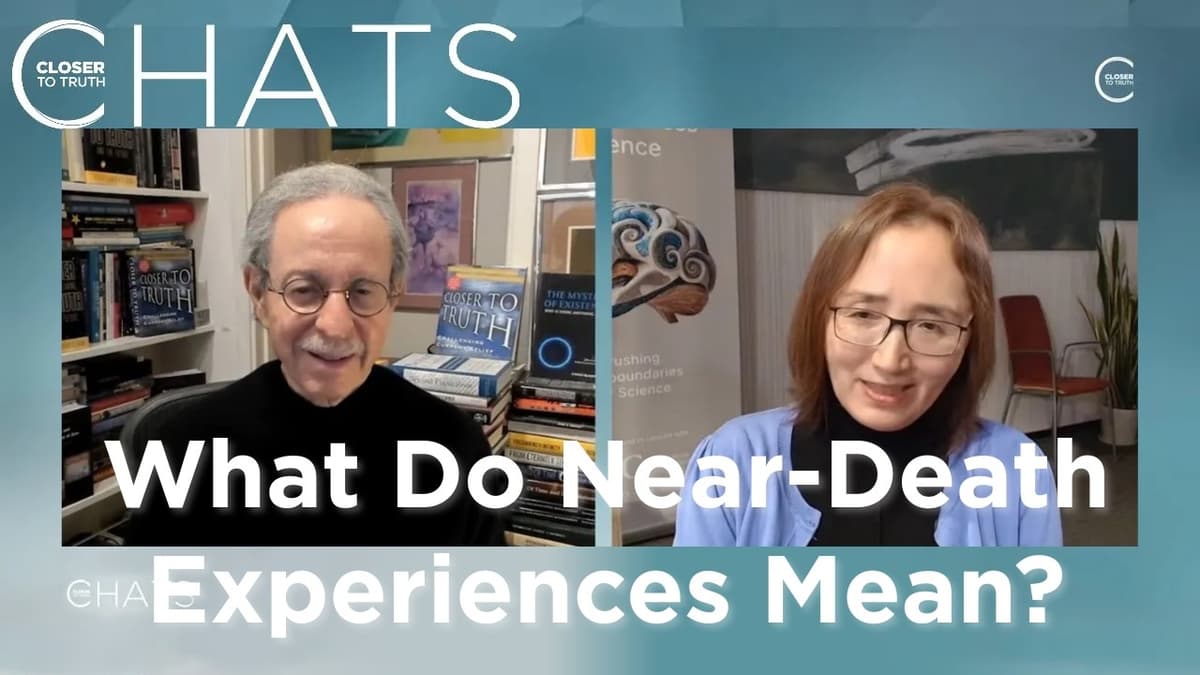
Jimo Borjigin - What Do Near-Death Experiences Mean? | Closer To Truth Chats
The video features neuroscientist Jimo Borjigin discussing a decade‑long investigation into the neural correlates of near‑death experiences (NDEs). Starting from an accidental observation of a massive serotonin surge in rats euthanized for stroke experiments, Borjigin pivoted to systematic recordings...

Liad Mudrik - What Is Consciousness?
The video explores how scientists tackle the notoriously elusive problem of defining and measuring consciousness. Liad Mudrik explains that his lab presents stimuli that are sometimes visible and sometimes invisible, then compares behavioral and neural responses to isolate the processes...