
Recent Posts
Video•Feb 20, 2026
AMATERASU Rays // Late Heavy Bombardment Doubts // Titan Bully
The episode covers a wide‑ranging set of space‑science stories, from the detection of an ultra‑high‑energy cosmic ray dubbed the Amaterasu particle to fresh insights on the Moon’s impact history, Titan’s possible role in creating Saturn’s rings, a massive ring system around a brown dwarf, and new laboratory evidence for pre‑biotic chemistry in space. The Amaterasu particle, with an estimated energy of about 2.4×10^20 eV—roughly 40 million times that of LHC collisions—was traced back to the star‑bursting galaxy M82, though its exact accelerator remains unknown. Meanwhile, China’s Chang‑E‑5 mission returned samples from the South‑Pole‑Aitken basin, dating a giant impact to 4.25 billion years ago, suggesting the classic Late Heavy Bombardment may be a misinterpretation of earlier, more intense bombardments. In the Saturn system, dynamical models propose that a proto‑moon collided with Titan about 400 million years ago, spawning the irregularly shaped moon Hyperion and the planet’s relatively young rings. Astronomers also reported a brown dwarf whose light dimmed by 97 % for 200 days, a phenomenon best explained by a colossal, tilted ring system spanning roughly 0.17 AU—half Mercury’s orbital radius—likely the debris of a planetary collision. Complementing these discoveries, laboratory work demonstrated that glycine, a fundamental amino acid, can form in icy mantles under space‑like radiation without liquid water, offering a plausible pathway for organic synthesis in comets and asteroids. Collectively, these findings reshape our understanding of cosmic‑ray origins, early Solar System chronology, satellite‑driven ring formation, and the ubiquity of pre‑biotic chemistry, with direct implications for astronaut radiation risk, planetary formation theories, and the search for life's building blocks beyond Earth.
By Fraser Cain (Universe Today)
Video•Feb 13, 2026
Ancient Venus Civilization, Dark Matter, Great Attractor | Q&A 397
In this episode of the “Question Show,” the host tackles four fan‑submitted topics: whether an ancient civilization could have turned Venus into a hellish world, the nature of dark matter, the mystery of the Great Attractor, and the current state...
By Fraser Cain (Universe Today)
Video•Feb 11, 2026
How Japan Built Its Crazy Space Agency
The video explores the evolution of Japan’s space agency, featuring an interview with historian Dr. Subo Vijatna. It traces the program from early 20th‑century curiosity, through wartime rocket experiments, to the formal establishment of JAXA in 2003, highlighting how cultural...
By Fraser Cain (Universe Today)
Video•Feb 6, 2026
Crazy New SpaceX Plans // AI Mars Takeover // NO Artemis 2 in February
The episode covers a wide‑ranging space briefing: new research questioning Europa’s habitability, a month‑long postponement of NASA’s Artemis 2 crew flight, an AI‑driven rover‑navigation experiment on Mars, SpaceX’s ambitious plan to launch up to a million data‑center satellites, and Blue Origin’s...
By Fraser Cain (Universe Today)
Video•Feb 3, 2026
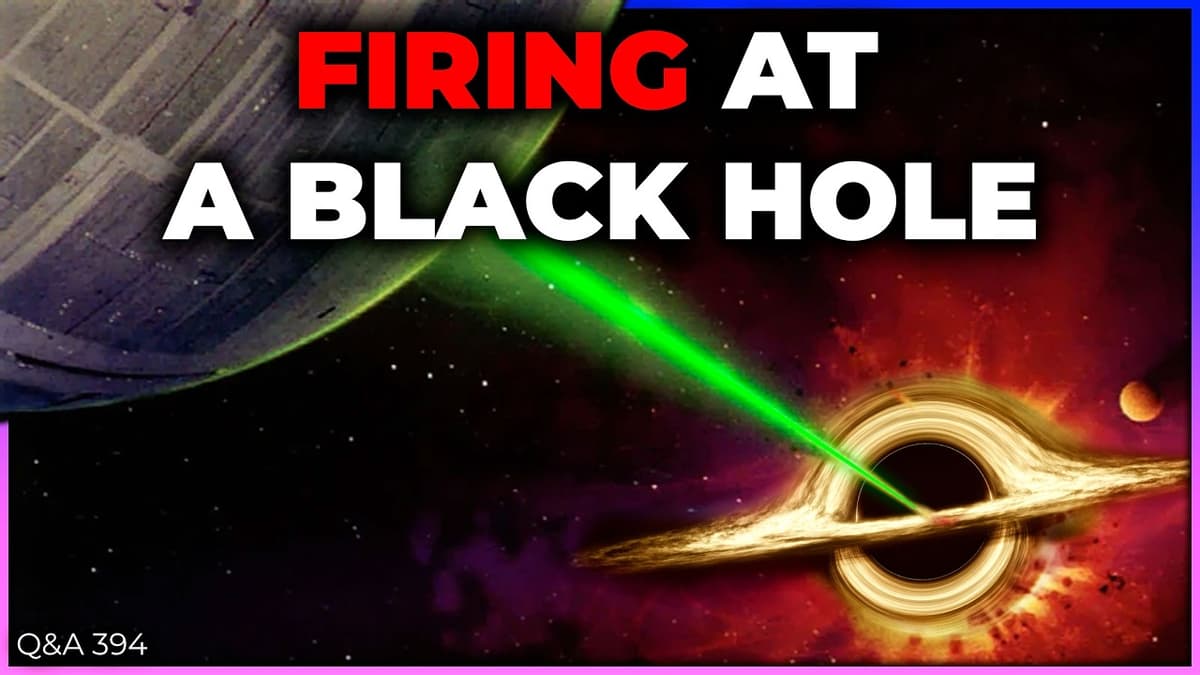
AI Warp Drive, Surviving in Space, Firing at a Black Hole | Q&A 394
In this episode of the Q&A series, Fraser tackles a range of speculative astrophysics questions—from whether aliens could survive interstellar travel, to the fate of gamma‑ray bursts striking black holes, the existence of Lagrange points in binary star systems, and...
By Fraser Cain (Universe Today)
Video•Feb 2, 2026
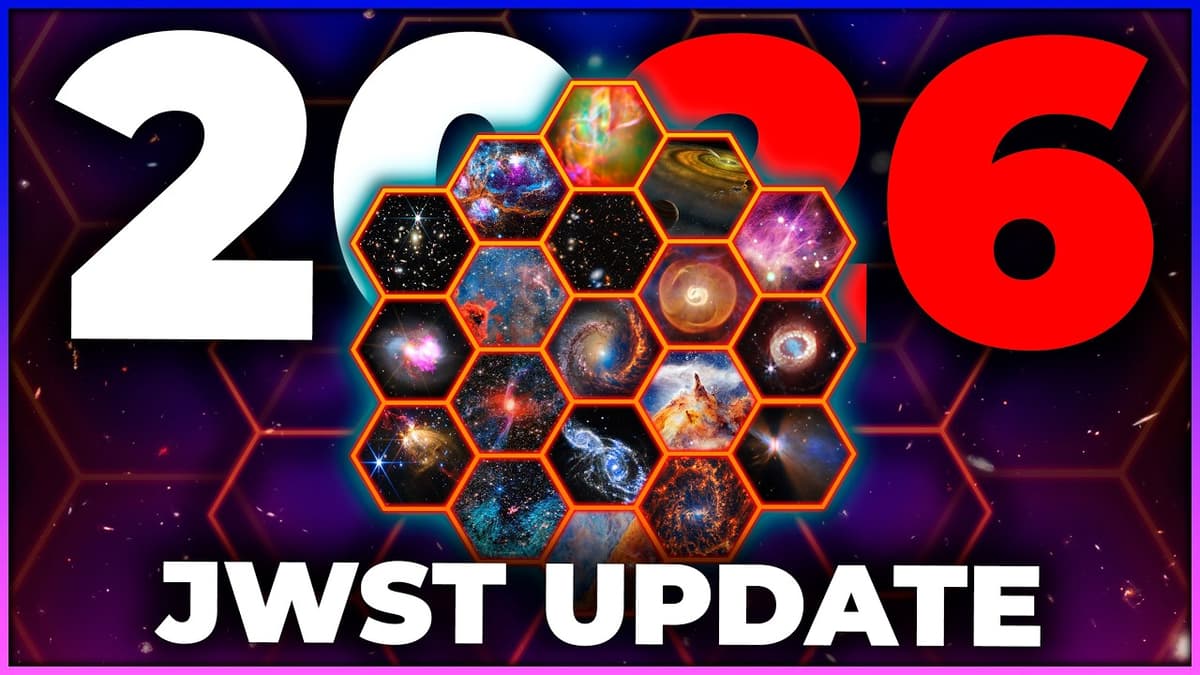
Everything You Need to Know About JWST's Discoveries in 2026
Since its launch, JWST has confirmed the existence of galaxies within a few hundred million years after the Big Bang and refined many contested photometric redshifts with spectroscopic measurements. Detailed JWST spectra and high-resolution imaging reveal surprising early complexity: some...
By Fraser Cain (Universe Today)