
8th Annual NBER Environmental and Energy Policy and the Economy Conference
The eighth annual NBER Environmental and Energy Policy and the Economy conference brought together researchers, government officials, and NGOs to showcase policy‑relevant work funded by the Sloan Foundation. Organized by Matthew Kocchin, Tatiana Darugina, and Catherine Wolfram, the meeting serves as a peer‑review forum, with feedback shaping papers slated for a Cambridge University Press volume. One of the highlighted presentations, by Daniel Bresler and co‑author Jeffrey Heal, tackled the thorny question of valuing excess deaths caused by climate change. The authors argue that the social cost of carbon (SEC) hinges critically on how premature mortality is monetized, noting that mortality now accounts for 50‑80% of SEC damages in recent EPA models. They stress that the choice of value‑of‑statistical‑life (VSL) across regions is the most influential factor, surpassing discount‑rate considerations. Bresler traced the debate back to the 1995 IPCC report, which controversially assigned a tenth‑world‑average VSL to developing nations, prompting diplomatic backlash. He highlighted advances in climate‑impact modeling—such as the Climate Impact Lab’s 25,000‑region resolution and RFF’s 184‑country grid—that now allow granular mortality assessments. The presentation also referenced the EPA’s 2023 SEC update, which employed three damage modules to illustrate the mortality share. The discussion underscores the policy stakes: regulators must decide whether to apply a uniform global VSL or region‑specific values, a choice that can dramatically shift the estimated benefits of carbon mitigation. As models become more spatially precise, the pressure mounts on agencies to adopt transparent, equitable valuation frameworks, influencing future climate‑related rulemaking and cost‑benefit analyses.
Applications of Artificial Intelligence in Healthcare
The video presents a randomized controlled trial evaluating an AI‑powered mental‑health application, MindSurf, among Mexican women experiencing mild psychological distress. Researchers recruited roughly 2,000 participants via social media, randomizing half to three months of free premium access and later offering extensions....
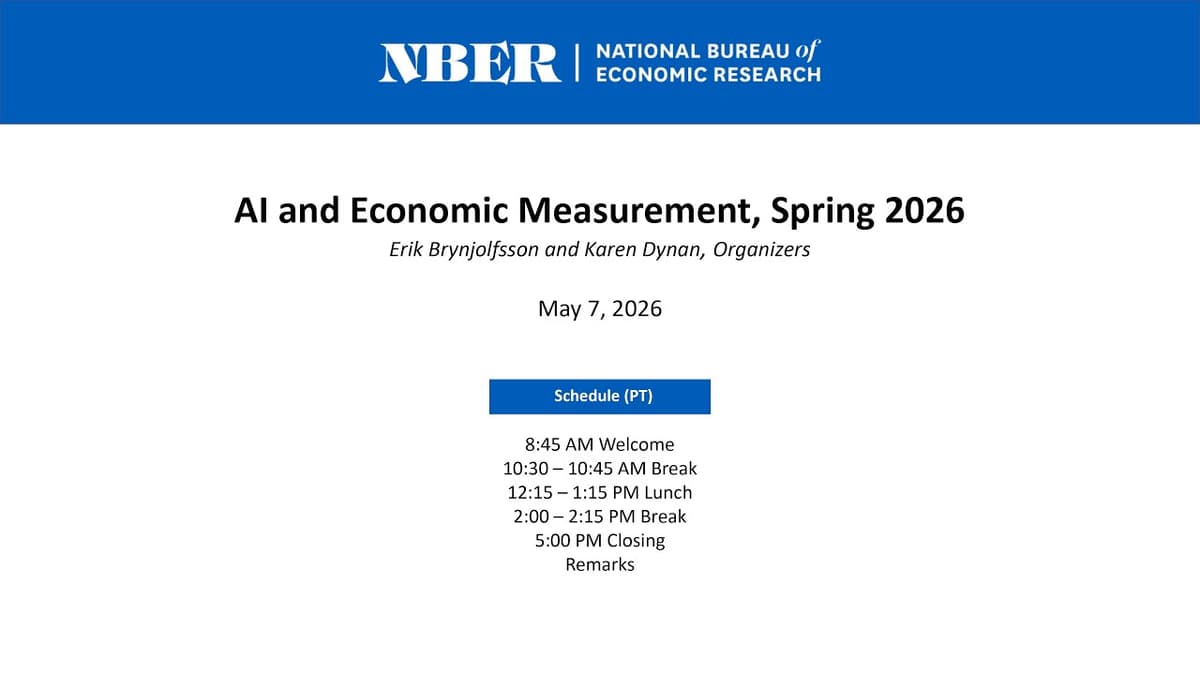
AI and Economic Measurement.
The workshop convened leading economists, policymakers and technologists to confront a pressing question: how can we accurately measure the economic impact of rapidly advancing artificial intelligence? Speakers highlighted the surge in AI capabilities—from coding assistants to autonomous agents—and warned that...

2025, Olivier Blanchard, 40th Annual Conference on Macroeconomics, "Thoughts About the Evolution....
The video marks the 40th anniversary of the NBER Macro Annual, featuring Olivier Blanchard’s retrospective on how macroeconomics has evolved from fragmented schools to a unified research agenda. Blanchard, a founding co‑editor, reflects on the conference’s role in fostering dialogue between...
Environment and Energy Economics Program Meeting, Spring 2026
The Environment and Energy Economics program featured a paper quantifying range anxiety – the fear of depleting an electric‑vehicle battery before reaching a charger – and its impact on adoption. Using five‑second granularity data from roughly 200,000 trips and 30,000...
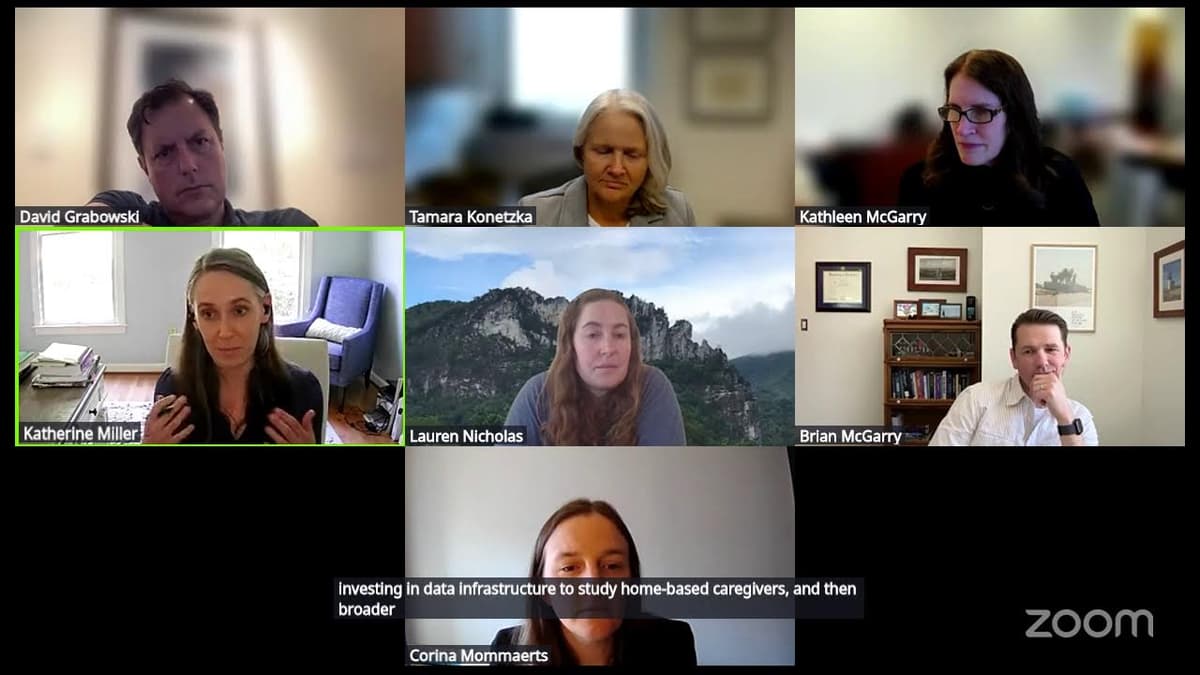
Data for Long-Term Care Research
The meeting opened by announcing an October 2 in‑person conference on long‑term‑care data and invited paper submissions, underscoring the field’s growing research appetite. Speakers highlighted the core data ecosystems: the Minimum Data Set (MDS) for resident assessments, Medicare fee‑for‑service and...
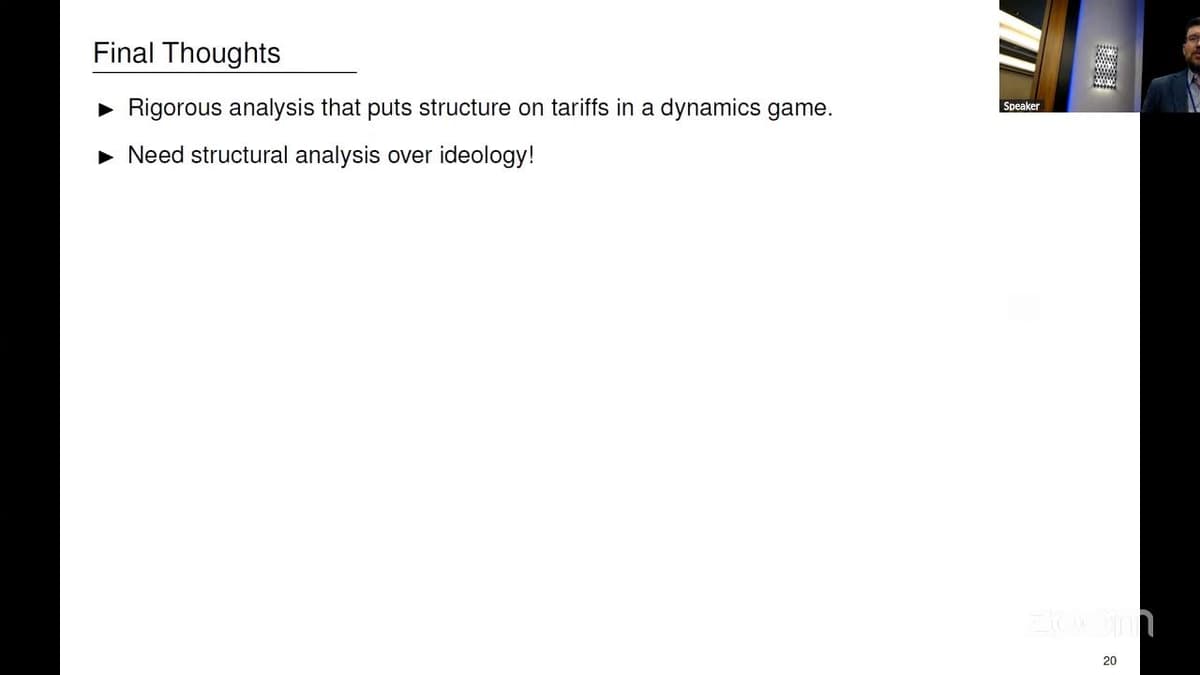
41st Annual Conference on Macroeconomics, 2026
Researchers presented at the 41st MBR Macroeconomics conference that the 2021–24 U.S. population increase of roughly 10 million was driven largely by unauthorized, low‑skilled immigrants—primarily from 11 Central and South American countries—whose arrival was widespread across 39 states. Using CPS...
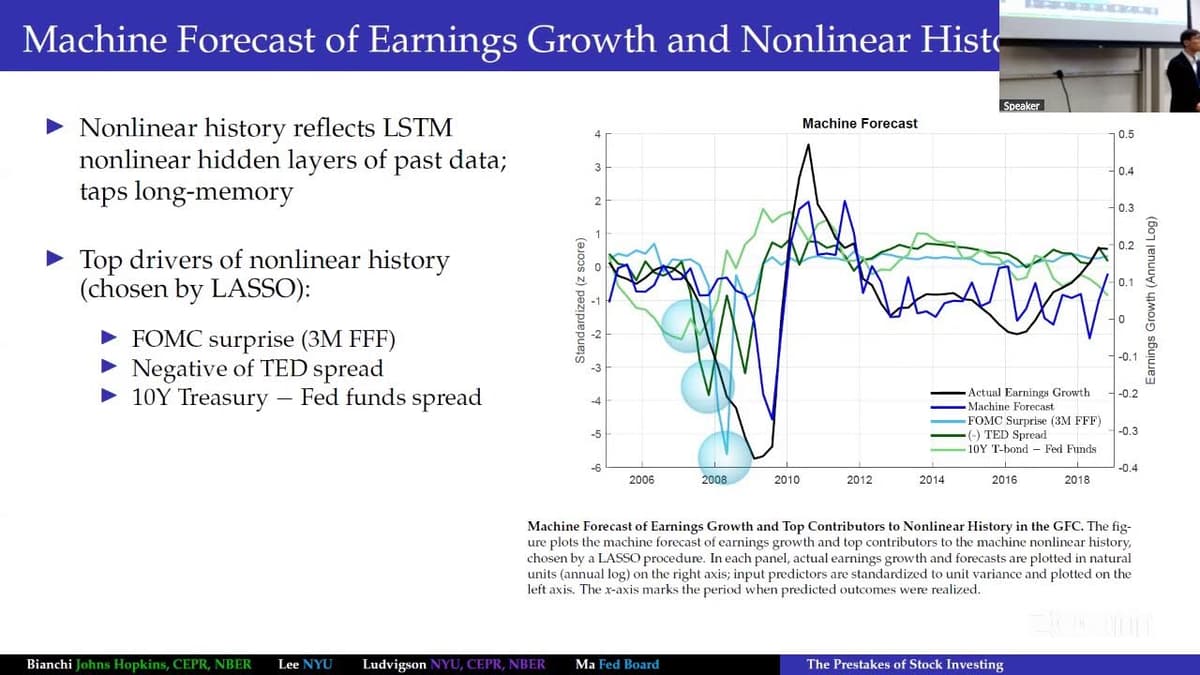
Asset Pricing Program Meeting, Spring 2026
Researchers presented a framework that measures how markets ‘represent’ firms using language embeddings from financial news and targeted foundation models, producing firm-by-year vector representations. They decompose annual cross-sectional stock-return variation and find these representation-related terms explain about 20% of variation—roughly...
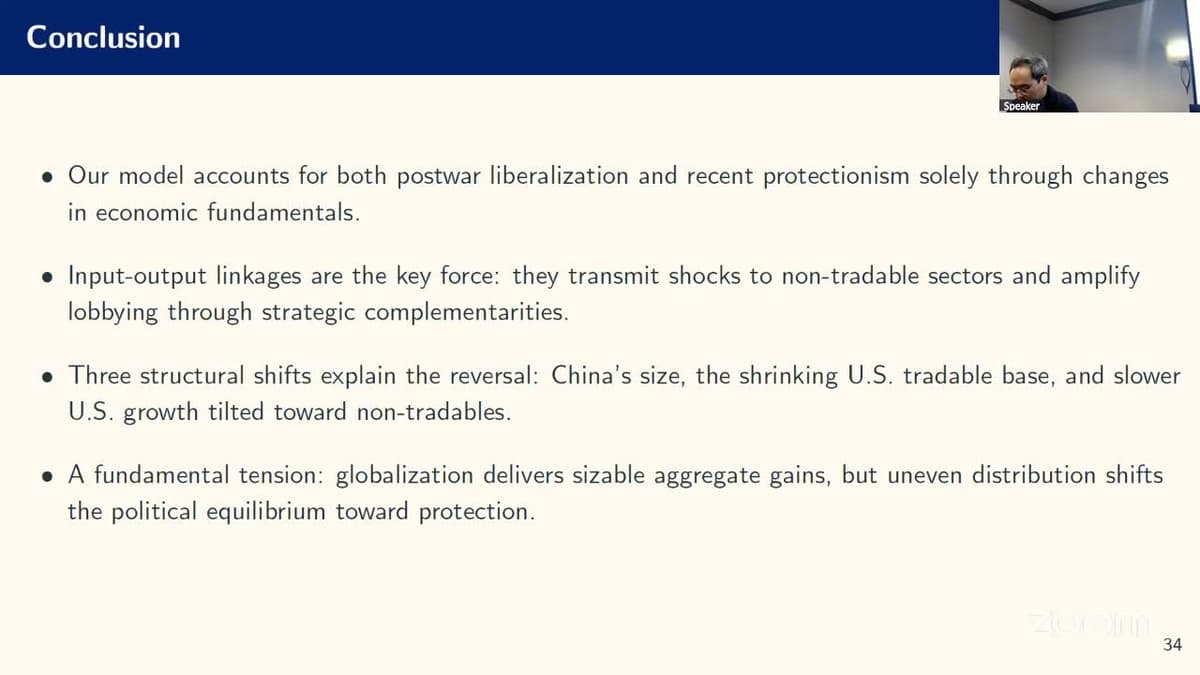
International Trade and Investment Program Meeting, Spring 2026
An academic presentation outlined a model combining assignment and principal–agent frameworks within a trade model to study how global shocks reshape CEO pay. The speaker derives a value function incorporating firm heterogeneity and interactive, time-varying shocks that affect both firm...
International Trade and Investment Program Meeting, Spring 2026
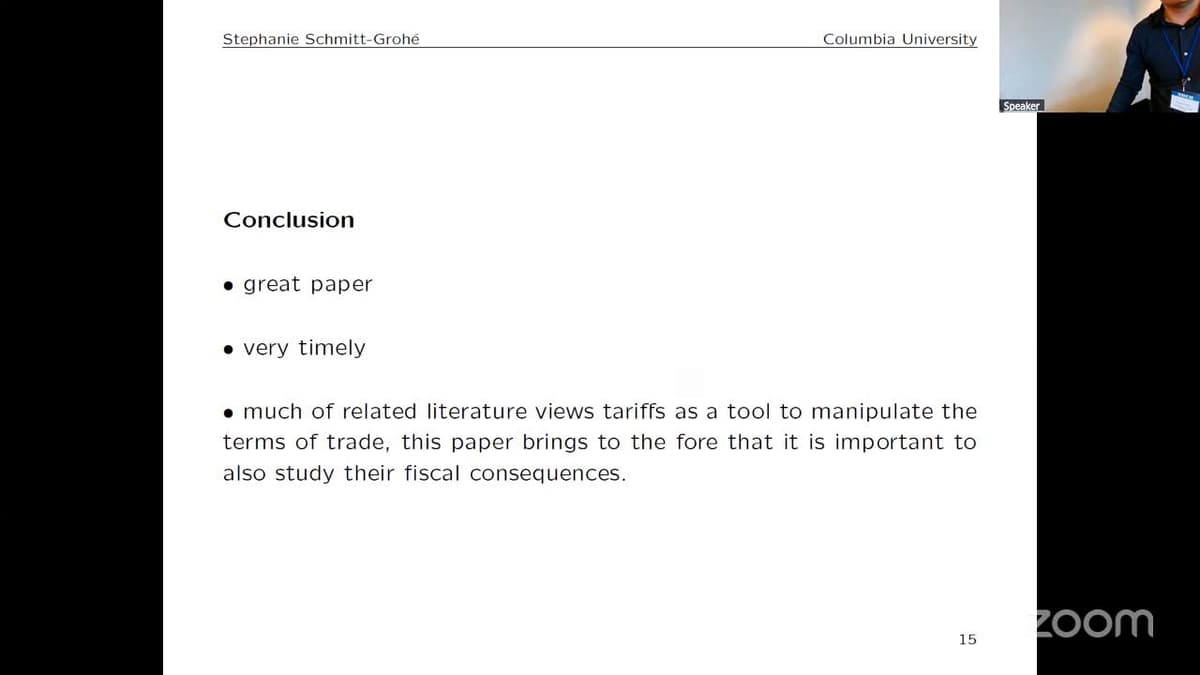
The presentation introduced a new welfare framework for analyzing trade under oligopolistic competition, focusing on how a small, fixed number of firms in each market shape welfare outcomes. Building on the nested CES model of Armington and the classic Brander‑Krugman...
NBER International Finance and Macroeconomics Program Meeting
At the NBER International Finance and Macroeconomics meeting organizers opened with logistical announcements—shortening lunch and removing a coffee break to accommodate travel—and reiterated meeting norms and the NBER code of conduct. Attendees briefly introduced themselves from a wide range of...

Inflation: Frontiers of Research and Policy
The NBER‑hosted conference “Inflation: Frontiers of Research and Policy” highlighted a growing consensus that the United States’ inflation measurement framework is anchored in 20th‑century survey methods and is ill‑suited for today’s fast‑changing economy. Speakers, including Jim Piterba and the Reset...

Assessing the U.S. Medical Innovation System
The NBER‑sponsored event titled “Assessing the U.S. Medical Innovation System” convened economists, health‑policy scholars, and industry experts to examine how public funding mechanisms shape biomedical research. Organizers highlighted the central question: does the NIH peer‑review process penalize investigators who...

NBER Monetary Economics Program Meeting
Researchers presented an analytical and quantitative study showing that slower fiscal adjustment after recessions—i.e., delaying tax hikes to shrink budget shortfalls—can act as a powerful dynamic automatic stabilizer in an economy with non‑Ricardian households. Using an overlapping‑generations (perpetual youth) model...

Immigrants and the U.S. Economy
David Card, a Nobel‑winning economist, presented a fourteen‑year project linking Austria’s and Germany’s social‑security databases to measure the earnings impact of international migration. By matching individuals via name and date of birth, the team assembled a quarterly panel of 168,000...