
How Artemis II Re-Entry Differed From Artemis I
NASA concluded that the heat‑shield damage on Artemis I was not a design flaw but a consequence of the skip‑entry trajectory used to shed lunar return velocity. After a two‑year forensic review, engineers found that the first atmospheric dip trapped pockets of gas inside the ablative shield; on the second dip those gases expanded, cracking the tiles and shedding fragments. The phenomenon was traced to the lift‑generated “skip” maneuver, which deliberately re‑enters, exits, then re‑enters the atmosphere. Mission officials described the maneuver as “a technique we use coming back from the moon because the velocity is much greater than coming back from low Earth orbit.” They contrasted it with the new plan: a straight, steeper ballistic trajectory—“as if the capsule has been fired like a bullet”—that avoids a second atmospheric pass. By retaining the proven heat‑shield architecture and abandoning the skip profile, Artemis II reduces thermal‑stress risk while preserving schedule. The change signals NASA’s cautious approach to crewed lunar return safety and may influence re‑entry strategies for future deep‑space missions.

What “The Biggest Loser” Got Wrong About Weight Loss
The video dissects the myth perpetuated by the reality series “The Biggest Loser,” showing how its dramatic weight‑loss feats clash with human physiology. Contestant Danny Cahill slashed his intake to about 800 calories and logged 45 hours of exercise weekly, shedding...
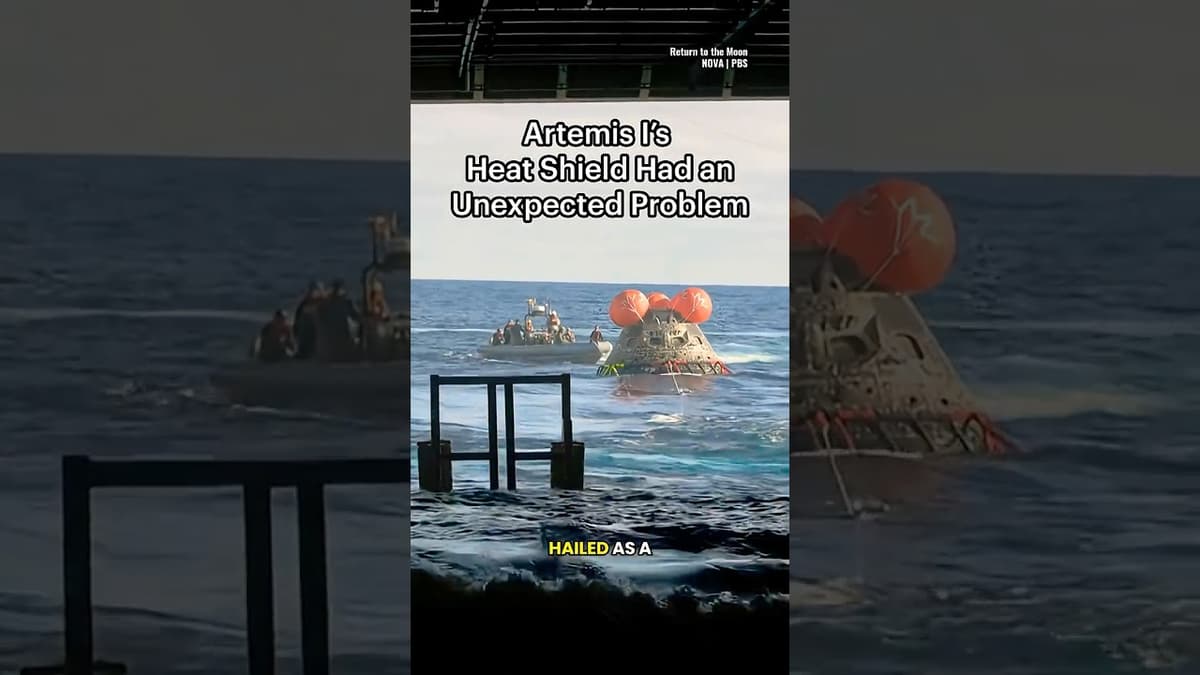
Artemis I’s Heat Shield Had an Unexpected Problem
The video highlights that while Artemis I’s splashdown was publicly celebrated, engineers quickly discovered serious degradation of Orion’s heat shield after re‑entry. The ablative epoxy‑resin tiles, designed to melt and vaporize, instead exhibited cavities, burn marks, and detached chunks. The Inspector...

Training for the Moon, Underwater #shorts #moon #artemis 
The video shows NASA engineers and astronaut Victor Glover conducting an underwater test of the next‑generation spacesuit intended for the Artemis program’s lunar surface operations. By submerging the suit in a pool, they replicate the Moon’s one‑sixth gravity while accounting for...
How One of the Universe’s Biggest Secrets Was Discovered
The video recounts the serendipitous birth of gravitational‑wave astronomy on September 14, 2015, when LIGO’s two detectors in Louisiana and Washington recorded a fleeting ripple in spacetime. A tired technician, Robert Schofield, chose to shut down the instruments, inadvertently preserving...

The Truth About Quantum Computers
The video examines the latest claim from Microsoft that it has finally tamed the elusive Majorana fermion to build topological qubits, a development it says could unlock practical quantum computers as early as 2025. It explains how quantum computers differ from...

(Podcast Version) Arctic Sinkholes | NOVA Remix | NOVA | PBS
The Nova Remix episode investigates a startling new phenomenon in the Arctic: massive sinkholes and explosive craters caused by rapidly thawing permafrost that releases trapped methane. Researchers first documented a 160‑foot‑deep crater on Russia’s Yamal Peninsula, noting its raised rim...

You Have Arachnids Living on Your Face 😖 #gross #science #biology #arachnid
The video explains that tiny arachnids called Demodex mites live in and around the hair follicles on our faces, particularly in eyebrows, eyelashes and the nose. These microscopic organisms have been co‑evolving with humans for millions of years and are...

4 Deadly Carnivorous Plants | NOVA | PBS
The NOVA segment explores the astonishing world of carnivorous plants, highlighting how these leafy predators have independently evolved a suite of hunting strategies to survive in nutrient‑poor environments such as peat bogs and stagnant water. The program details four emblematic traps:...

Is Electricity Instant? A Shocking Experiment From 1746 | What the Physics?! NOVA | PBS
The video revisits Jean‑Antoine Nollet’s 1746 demonstration, where a line of monks linked by wires were shocked simultaneously, prompting the claim that electricity travels instantaneously. It uses this dramatic episode to explore the centuries‑long quest to measure the true speed...