

Attribution: From Credit Scoreboard to Coordination Engine
Attribution was supposed to tell us which channels deserve credit. It mostly told us which teams should fight about it. Frans Riemersma and I just published The State of Marketing Attribution 2026 (sponsored by CaliberMind), and the finding that hit hardest wasn't about models or data. It was about people. The companies getting attribution right in 2026 aren't using it as a scoreboard. They're using it as a coordination system. When we interviewed marketing and revenue ops leaders at companies that have genuinely cracked this, the pattern was striking. They'd stopped asking "who gets credit?" and started asking "where are our highest-impact opportunities, and how do we align around them?" That one reframing changed everything — because it shifted the conversation from dividing up credit to multiplying impact. Attribution became the shared language that got marketing, sales, and leadership coordinating around the same customers, the same journeys, and the same revenue signals. Think about what happens without that shared language. In a flat or shrinking budget environment, attribution defaults to Hunger Games dynamics. Every team defends its slice. Decisions drift toward whichever channel has the easiest reporting, not the strongest contribution. A lot of motion. No coordinated action. The teams we studied flipped that. They used attribution to align the entire go-to-market organization around where value compounds, and the results were remarkable. One company generated 30% more enterprise opportunities at 31% lower cost per opportunity. We're calling this shift Attribution 2.0. The row I'd highlight in the table below: Decision outcomes move from "tactical optimization" to "strategic coordination." Everything else in the shift follows from that. Two forces are converging to make this possible: Context Engineering — AI adds a reasoning layer that turns fragmented data into actionable context. Attribution provides the structure. AI provides the interpretation. Value Engineering — Marketers move up the stack from operators to orchestrators. They reverse-engineer revenue instead of optimizing campaigns. 9 out of 10 marketers can't tell you who their most profitable customers are, what they buy most, and where the margins live. The teams in this report could. The bottom line: modern attribution works like a control tower. Different teams keep their own cockpit dashboards, but they navigate by the same signals. The value of modern attribution lies not in precision, but in coordination action under uncertainty. It's better to be approximately right together than precisely wrong in silos. 📥 Full report here: https://t.co/or3AW7nfT2 Where is your organization on the 1.0 → 2.0 spectrum? I'd love to hear what's working — or what's still stuck.

Introducing Forward Deployed Martech: Real‑World Buyer Intelligence
Big announcement: chiefmartec has acquired Watchem, Bugg & Hyde, a boutique investigative services firm, to launch what I believe is the industry's first Forward Deployed Martech practice. Here's the thesis: Every martech vendor talks about "intent signals" and "buyer intelligence." But let's...

Marketers Embrace AI “Vibe Coding” To Build Tools
For years, the most automated thing in marketing was the auto-reply on your engineering ticket. Now marketers are building their own dashboards, integrations, automations, and internal apps — no engineering queue required. Just a prompt, an AI model, and a clearer...

AI Powers Agency Boom, Small Firms Match Giants
Hot take from the 4A's Decisions event in Boston this week: While SaaS companies wrestle with AI angst, agencies and service providers are quietly entering their best era. More clients need more help than ever. AI lets small firms do what used...

AI Demands a Composable Martech Canvas, Not Stacked Tools
Bryce Peake, who led marketing decision sciences at Domino’s, says this in my new report with Databricks, released this morning — and I think it gets to the heart of it: “We’ve been trying to modify the same martech stack we’ve...
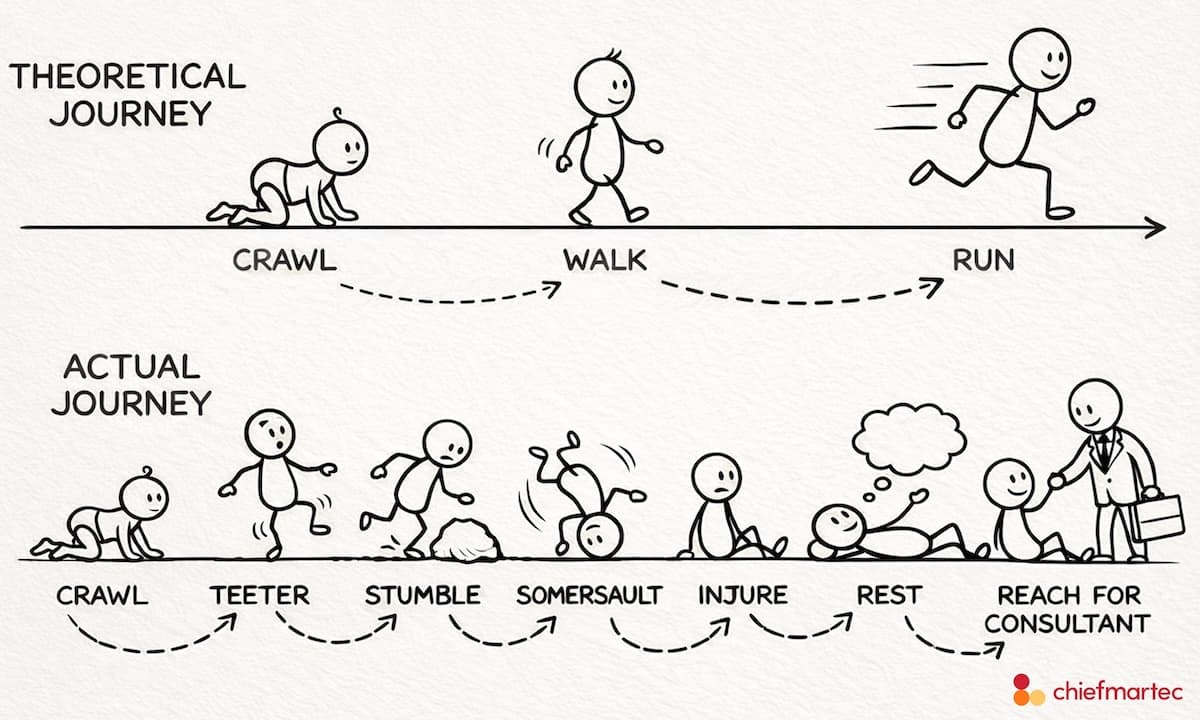
Beyond Crawl‑Walk‑Run: A More Realistic Implementation Framework
Having sat through thousands of crawl-walk-run presentations in my life, I thought it might be helpful to expand the model a bit to cover more, um, realistic implementation paths. https://t.co/fGXlclB0Qi

Build Systems for Exponential Growth, Not Linear Output
Fantastic article by John Maeda on building systems for exponential growth vs. merely delivering ouputs that track to linear growth — and why this distinction is crucial in the AI Age. -- LINEAR GROWTH: "Linear growth is steady and visible....

Third‑Party AI Apps Thrive Amid Model‑Built Race
"Are enterprises building directly on models, or are they buying applications, instead? The answer is nuanced, but one thing is clear: the reported death of third party apps is greatly exaggerated, to put it mildly." Reading through the latest "Leaders,...

Legacy Records Must Evolve Into Ecosystem‑Driven Platforms
"Why can or can't legacy systems of record just add AI?" Great reflections by Jamin Ball in his latest "Clouded Judgment" newsletter (link in comments). I'll just add that this is one of the best arguments for those legacy systems...

Scalability, Not Ambition, Is Marketing’s New Bottleneck
The results are in from the Adapt or Die: 2026 Resilient Marketer Survey that I collaborated on with the team at MoEngage . One pattern is already clear: the challenge for most B2C marketing teams is no longer experimentation or...
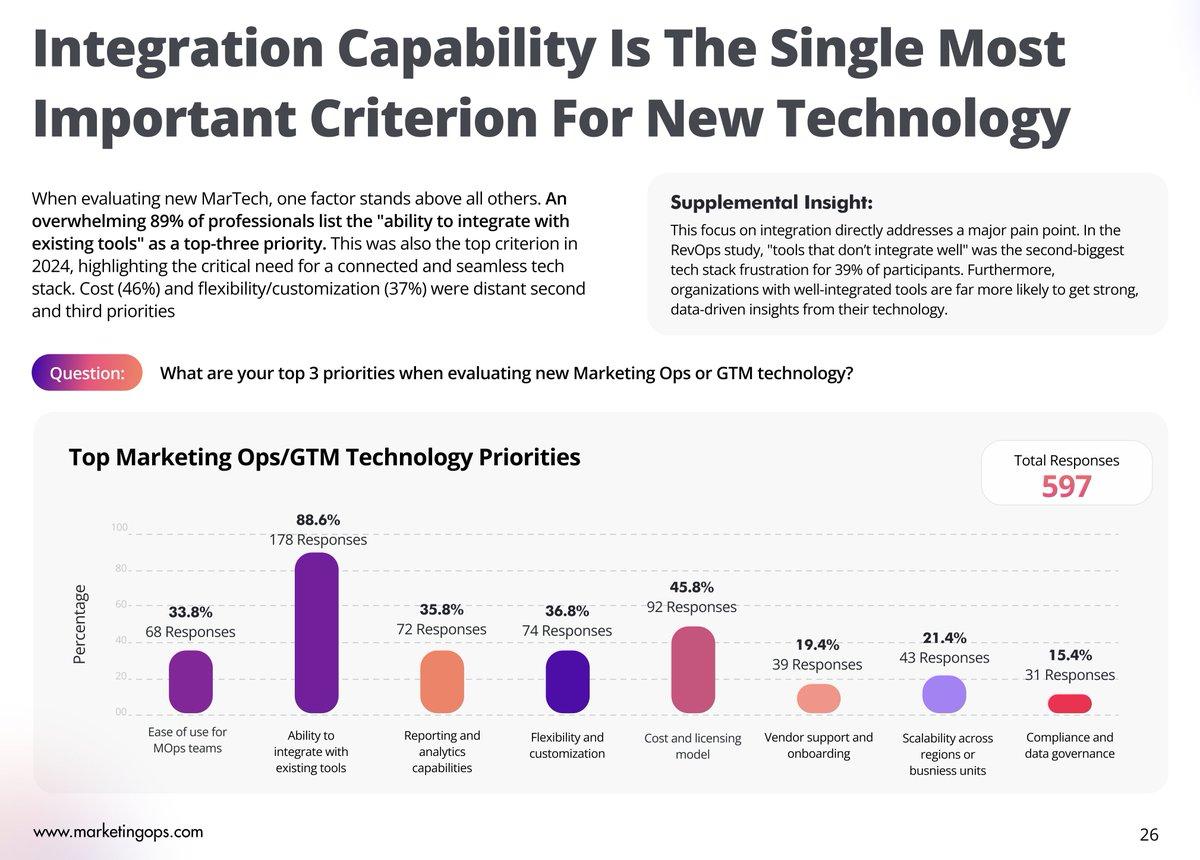
Integration Tops Martech Vendors' Evaluation Criteria
My annual reminder to #martech vendors that integration is a top criterion when marketing ops professionals evaluate your product. 😀 Data from the latest State of the Marketing Operations Professional report, published in November 2025, produced by Mike Rizzo and...
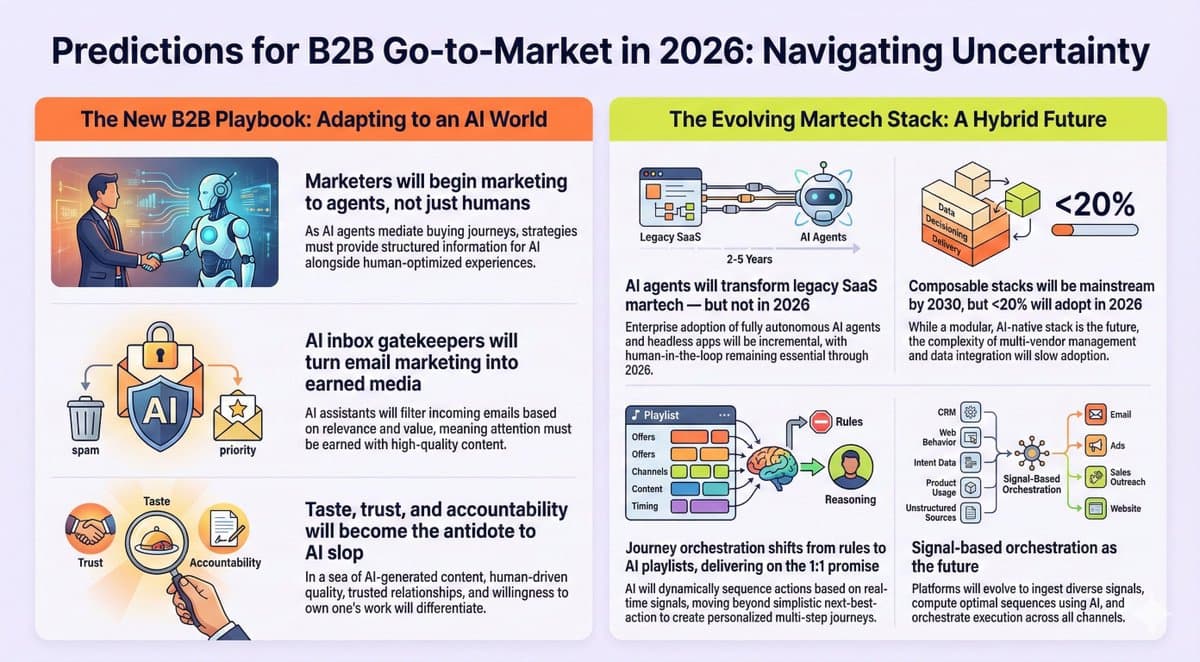
2026 B2B GTM Shifts: AI, Agents, and Composable Stacks
I rarely publish guest posts on chiefmartec. This epic essay by @jonmiller — Predictions for B2B Go-To-Market in 2026 — was so good I made an exception. Jon certainly has the cred: the co-founder and original CMO of Marketo, a leading...

Early‑stage Success Driven Primarily by Internal Capabilities
Great to see ecosystems getting more recognition as a crucial part of GTM strategy. 🙌 This is my favorite graph from Battery Ventures ' new State of AI report, showing the relative importance of different kinds of competitive moats —...

Long Tail Drives Success in Modern Ecosystem Leaders
So few companies get the power of the long tail in an ecosystem. IMHO: Ecosystem = Long Tail. Amazon, Apple, Shopify, Salesforce, HubSpot are all examples of companies that have *thrived* by embracing and leveraging the long tail of their...

Retailers Must Cut Layers Before AI Platforms Replace Them
This article by Ray Iyer is a searingly insightful view of the dangers of vertical competition emerging around consumer AI assistants. "Every retailer—grocery or otherwise—should be asking two questions: 1. How many layers sit between you and your customer? Count...

Benchmark AI Adoption: Survey Resilient B2C Marketers 2026
Sorting through the signal vs. noise of AI marketing? Want to get to the ground truth of real implementation and impact, benchmarked with your peers? I am collaborating with MoEngage on a new research project — Adapt or Die: The...

Free 2026 Martech Report Launch Tomorrow – Get Priority Access
After months of research and interviews, tomorrow (Dec 2) is the big release of our new 123-page MARTECH FOR 2026 report. 🚀 There's still time to sign up to get priority access to the report at 11am EST and have...

Practical AI Agent Trends for Marketing 2024‑2025
SPOILER ALERT: our new 100+ page "Martech for 2026" about to be released has a lot to say about #AI #agents in #marketing and #martech . Before you do the LinkedIn equivalent of swiping left, let me assure you that...

Partner Ecosystems Overperform yet Remain an Underappreciated Opportunity
Reading through Norwest 's 2025 B2B Sales & Marketing Benchmark Report, I found these stats on partners' impact in sales outreach and marketing-sourced opportunities encouraging. 🙌 Aligns with Kyle Poyar 's findings earlier this month about ecosystem GTM as a...
Buyer‑side Agents Will Disrupt Martech by 2026
Buyer-side agents are the real disruption (a sneak preview of our Martech for 2026 report) https://t.co/emy5sjMTIh #martech https://t.co/iZu2dsRJza

AI Hype Hits Goldilocks Sweet Spot for Support, Not Sales
Reading through the new 2025 SaaS Survey report from KeyBanc Capital Markets and Sapphire Ventures , I found this chart of #AI hype for different categories interesting. The "properly hyped" figures are the Goldilocks of Hype. 😂 Note the significant...

Customer‑owned AI Agents Poised to Disrupt Marketing
Putting the final touches on our big "Martech for 2026" report — over 100 pages of lovingly, human-written explanation of what's actually happening with #AI and #martech headed into the next 6-12 months. Of course, there's a lot about agents....

Misinterpreted SaaS GTM Benchmarks Hide High-Value Opportunities
Great new SaaS Benchmarks report from High Alpha . But I have questions on this table of the effectiveness of go-to-market channels. What do these percentages represent? 1. The number of respondents in the study using that channel? 2. The...
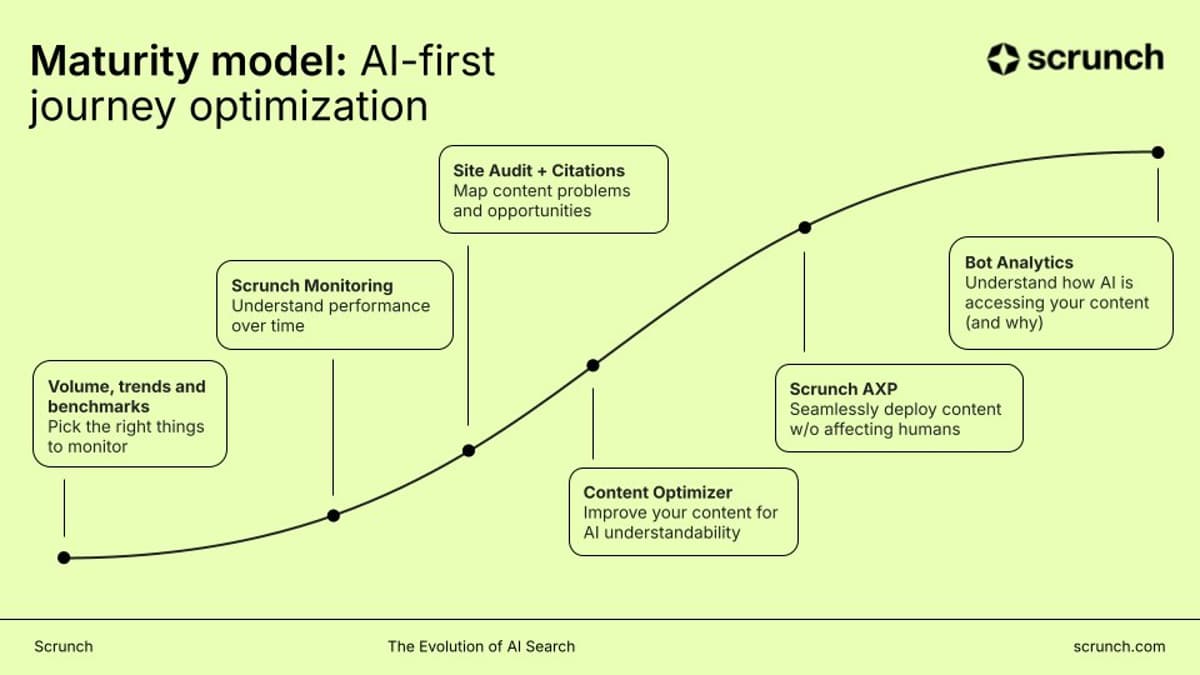
Master AEO: Practical Strategies Beyond Traditional SEO
Want to learn the new art and science of AEO (AI/Answer Engine Optimization) and how it differs from classic SEO? Join me and Chris Andrew, co-founder and CEO of Scrunch AI, for a deep dive into the questions you have —...

Q3 Sees Surge in Martech and Adtech Deals
Terence Kawaja and the team at LUMA Partners share the latest data on #martech and #adtech M&A activity from Q3. Overall, the market for martech acquisitions has remained healthy. Although, given how many pre-2020 martech companies are looking for an...
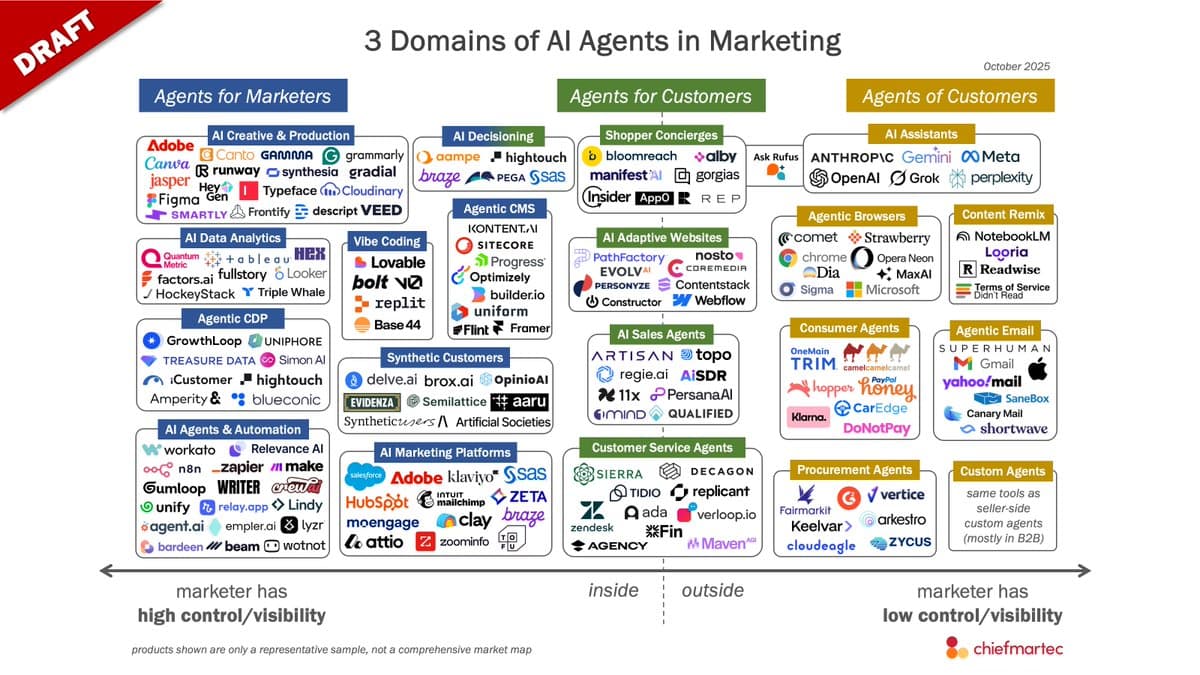
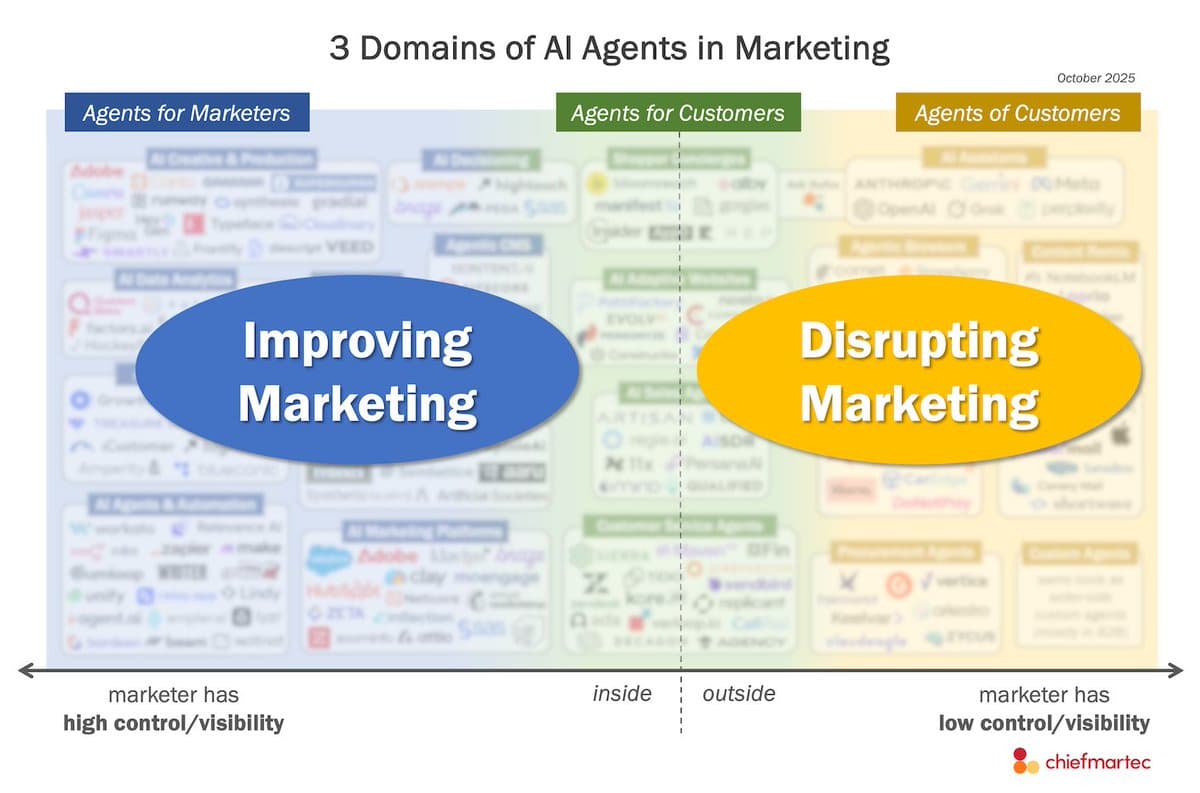
Customers' AI Agents Redefine the Marketing Landscape
Sharing a draft illustration of 3 different "domains" of AI agents in marketing to solicit feedback. The 3 different domains: 1. AI agents for marketers, used internally. 2. AI agents for customers externally, but run by marketers internally. 3. AI agents operating on behalf...