
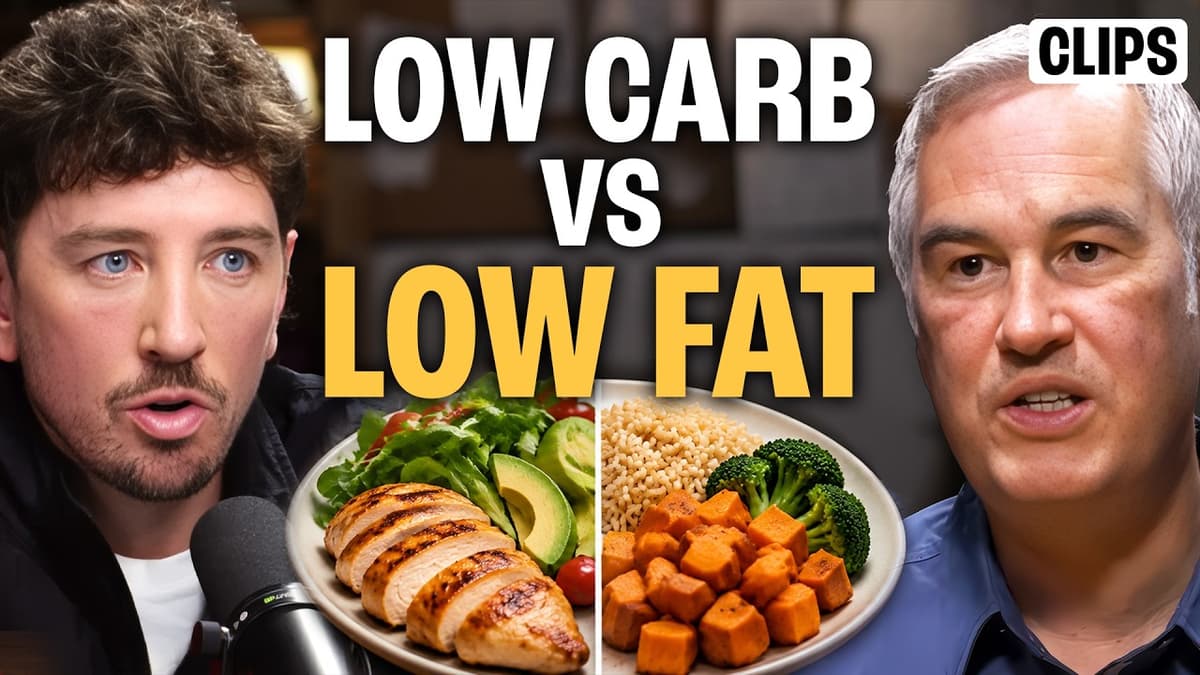
Kevin Hall Destroys the Low-Carb vs Low-Fat Debate: What Actually Causes Fat Gain? | Kevin Hall
Kevin Hall, a leading metabolic researcher, revisits the long‑standing low‑carb versus low‑fat controversy, arguing that while the classic "a calorie is a calorie" notion is broadly true, subtle physiological differences emerge when macronutrient ratios shift. Drawing on his early computer‑simulation work and a series of tightly controlled feeding studies, Hall demonstrates that swapping 30 % of calories from carbs to fat produces only marginally greater fat loss—on the order of 100‑200 kcal per day—detectable only in respiratory‑chamber measurements. The data challenge the carbohydrate‑insulin model popularized by Gary Taubes. In Hall’s initial study, reduced‑fat diets yielded slightly higher energy expenditure and modestly more fat loss despite lower insulin spikes, contradicting the expectation that low‑carb, low‑insulin diets should dominate. Subsequent longer‑term trials, including a ketogenic versus vegan‑style low‑fat protocol, confirmed these tiny effects and revealed that participants on the high‑fat keto diet consumed more calories, largely because of its higher energy density. Hall cites Max Rubner’s early 20th‑century isodynamic law—calories, not gram weight, dictate fat loss—as a historical anchor for his findings. He also recounts Taubes’s scathing New York Times editorial, underscoring the heated debate when empirical results clash with entrenched dietary narratives. The ketogenic arm’s higher intake illustrates how food composition, beyond macronutrient percentages, drives real‑world energy balance. The takeaway for clinicians, policymakers, and consumers is clear: macronutrient tweaks produce only negligible weight‑loss advantages, whereas the broader food environment—particularly ultra‑processed, energy‑dense products—exerts a far larger influence on obesity trends. Future dietary guidance should prioritize reducing processed food exposure over debating carb versus fat ratios.
Pregnancy Guideline Author Dr. Margie Davenport: Exercise Cuts Complication Risk 40%
The video features Dr. Margie Davenport, an exercise physiologist at the University of Alberta, who reviews the latest research on physical activity during pregnancy and the postpartum period. She cites studies showing that women who maintain regular exercise from pre‑conception through...

How Cultured Meat Went From 4 Research Papers to a $250 Million Revolution | Bruce Friedrich
The video recaps the rapid evolution of cultivated meat from a handful of academic papers to a multi‑hundred‑million‑dollar sector, highlighting regulatory wins, funding milestones, and industry collaborations. Since 2019, the United States (Eat Just, Upside Foods) and Singapore have granted market approvals,...
The Anabolic Window Might Be One of Fitness' Biggest Myths. | EP#406
The video debunks the anabolic‑window myth, tracing its roots to 1980s glycogen‑replenishment studies that were later extrapolated to protein timing after resistance training. Acute experiments showed faster muscle‑protein synthesis when protein and carbs were consumed immediately post‑exercise, but longitudinal trials with...
Nutrition Scientist Dr. Federica Amati: Why Weight Struggles Can Start Before Birth
The video features nutrition scientist Dr. Federica Amati, who explains that a mother’s obesity and leptin resistance during pregnancy can permanently rewire the infant’s hypothalamic pathways, setting the stage for future weight‑gain challenges. She links prenatal metabolic programming to the...
Nutrition Scientist Dr. Federica Amati: Why It's So Hard to Lose Weight and Keep It Off
Dr. Federica Amati, head of nutrition science at Zoe, explains why losing weight and keeping it off remains a biological challenge and how emerging GLP‑1 medications are reshaping the landscape. She frames the conversation around her new book, *The Appetite...
Is Obesity Genetic? What the Twin Study Data Actually Shows | Kevin Hall | EP#411
In a recent episode of The Proof, Kevin Hall examines why some individuals are more vulnerable to the modern food environment and clarifies what genetics can and cannot explain about obesity. He reviews classic twin studies that suggest roughly 70%...
What 3 Studies Reveal About Mindset, Food, and Your Body's Response | EP#420
The episode spotlights three recent studies that reveal how perception and mindset can drive measurable health changes, challenging the conventional focus on diet and exercise alone. One randomized trial showed a modified Mediterranean diet lifted 33% of clinically depressed participants...

Yoga, Pilates, and Pickleball Won't Save Your Bones. Here's What Will | EP#407
The episode tackles bone health for women, debunking the notion that yoga, Pilates, or pickleball alone protect bones and emphasizing the need for targeted resistance training. Hosts explain that strength training provides the biggest stimulus for bone density; research shows adding...
Bruce Friedrich: Why Cultivated Meat Could Replace Factory Farming | Bruce Friedrich | EP#419
Bruce Friedrich argues that cultivated meat is narrowing the timeline gap with plant‑based alternatives, driven by scientific breakthroughs and evolving regulations. He highlights that the talent pool for cultured meat is extremely limited—primarily medical doctors and tissue engineers—making the replication...
Beyond the Headlines: Exploring the Future of Alternative Proteins with Bruce Friedrich | EP#419
The episode features Bruce Friedrich, founder of the Good Food Institute, discussing his new book Meat and the broader push toward alternative proteins. He frames the conversation around the massive inefficiencies of conventional animal agriculture—feeding 1.4 billion metric tons of crops to...
Fiber vs Fermented Foods: What a Microbiome Scientist Says You Actually Need Both | EP#412
The episode explores why a microbiome scientist argues that both dietary fiber and fermented foods are essential for optimal gut and immune health, debunking the notion that one can replace the other. Epidemiological data show that each additional five grams of...
How to Improve Cholesterol and Blood Pressure with Diet | Masterclass | The Proof EP#418
The episode is a master‑class on using nutrition to lower cholesterol, blood pressure, and cardiovascular risk, pulling together research from Harvard, cardiology dietitians, and nephrologists. It highlights legumes as an underrated food group, noting that swapping animal protein for plant protein...
Same Calories, Twice the Fat Loss: What the 2025 UCL Study Found | Rhiannon Lambert
The video examines ultra‑processed foods (UPFs) through the lens of a newly released 2025 UCL study and practical nutrition advice. It contrasts the weight‑loss outcomes of home‑cooked dinners with identical ready‑meal versions, revealing that participants who cooked their meals shed...

Dr. Valter Longo on GLP-1, Growth Hormone Peptides and the Diet That Reverses Aging | EP#417
In this episode, longevity researcher Dr. Valter Longo critiques the hype surrounding GLP‑1 agonists and growth‑hormone‑releasing peptides, arguing that they are not the panacea for anti‑aging. He contrasts these pharmacologic shortcuts with dietary regimens that aim to reverse aging through...