

The Renaissance as Historical Laboratory: The Case of the Sack of Rome of 1527
Professor Guido Reni’s inaugural lecture, titled “The Renaissance as Historical Laboratory: The Case of the Sack of Rome of 1527,” opened the evening at the Centre for Late‑Medieval Studies. He framed the 1527 sack as a pivotal moment that allows scholars to test assumptions about the Italian Renaissance, using the event as a laboratory to examine the interplay of art, politics, and society. Reni emphasized an interdisciplinary methodology that fuses art‑historical visual analysis with diplomatic correspondence and urban archives. He critiqued the long‑standing positivist habit of treating published collections as objective truth, arguing that only by returning to contemporaneous voices—while acknowledging their own agendas—can researchers expose the fractures and contradictions that shaped Renaissance power structures. A memorable anecdote highlighted his scholarly identity: when historian Silana Deli asked whether he was a historian or an art historian, Reni rejected the binary, insisting on a “fracture‑focused” approach. He also cited his collaboration with his wife, Barbara Fali, on exhibitions that bring archival findings to public audiences, illustrating how personal networks can amplify scholarly impact. The lecture’s implications extend beyond a single event; they call for a reassessment of Renaissance narratives that privilege masterpieces over marginal actors and institutional ambiguities. By modeling rigorous archival work combined with cross‑disciplinary lenses, Reni’s approach offers a template for future research that can more accurately reflect the era’s social and political complexities.

Behind the Scenes of Seurat's Process 🎨 | The Griffin Catalyst Exhibition: Seurat and the Sea
The Griffin Catalyst exhibition’s video pulls back the curtain on Georges Seurat’s on‑site painting practice, spotlighting an oil sketch he completed in the summer of 1890 on the sandy shores of Gravelines. The work, a compact panel rendered with Seurat’s...
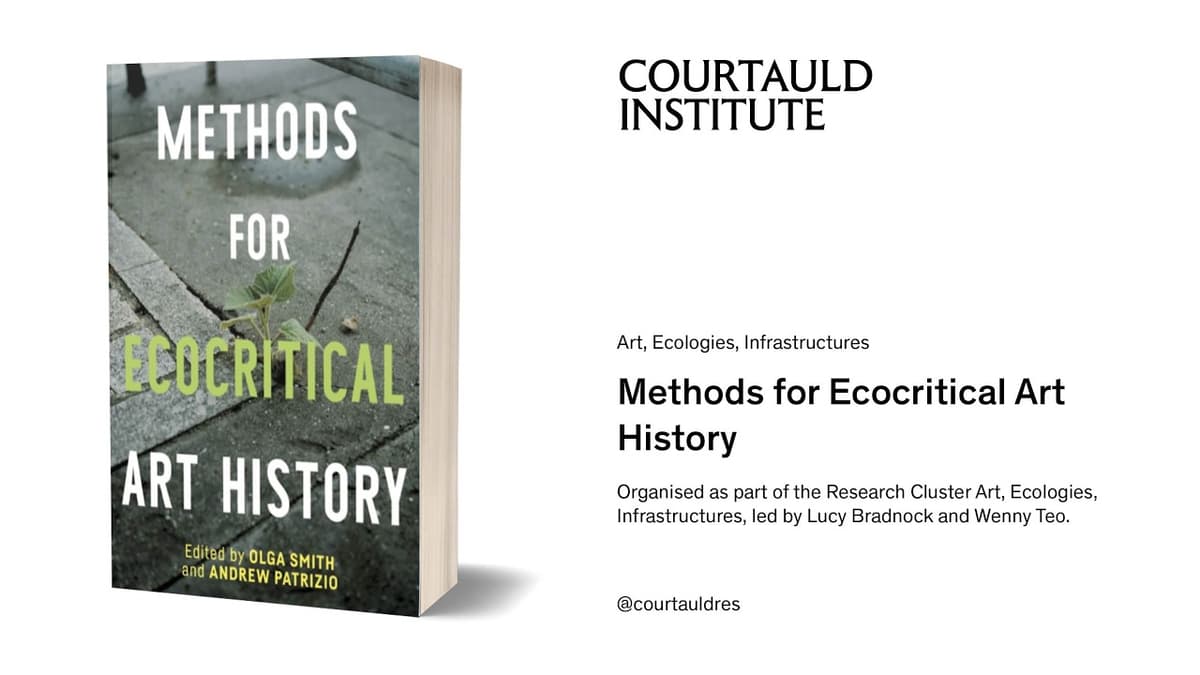
Methods for Ecocritical Art History
Good evening attendees gathered to celebrate the launch of Methods for Eco‑critical Art History, edited by Olga Smith and Andrew Patritio, under the auspices of the CLD Art Ecologies Infrastructure Research Cluster. The event introduced the volume as a practical...