
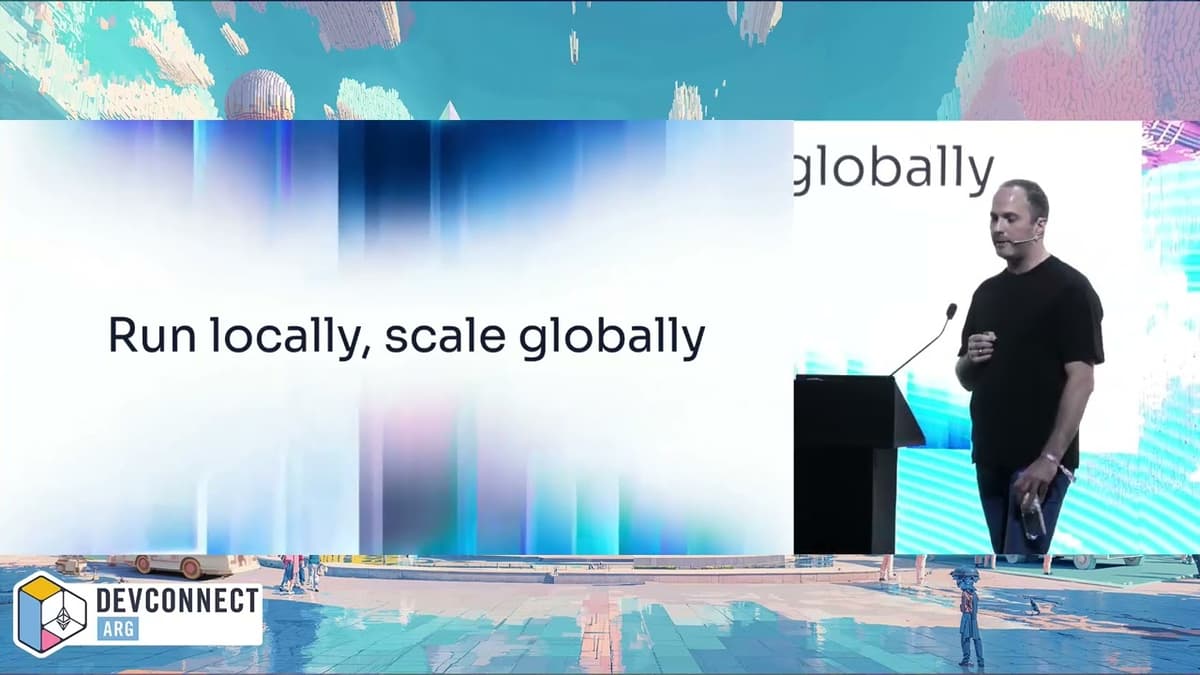
The Blockchain Native Database by Sebastian Lorenz
Good morning everyone. Today Sebastian Lorenz unveiled AMP, a purpose‑built blockchain‑native database designed to treat blockchain data as a first‑class domain rather than an afterthought. By constructing the system from the ground up on modern data‑processing primitives, AMP aims to reconcile the contradictory demands of low‑latency, real‑time application interfaces and the inherent uncertainty of append‑only, re‑org‑prone ledgers. Lorenz highlighted the fundamental mismatch between traditional databases and blockchain workloads: conventional systems view consistency corrections as failure recovery, while blockchain applications must constantly handle block replacements, transaction disappearances, and chain reorganizations. Rather than cobbling together off‑the‑shelf components, AMP leverages Apache Data Fusion for SQL parsing and execution and the Arrow columnar format for in‑memory processing and gRPC transport, delivering both high‑throughput batch queries and sub‑second streaming semantics that are re‑org aware. The demo showcased concrete performance claims: AMP can decode millions of smart‑contract events per second, peaking at roughly four million events per second on an Uniswap swap benchmark, and maintains sub‑second latency at chainhead even on high‑throughput chains like Arbitrum and Solana. It exposes standard SQL, supports user‑defined functions for custom logic, and offers Rust and TypeScript streaming clients with exactly‑once guarantees and durable checkpointing, all packaged as a single binary that scales from local development to globally distributed deployments. For developers and enterprises, AMP promises to eliminate the heavy operational plumbing traditionally required to index and query blockchain state. By providing a declarative, SQL‑centric interface that integrates with existing tooling such as Foundry and Hard‑Hat, it accelerates data‑driven dApp development, enables real‑time analytics, and opens the door for broader ecosystem adoption, including LLM‑powered insights and cross‑chain data products.
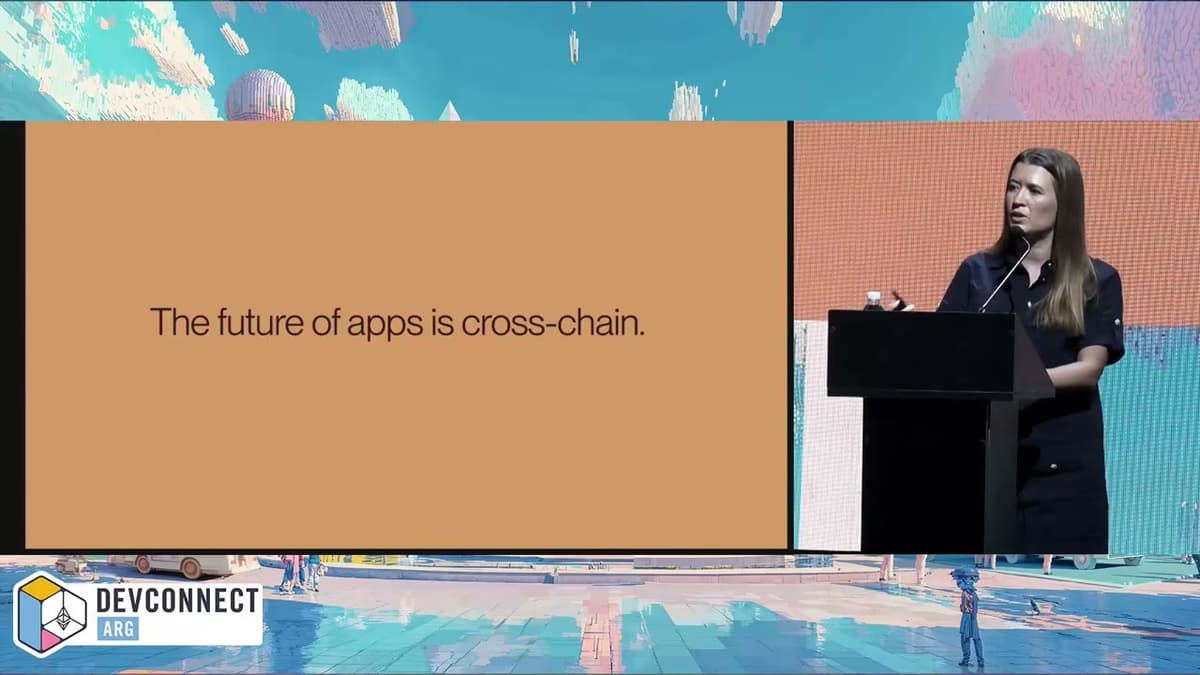
Entering the Cross-Chain Era by Jill Gunter
Great, thank you so much. As co‑founder of Espresso Systems, Jill Gunter opened her talk by announcing that the company’s Ethereum interoperability layer—named Espresso—has been live on mainnet for over a year, securing hundreds of millions of dollars in transactions...

Devconnect ARG - Worlds Fair Lighting Stage
The video opens with a vivid illustration of Argentina’s chronic currency devaluation, tracing the peso’s journey from a 1:1 peg with the U.S. dollar in 1881 to a staggering 1,500‑to‑1 ratio today. The speaker uses the metaphor of a 1,500‑mile‑tall...

Devconnect ARG - Ceibo Room Red Pavilion
The video introduces Stormbit, a DeFi fixed‑term lending platform that eliminates liquidations and over‑collateralization by leveraging zero‑knowledge trust‑less (ZKTLS) proofs to verify borrowers' creditworthiness without revealing their identity. Stormbit argues that DeFi’s $83 billion lending pool is a fraction of the $100 trillion...

Devconnect ARG - XS Yellow Pavilion
The Devconnect ARG‑XS Yellow Pavilion session opened with a personal narrative that linked a background in quantum computing, public‑health safety, and a 6,000‑word essay on coal‑mining protocols to the emerging Ethereum ecosystem, framing the discussion around the timeless nature of...

Devconnect ARG - M2 Yellow Pavilion
The video, presented at DevConnect in Argentina, introduced X402, a new protocol that embeds payment functionality directly into the HTTP stack via the 402 "payment required" status code. By leveraging stablecoins and wallet‑based authentication, X402 aims to eliminate the cumbersome...

Devconnect ARG - M1 Yellow Pavilion
The Devconnect ARG panel explored how institutional finance can gradually migrate to decentralized finance (DeFi) by encoding market rules on Ethereum, while navigating regulatory red tape and compliance constraints. Speakers argued that institutions will seek tightly scoped compliance, incentivizing micro‑funds...
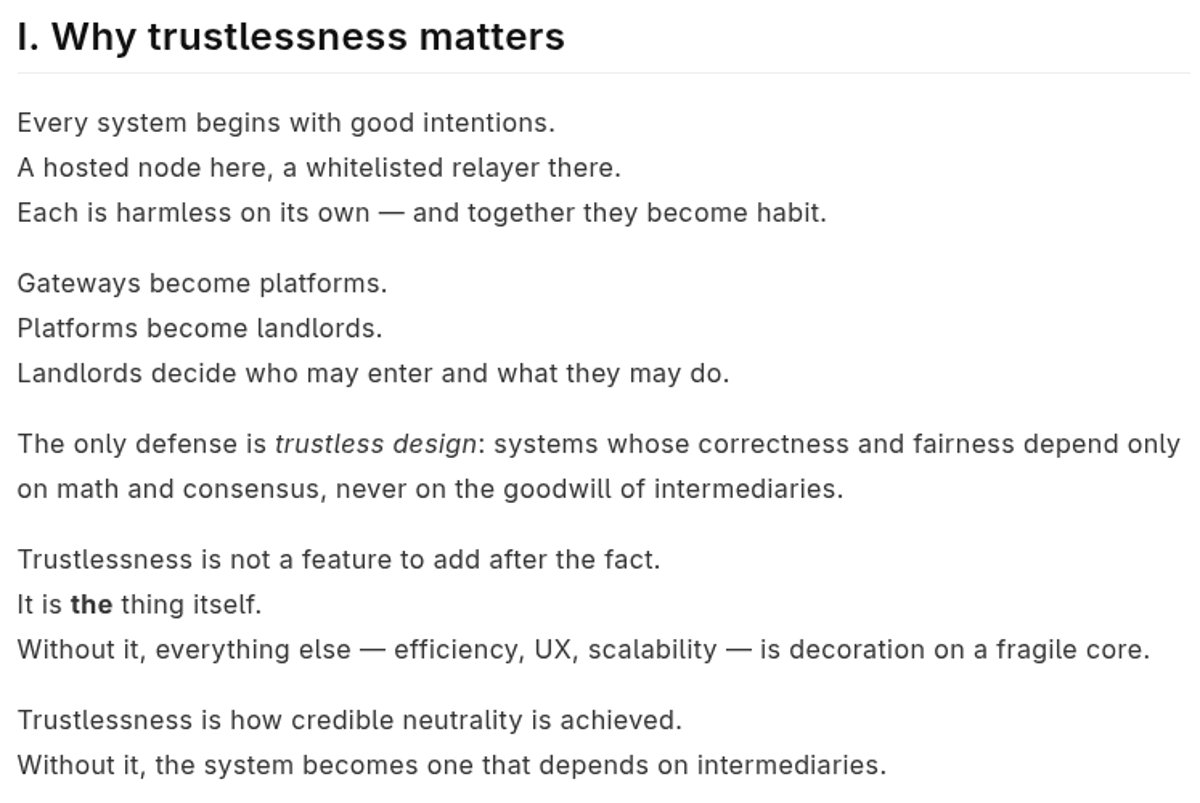
We’ve Officially Signed the Trustless Manifesto
Signed the trustless manifesto! https://t.co/VhHlx3K2vt @thewizardofpos @yoavw https://t.co/lOuz1W7DQL

Devconnect ARG
DevConnect Argentina opened as an Ethereum-focused developer conference dubbed “Ethereum Day,” featuring speakers from the Ethereum Foundation, local builders and application founders. Organizers highlighted Argentina’s outsized crypto adoption—roughly 20% ownership and more than 5 million daily users, or about 10%...

Faster Withdrawals Could Speed Stage‑1 Optimistic Rollups
Some discussion on effects of potentially reducing withdrawal times for stage 1 optimistic rollups: https://t.co/aKDk0n0QRU

Ethereum Scaling Advances, Boosting Network Capacity
Ethereum is scaling.
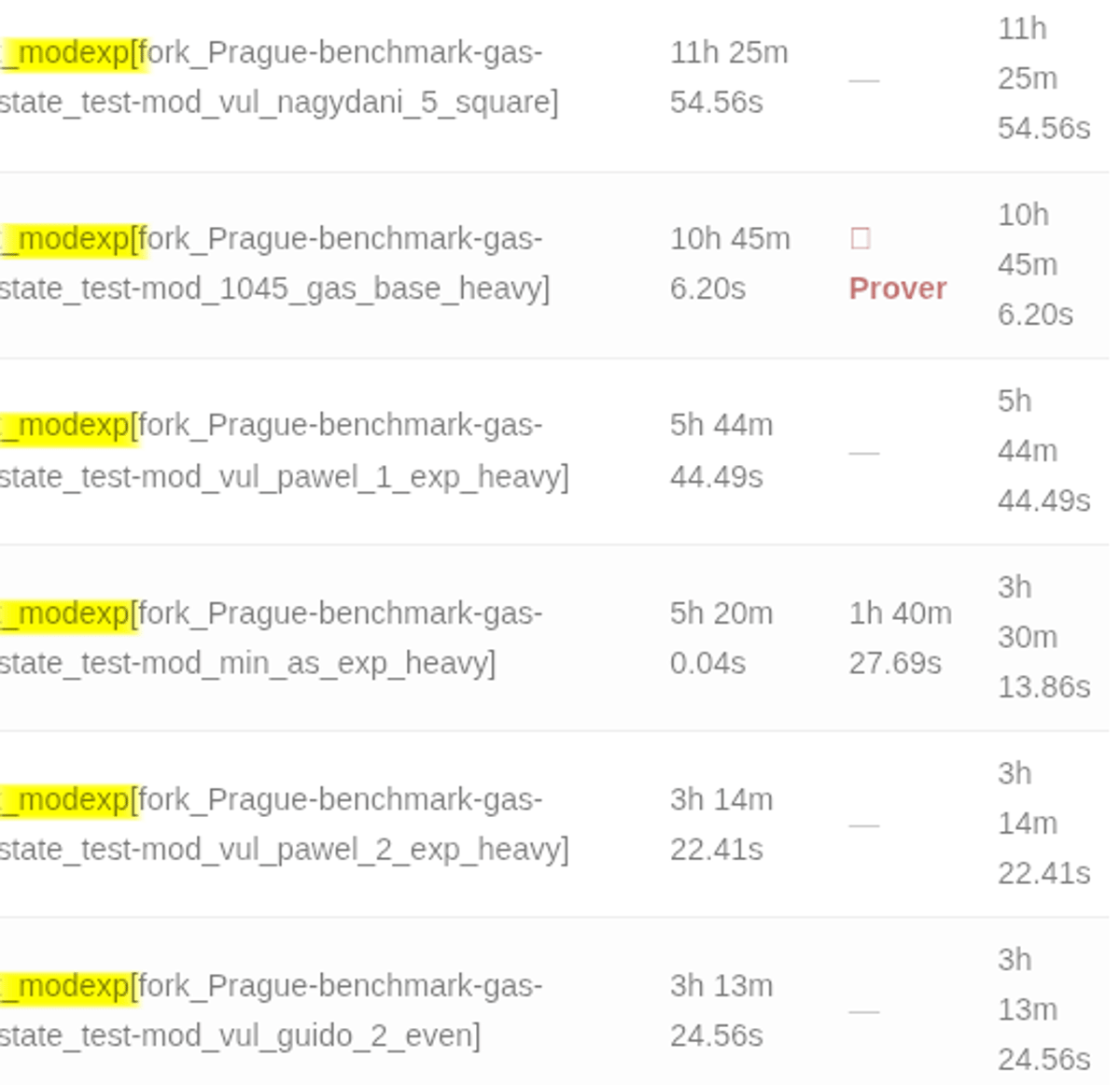
Modexp Kills ZK‑EVM Performance; Propose EIP
Modexp seems to be by far the worst offender in terms of ZK-EVM prover-unfriendliness; up to 50x worse than average blocks. We really should do an EIP to replace the precompile with computationally equivalent EVM code (which would cost more gas) Very...

Ethereum's Key Strength: Its Incorruptibility
Incorruptibility is Ethereum's most important property.

ZKsync’s Underrated Contributions Strengthen Ethereum Ecosystem
ZKsync has been doing a lot of underrated and valuable work in the ethereum ecosystem. Excited to see this come from them!

51% Can't Forge
Regular reminder: A key property of a blockchain is that even a 51% attack *cannot make an invalid block valid*. This means even 51% of validators colluding (or hit by a software bug) cannot steal your assets. However, this property does not...

Devconnect Argentina - The Ethereum Worlds Fair
Devconnect Argentina positions itself as a modern "World's Fair" for Ethereum, running November 17–22 and showcasing the blockchain’s transition from theory to real-world applications. The event markets Ethereum as a global, living network that enables solutions beyond traditional infrastructure, emphasizing...

From Whiteboard to Mainnet Podcast | Episode 3: Proposer-Builder Separation
Guests from academia and the Ethereum Foundation explained why specialized block builders emerged: extracting complex MEV (maximal extractable value) opportunities requires sophisticated tooling and continuous market activity that ordinary validators are ill-equipped to perform, so builders and middleware like MEV-Boost...

Polygon & Sandeep Nailwal: Driving Ethereum Innovation & Impact
I really appreciate both @sandeepnailwal's personal contributions and @0xPolygon's immensely valuable role in the ethereum ecosystem. To recap: * Polygon hosts @Polymarket, which is probably the single most successful example of a "not just boring finance" app that has actually been successful...

Step-by-Step GKR Tutorial for Beginners
A GKR tutorial: https://t.co/Oo7jraC4sy

Report Cryptographic Overhead Ratios, Not Just Ops per Second
I wish more ZK and FHE people would give their overhead as a ratio (time to compute in-cryptography vs time to compute raw), rather than just saying "we can do N ops per second" It's more hardware-independent, and it gives a...

Greg Maxwell Defends Free, Market‑driven Resource Allocation over Censorship
Greg Maxwell defends a principled commitment to freedom and open market-based resource allocation against the populist desire to censor the Current Hated Thing.

Pico Prism Slashes ZK‑EVM Proving Time, Boosts Ethereum Scaling
Excited to see @brevis_zk's Pico Prism entering the ZK-EVM proving arena! An important step forward in ZK-EVM proving speed and diversity.