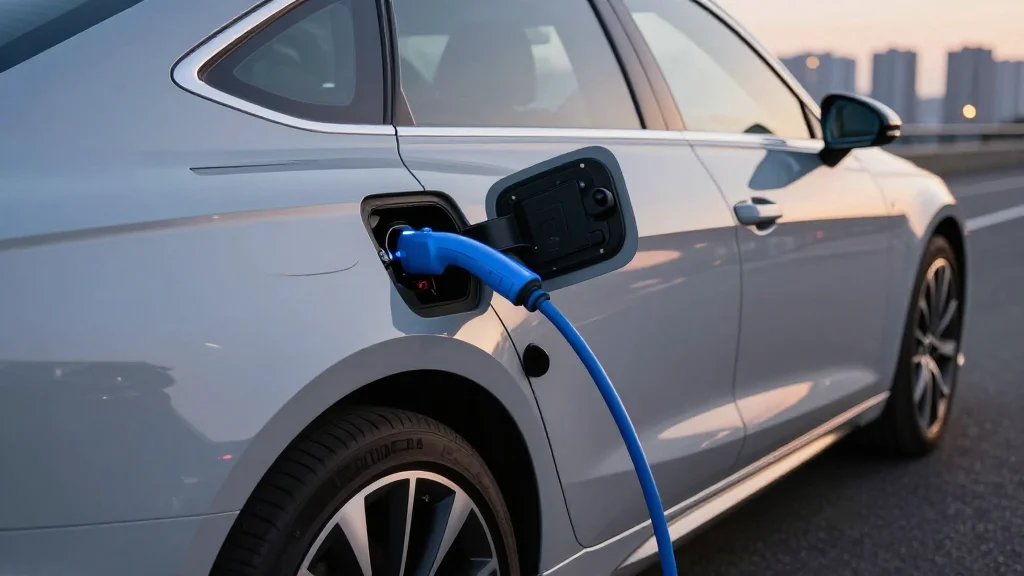
Audi Launches $4.4 B Electric Sedan as VW Vows New EV Every Two Weeks in China

Companies Mentioned
Why It Matters
The Chinese EV market is the world’s largest, accounting for over 16 million units sold in 2025. Foreign automakers that fail to adapt their technology stacks risk losing relevance in a market that now dictates global EV trends. By committing $4.4 bn to a dedicated electric plant and pledging a relentless launch cadence, Audi and Volkswagen signal that their CTOs are overhauling powertrain, software and supply‑chain strategies to compete with Chinese firms that already dominate 69.5 % of passenger‑car sales. For CTOs across the industry, the moves illustrate a broader shift: success will depend less on traditional engineering prowess and more on the ability to integrate local software ecosystems, secure battery supply, and deliver rapid OTA updates. The outcomes in China will likely set benchmarks for how multinational OEMs structure their global R&D, partnership models and manufacturing footprints in the coming decade.
Key Takeaways
- •Audi's A6L e‑tron launches from a 30 billion‑yuan ($4.4 bn) plant dedicated to EVs in Changchun.
- •Volkswagen vows a new EV every two weeks in 2026, its biggest electric‑mobility push in China.
- •NEVs made up >50 % of Chinese new‑car sales in 2025; domestic brands hold 69.5 % market share.
- •Audi partners with Huawei, using the Qiankun smart‑driving system with an 815 km CLTC range.
- •CTOs must redesign powertrain architectures, supply chains and software stacks to keep pace with Chinese rivals.
Pulse Analysis
The accelerated electrification push by Audi and Volkswagen marks a strategic inflection point for global automotive CTOs. Historically, foreign OEMs relied on a "German engineering" halo to command premium pricing, but Chinese competitors have eroded that advantage by delivering comparable performance at lower cost, backed by sophisticated AI‑driven software. By embedding Huawei's Qiankun platform, Audi acknowledges that future differentiation will stem from data, connectivity and OTA capabilities rather than pure hardware.
Volkswagen's announced cadence—one new model every two weeks—mirrors the rapid product cycles of Chinese tech firms, suggesting a convergence of automotive and consumer‑electronics development timelines. This shift forces CTOs to adopt modular, software‑first vehicle architectures that can be updated post‑sale, a practice already standard in smartphones but still nascent in the auto sector. The financial commitment of $4.4 bn underscores that such transformation requires deep capital investment in localized R&D, battery gigafactories and high‑speed digital infrastructure.
If these initiatives succeed, they could recalibrate the global EV value chain. Foreign OEMs may shift more of their engineering talent to China, creating hybrid teams that blend German reliability with Chinese agility. Conversely, a failure to achieve the promised launch cadence or software integration could accelerate the decline of foreign market share, reinforcing the dominance of domestic players like BYD and Nio. The coming months will test whether the CTOs' new playbooks can deliver the speed, cost efficiency and digital experience that Chinese consumers now expect.
Audi launches $4.4 B electric sedan as VW vows new EV every two weeks in China
Comments
Want to join the conversation?
Loading comments...