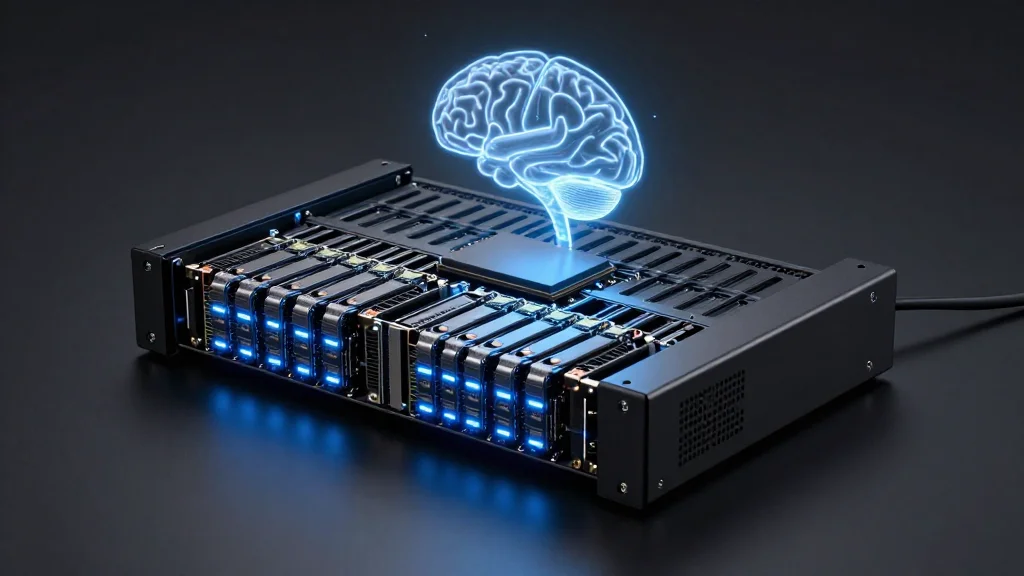
Nvidia Accelerates Vera Rubin Production, Targeting 350 Partners for AI Factories

Companies Mentioned

Why It Matters
The Vera Rubin platform represents the first fully integrated hardware stack purpose‑built for agentic AI, a workload class that blends reasoning, tool use and autonomous decision‑making. By delivering ten‑fold throughput gains and dramatically lower token costs, Nvidia is positioning itself as the primary supplier of the compute fabric that will power future AI‑driven enterprises, from finance to autonomous systems. The scale of the supply‑chain rollout—350 partners in 30 countries—also signals a rapid commoditization of AI‑centric data center hardware, potentially lowering barriers to entry for midsize firms seeking to adopt advanced AI agents. For CTOs, the shift to token‑per‑dollar economics means procurement decisions will increasingly prioritize CPU‑GPU co‑design, interconnect efficiency, and power‑aware networking. Vera Rubin’s liquid‑cooled, high‑density architecture could reshape data‑center floor plans, cooling strategies, and capacity planning, while the promised performance uplift may accelerate time‑to‑value for AI initiatives across industries.
Key Takeaways
- •Nvidia moves Vera Rubin platform into volume production at Computex, with >350 partners in 30 countries.
- •The NVL72 rack integrates 72 Rubin GPUs and 36 Vera CPUs, delivering 10× agentic AI throughput and 0.1× token cost.
- •Vera CPU features 227 billion transistors, offering 1.8× faster task completion versus x86 CPUs.
- •Early adopters include NYSE, Anthropic, Oracle Cloud Infrastructure, ByteDance, and major system integrators Dell, HPE, Lenovo, Supermicro.
- •New Spectrum‑X Ethernet Photonics switches claim five‑fold power efficiency and 1.3× faster deployment.
Pulse Analysis
Nvidia’s aggressive push to mass‑produce Vera Rubin is more than a product launch; it is a strategic bet that the AI market will coalesce around a unified hardware ecosystem. Historically, AI infrastructure has been fragmented—GPUs from Nvidia, CPUs from Intel or AMD, networking from Mellanox or Cisco—forcing CTOs to stitch together disparate components. By delivering a tightly coupled stack that includes GPU, CPU, DPU, NIC and switch, Nvidia reduces integration risk and operational complexity, a compelling value proposition for enterprises that lack deep hardware expertise.
The token‑per‑dollar metric introduced by Nvidia reframes the ROI conversation. Traditional benchmarks focus on FLOPS per dollar, but agentic AI workloads are dominated by latency‑sensitive, high‑throughput token processing. If Vera Rubin can indeed deliver ten‑fold throughput at a tenth of the token cost, the total cost of ownership for large‑scale AI services could shrink dramatically, accelerating adoption in sectors like finance, where NYSE processes over 1.1 trillion messages daily, and in autonomous research labs such as Anthropic. This shift may also pressure competing silicon vendors to develop comparable agentic‑AI‑optimized CPUs, potentially igniting a new wave of architecture‑specific competition.
Looking ahead, the success of Vera Rubin will hinge on real‑world validation. Early benchmarks are promising, but large‑scale deployments will test cooling, reliability, and software stack maturity. Nvidia’s extensive partner network should help smooth rollout, yet the complexity of integrating co‑packaged optics and liquid cooling at hyperscale remains a risk. If those challenges are managed, Vera Rubin could become the de‑facto standard for AI factories, cementing Nvidia’s dominance beyond GPUs and reshaping the data‑center procurement landscape for years to come.
Nvidia Accelerates Vera Rubin Production, Targeting 350 Partners for AI Factories
Comments
Want to join the conversation?
Loading comments...