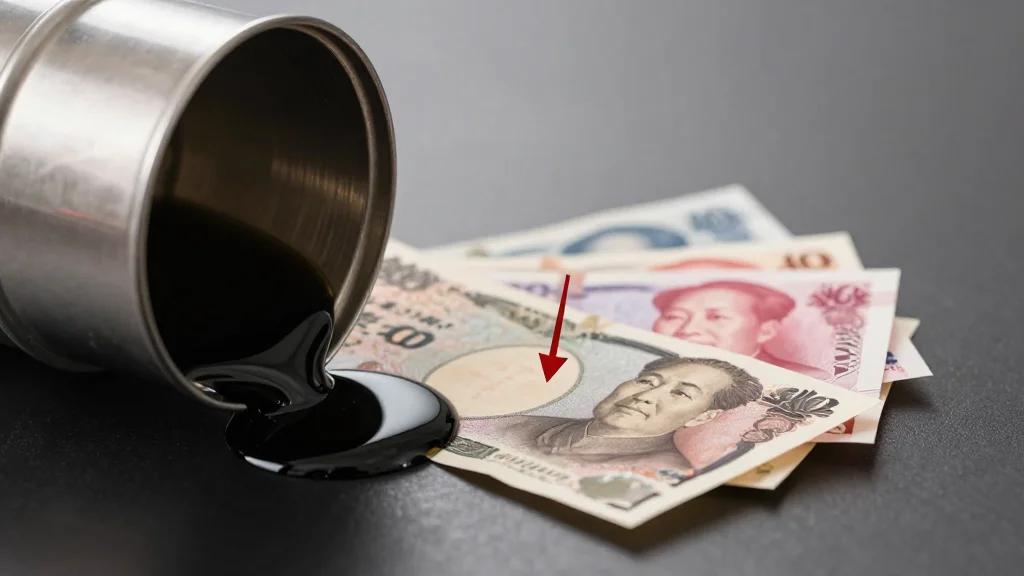
Asian Currencies Slide as Oil Tops $110, LNG Soars 143% Amid Crisis

Why It Matters
The currency fallout from the US‑Israel‑Iran crisis illustrates how geopolitical shocks can quickly translate into macro‑economic stress for energy‑importing economies. Depreciating currencies raise the cost of imported fuel, food and industrial inputs, feeding inflation and eroding real incomes across the region. For investors, the episode underscores the importance of monitoring geopolitical risk as a driver of FX volatility and sovereign credit risk. In the longer term, repeated energy‑price spikes could accelerate a shift toward diversified energy sourcing and greater hedging of commodity exposure. Asian economies may also see a re‑evaluation of fiscal buffers and monetary policy frameworks to better absorb external shocks, influencing the trajectory of growth and financial stability in the coming years.
Key Takeaways
- •Oil prices surged over 50% to $110‑$116 per barrel amid the US‑Israel‑Iran crisis.
- •LNG prices jumped 143%, the highest increase in three years, tightening Asian energy supplies.
- •The Japanese yen, South Korean won and Philippine peso each weakened more than 3% against the dollar.
- •IMF downgraded the Philippines' growth outlook to 3.6%‑4.4% from an earlier 5%‑6% forecast.
- •Central banks in Japan, South Korea and the Philippines are delaying rate cuts, keeping monetary policy tight.
Pulse Analysis
The current FX turbulence is a textbook case of a supply‑side shock spilling over into monetary and fiscal domains. Historically, sharp oil price spikes have forced import‑dependent economies to tighten policy, as seen during the 2008 commodity boom. This time, the added dimension of LNG scarcity—critical for petrochemical and fertilizer production—creates a dual‑shock scenario that amplifies inflationary pressures. The yen’s slide, for instance, is not merely a reaction to higher import bills but also reflects investors’ risk aversion to a region where growth is already constrained by demographic headwinds.
From a strategic perspective, the crisis may accelerate the region’s pivot toward energy diversification. Countries like Japan and South Korea have already begun expanding LNG contracts with the United States and Qatar, while China is deepening its ties with Russian oil and gas. These moves could mitigate future currency shocks but will require substantial capital outlays and may reshape trade balances over the medium term. Investors should therefore monitor not only price movements but also policy announcements on energy procurement and currency intervention.
Finally, the episode highlights the growing interdependence between geopolitical events and financial markets. As central banks grapple with the trade‑off between defending currency stability and supporting growth, the policy space in many Asian economies is narrowing. Market participants should prepare for a prolonged period of heightened volatility, with potential spillovers into equity markets, sovereign bond yields and cross‑border capital flows. The ability of policymakers to communicate clear, data‑driven strategies will be pivotal in anchoring expectations and preventing a self‑fulfilling spiral of depreciation and inflation.
Asian Currencies Slide as Oil Tops $110, LNG Soars 143% Amid Crisis
Comments
Want to join the conversation?
Loading comments...