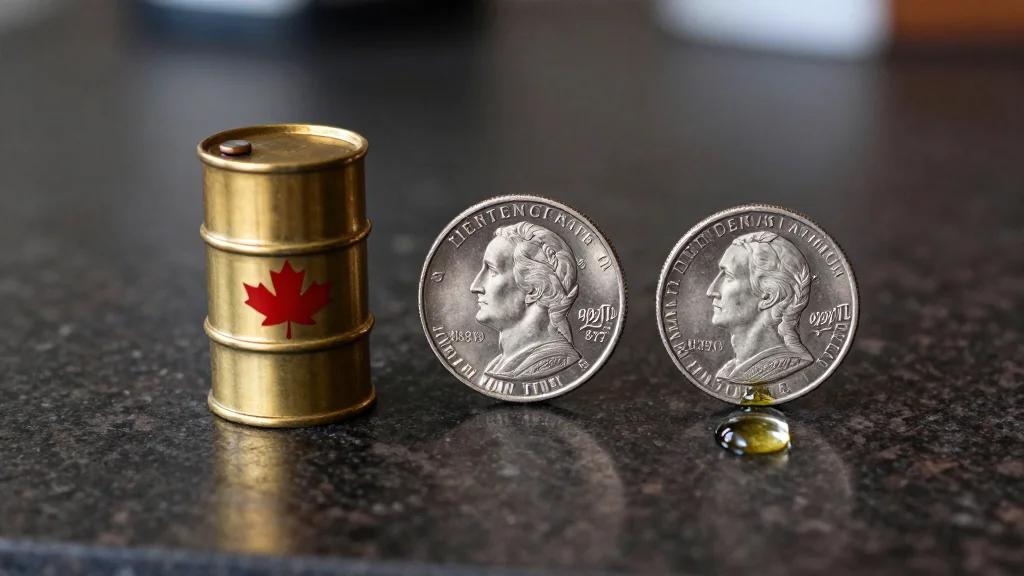
USD/CAD Stalls Near 1.3840 as Oil Spikes and Fed Hawkishness Offset Each Other

Why It Matters
The USD/CAD pair is a bellwether for the broader North‑American economy because it reflects both commodity price movements and monetary‑policy expectations. A sustained rise in oil prices can boost Canada’s trade surplus, improve fiscal balances, and support risk‑on sentiment, while a hawkish Fed stance can tighten global liquidity and elevate the dollar’s safe‑haven appeal. Traders, corporates, and policymakers watch this pair to gauge the balance of trade‑related strength versus interest‑rate differentials, making its stability—or lack thereof—a key indicator of regional economic health. Moreover, the current stalemate underscores how external geopolitical shocks can quickly offset domestic monetary policy signals. As the U.S. and Iran tensions flare, the resulting risk‑aversion can reinforce the dollar even as commodity‑driven economies like Canada benefit from higher oil prices. Understanding this interplay helps market participants anticipate future volatility and adjust hedging strategies accordingly.
Key Takeaways
- •USD/CAD trades around 1.3840, flat after brief intraday rise
- •WTI crude jumps nearly 7% on Monday amid US‑Iran tensions
- •Higher oil prices support the Canadian dollar, limiting USD gains
- •Fed hawkish expectations keep U.S. Treasury yields rising
- •Technical resistance near 1.3860, support around 1.3820; next catalysts: OPEC+, U.S. CPI, Canada employment data
Pulse Analysis
The current USD/CAD equilibrium is a textbook case of competing macro forces neutralising each other. Historically, oil price spikes have delivered a 0.5‑1.0% lift to the loonie over a week, but the recent 7% surge is unprecedented in the short term and could have a more pronounced effect if it persists. At the same time, the Fed’s implied rate path—still anchored to a higher‑for‑longer stance—has been a consistent driver of dollar strength across major pairs. The convergence of these two dynamics creates a narrow trading range that rewards range‑bound strategies but penalises directional bets.
From a risk‑management perspective, traders should consider overlaying oil‑price hedges or using options to protect against sudden reversals in either direction. The upcoming U.S. core CPI release will be a litmus test for inflation momentum; a reading above expectations could reinforce hawkish bets and push the pair toward 1.3900. Conversely, any de‑escalation in Middle‑East tensions that cools oil prices could free the loonie to rally toward 1.3800.
Looking ahead, the pair’s trajectory will likely mirror the broader narrative of how commodity‑driven economies adapt to a tightening monetary environment. If the Fed signals a pause or a more dovish tone in its minutes, the dollar could lose its edge, allowing oil‑driven gains to dominate. If, however, oil prices retreat or OPEC+ signals increased supply, the loonie’s upside may be capped, keeping the pair in a tight band. In either scenario, the USD/CAD remains a critical gauge for investors tracking the intersection of energy markets and monetary policy.
USD/CAD stalls near 1.3840 as oil spikes and Fed hawkishness offset each other
Comments
Want to join the conversation?
Loading comments...