CVE-2026-3854 GitHub Flaw Enables Remote Code Execution
Key Takeaways
- •CVE‑2026‑3854 allows RCE via a single git push.
- •Affected products include GitHub Enterprise Cloud and Server versions up to 3.19.3.
- •GitHub patched the flaw within two hours of disclosure.
- •88% of Enterprise Server instances remain unpatched, per Wiz data.
- •Vulnerability highlights risks of unsanitized metadata in multi‑service architectures.
Pulse Analysis
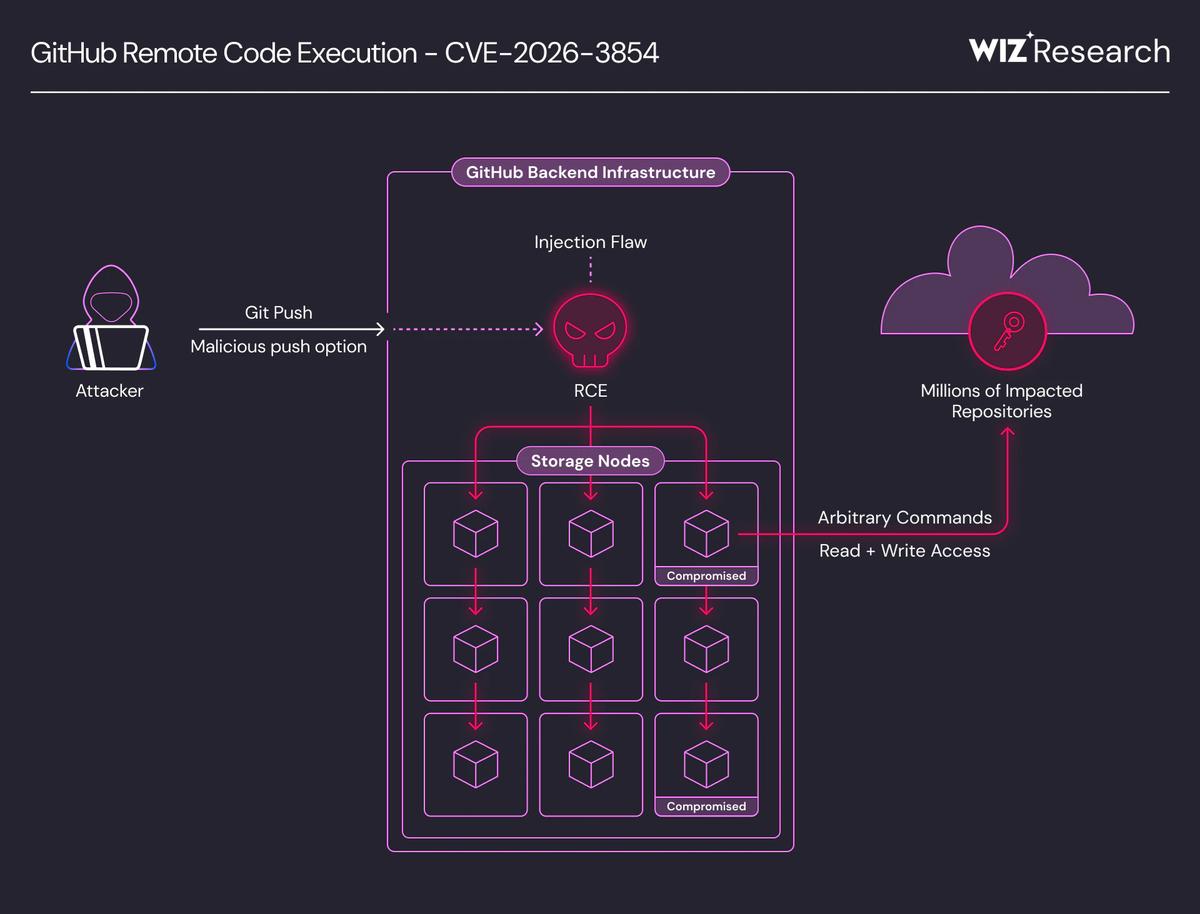
The newly disclosed CVE‑2026‑3854 is a command‑injection flaw that exploits the way GitHub processes user‑supplied push‑option values. During a standard git push, these options are concatenated into internal service headers without proper sanitization, allowing an attacker to inject additional metadata fields. When downstream services interpret the malformed header, they execute arbitrary commands under the git service user, granting full remote code execution on both GitHub.com’s shared storage nodes and on‑premise Enterprise Server instances.
GitHub’s response was unusually swift: the vulnerability was reported on March 4, 2026, and patches for Enterprise Server versions 3.14.24, 3.15.19, 3.16.15, 3.17.12, 3.18.6, and 3.19.3 were released within two hours. Despite the rapid fix, Wiz’s monitoring indicates that about 88 % of Enterprise Server deployments have not yet applied the updates, leaving a large attack surface. For organizations that rely on GitHub’s multi‑tenant architecture, the risk extends beyond code theft; a successful exploit could compromise all repositories on a shared node, alter configuration files, and exfiltrate sensitive data.
Beyond the immediate remediation, CVE‑2026‑3854 underscores a systemic challenge in modern software supply chains: the trust placed in internal protocols that shuttle untrusted data across heterogeneous services. The flaw illustrates how a single unsanitized field can cascade into a full‑system breach, especially when services are written in different languages and assume implicit safety. Security teams should prioritize rigorous input validation, adopt zero‑trust principles for inter‑service communication, and consider automated fuzzing of internal APIs. The incident also highlights the growing role of AI‑assisted vulnerability discovery, suggesting that future threats may emerge from increasingly sophisticated analysis of closed‑source code.
CVE-2026-3854 GitHub flaw enables remote code execution
Comments
Want to join the conversation?