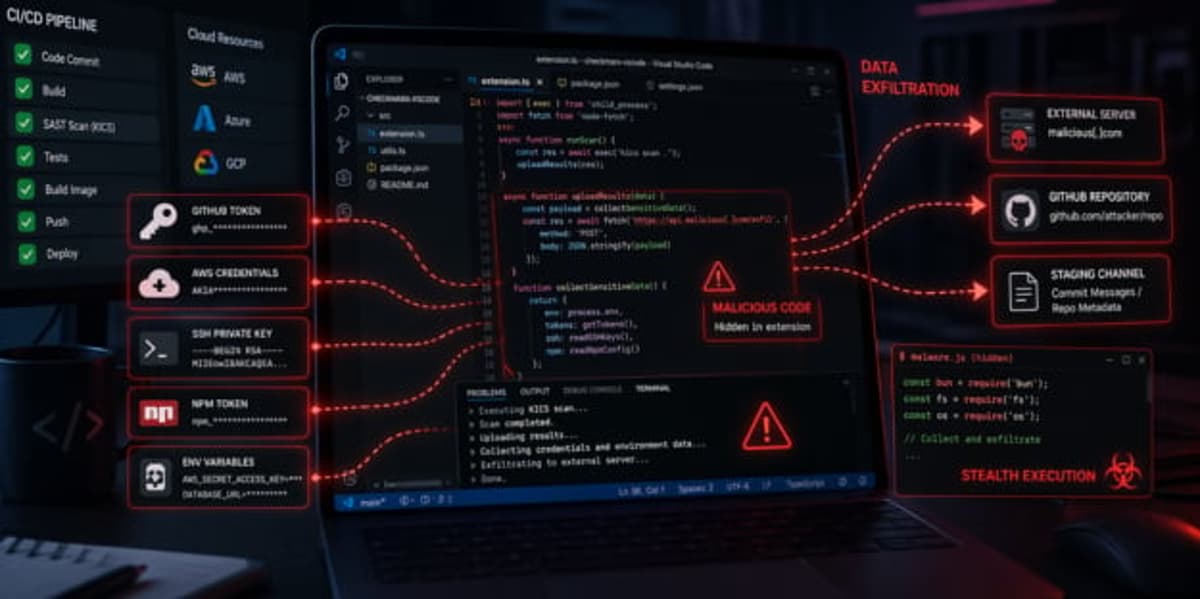
Checkmarx Supply Chain Attack Exploits Docker Images and CI/CD Pipelines
Why It Matters
The breach shows how a single compromised developer tool can expose vast amounts of infrastructure secrets, amplifying risk across multiple organizations. It forces enterprises to rethink supply‑chain security and enforce zero‑trust controls in CI/CD environments.
Key Takeaways
- •Attack poisoned official Checkmarx/KICS Docker images on Docker Hub.
- •Malicious VS Code extensions delivered second‑stage payload stealing credentials.
- •Threat group TeamPCP leveraged CI/CD pipelines to exfiltrate secrets.
- •Recommendation: pin Docker images to immutable digests and rotate credentials.
- •Similar supply‑chain compromise observed in Bitwarden CLI.
Pulse Analysis
Supply‑chain attacks have moved from peripheral software updates to the heart of development workflows. In the recent Checkmarx incident, attackers hijacked the official KICS Docker Hub repository, swapping legitimate tags with malicious images that embedded hidden data‑collection binaries. By targeting a tool that scans Terraform and Kubernetes configurations, the threat actors gained access to scan outputs that often contain plaintext credentials, cloud tokens, and other secrets. This method of Docker image poisoning demonstrates how trusted container registries can become a covert entry point for large‑scale credential theft.
The compromise extended beyond containers to compromised VS Code extensions, where specific versions silently downloaded a second‑stage payload built on the Bun runtime. The payload, mcpAddon.js, harvested GitHub tokens, SSH keys, npm configs, and environment variables, encrypting and exfiltrating them to attacker‑controlled repositories. Leveraging the stolen GitHub credentials, the group automated the creation of malicious workflow files in victim repositories, enabling continuous secret extraction without detection. A parallel investigation revealed a similar attack on the Bitwarden CLI, indicating that the adversary, identified as TeamPCP, is pursuing a coordinated campaign against developer‑centric tools.
For organizations, the incident is a wake‑up call to embed supply‑chain hygiene into DevSecOps practices. Immediate steps include purging compromised Docker images and extensions, pinning dependencies to immutable digests, and rotating all potentially exposed credentials. Longer‑term defenses require strict least‑privilege token policies, workflow approval gates, and continuous monitoring for anomalous runtime activity. As supply‑chain threats become a primary vector, adopting zero‑trust principles across CI/CD pipelines and maintaining up‑to‑date SBOMs are essential to limit blast radius and protect critical infrastructure.
Checkmarx Supply Chain Attack Exploits Docker Images and CI/CD Pipelines
Comments
Want to join the conversation?
Loading comments...