ClickUp Data Leak Exposes Enterprise Emails for Over a Year
Companies Mentioned
Why It Matters
The exposure of thousands of enterprise emails and internal development signals heightens the risk of sophisticated social engineering campaigns, underscoring the critical need for robust SaaS security controls. It also serves as a cautionary example for all cloud‑based service providers about the dangers of hard‑coded credentials.
Key Takeaways
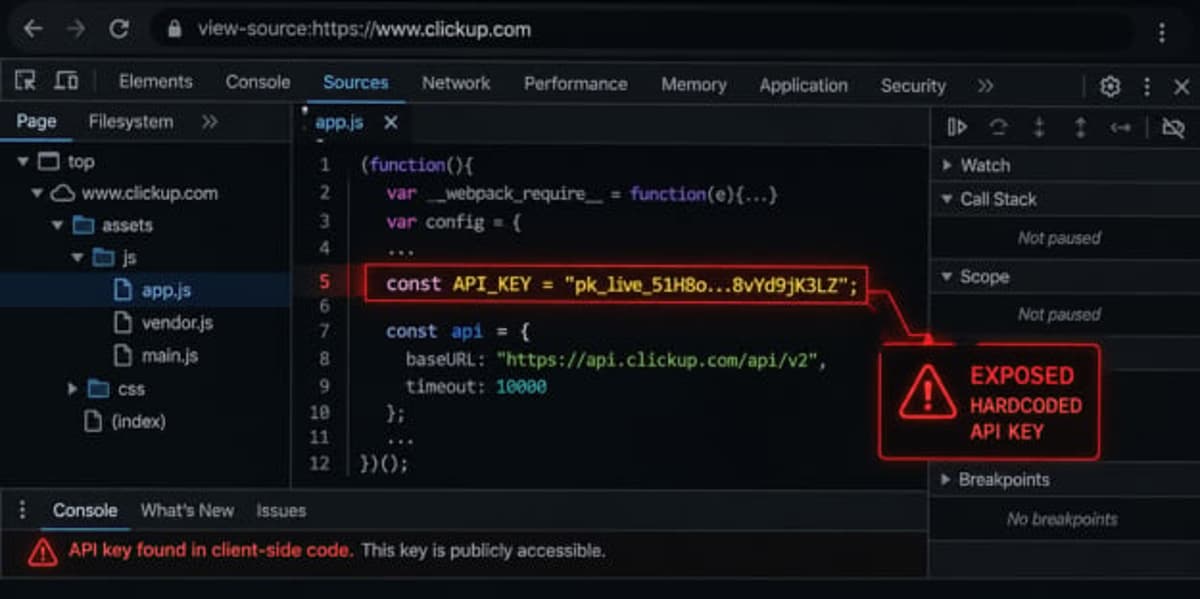
- •Hardcoded API key exposed 959 corporate emails and 3,165 feature flags
- •Vulnerability persisted from early 2025 through April 2026
- •Lack of access controls enables unauthenticated data extraction
- •Exposure raises phishing and credential‑stuffing risk for targeted organizations
- •Incident underscores need for API key hygiene and zero‑trust SaaS policies
Pulse Analysis
The ClickUp data leak illustrates how a single misconfiguration can cascade into a large‑scale breach. By embedding a third‑party API key in client‑side JavaScript, ClickUp unintentionally granted public access to an endpoint that returned email addresses and internal feature flags. Researchers were able to pull the data with a simple GET request, exposing nearly a thousand employee contacts from high‑profile corporations and government agencies. The incident remained unresolved for more than a year, highlighting gaps in secure software development lifecycles and the importance of rigorous code reviews for public‑facing assets.
For organizations that rely heavily on SaaS platforms, the breach reinforces the urgency of tightening credential management and adopting zero‑trust principles. Hard‑coded secrets should be eliminated, and any API tokens used in front‑end code must be scoped, short‑lived, and rotated regularly. Continuous monitoring of API usage, coupled with anomaly detection, can flag unexpected access patterns before data is exfiltrated. Moreover, enforcing MFA, conditional access, and robust email security protocols such as DMARC, DKIM, and SPF reduces the attack surface that exposed credentials can amplify.
Looking ahead, the ClickUp episode is likely to spur industry‑wide audits of client‑side code and third‑party integrations. Vendors are expected to adopt stricter supply‑chain security standards, while enterprises will prioritize SaaS risk assessments and automated remediation workflows. As regulators increasingly focus on data protection, failure to secure API keys could invite compliance penalties alongside reputational damage. Embracing a zero‑trust architecture—where every request is verified regardless of origin—offers the most resilient defense against similar exposures in the future.
ClickUp Data Leak Exposes Enterprise Emails for Over a Year
Comments
Want to join the conversation?
Loading comments...