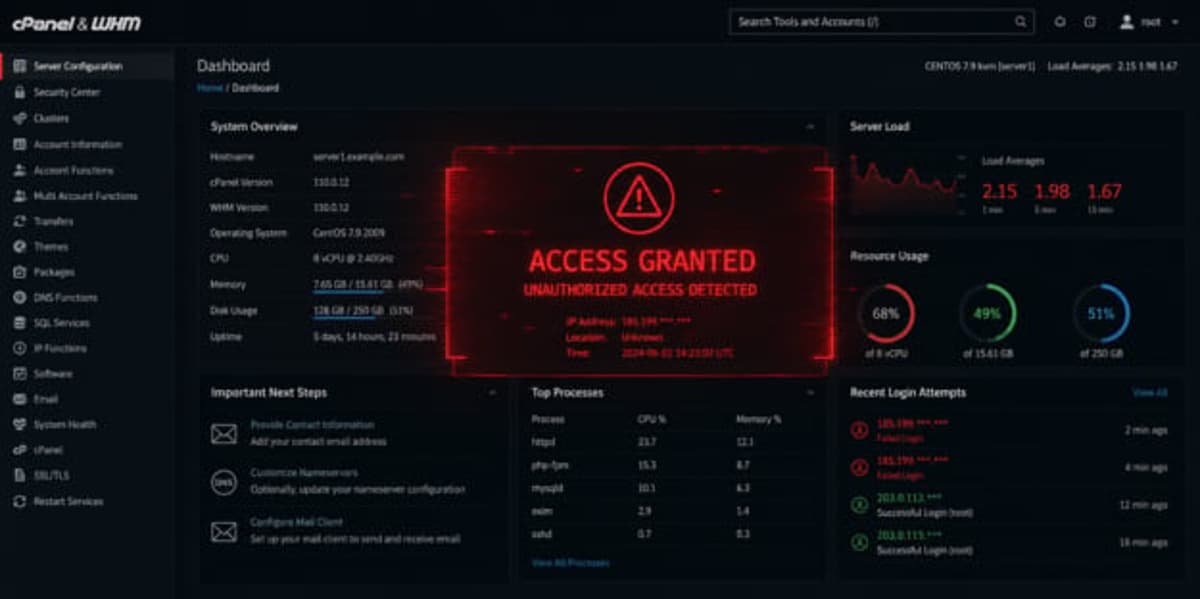
CPanel Vulnerability Exposes Servers to Takeover
Why It Matters
The vulnerability threatens the core management layer of thousands of web servers, making rapid remediation essential to prevent widespread data loss and service disruption.
Key Takeaways
- •Unauthenticated bypass lets attackers take full WHM control
- •All supported cPanel versions are vulnerable, affecting thousands of servers
- •Emergency patches released; immediate upgrade required to prevent exploitation
- •WatchTower provides detection script for vulnerable hosts
- •Enforcing MFA, IP allowlists, and zero‑trust reduces breach impact
Pulse Analysis
The latest cPanel and Web Host Manager (WHM) flaw, catalogued as CVE‑2026‑41940, is an unauthenticated authentication bypass that can grant an attacker root‑level access to the management plane of any affected server. Because cPanel sits in front of millions of websites, a successful exploit enables full control over web files, databases, email accounts and configuration settings. The vulnerability spans all currently supported cPanel releases, meaning shared‑hosting providers, managed WordPress platforms and enterprise data centers are all exposed. Early reports already show exploitation in the wild, prompting cPanel to issue an emergency patch on April 28, 2026.
The incident underscores a broader shift in cyber‑threats toward compromising centralized admin interfaces. When a single control plane like WHM is compromised, the attacker can cascade across hundreds or thousands of downstream sites, amplifying the blast radius. This reality accelerates adoption of zero‑trust architectures that treat every administrative request as untrusted, enforce strict verification, and segment access to critical services. Vendors and hosting operators are now pressured to redesign privilege models, limit root usage, and integrate multi‑factor authentication to mitigate the systemic risk of such high‑value targets.
Practically, administrators must apply cPanel’s latest security update immediately and verify that the patch is active across all nodes. WatchTower’s open‑source detection script offers a quick way to scan for vulnerable instances before they are exploited. Complementary controls—mandatory MFA, IP allowlisting, VPN‑only WHM access, and continuous authentication logging—provide layered defense against future bypass attempts. Organizations should also rehearse incident‑response playbooks that include control‑plane compromise scenarios and maintain immutable backups for rapid recovery. By combining rapid patching with zero‑trust principles, the hosting ecosystem can reduce exposure and restore confidence in its core management tools.
cPanel Vulnerability Exposes Servers to Takeover
Comments
Want to join the conversation?
Loading comments...