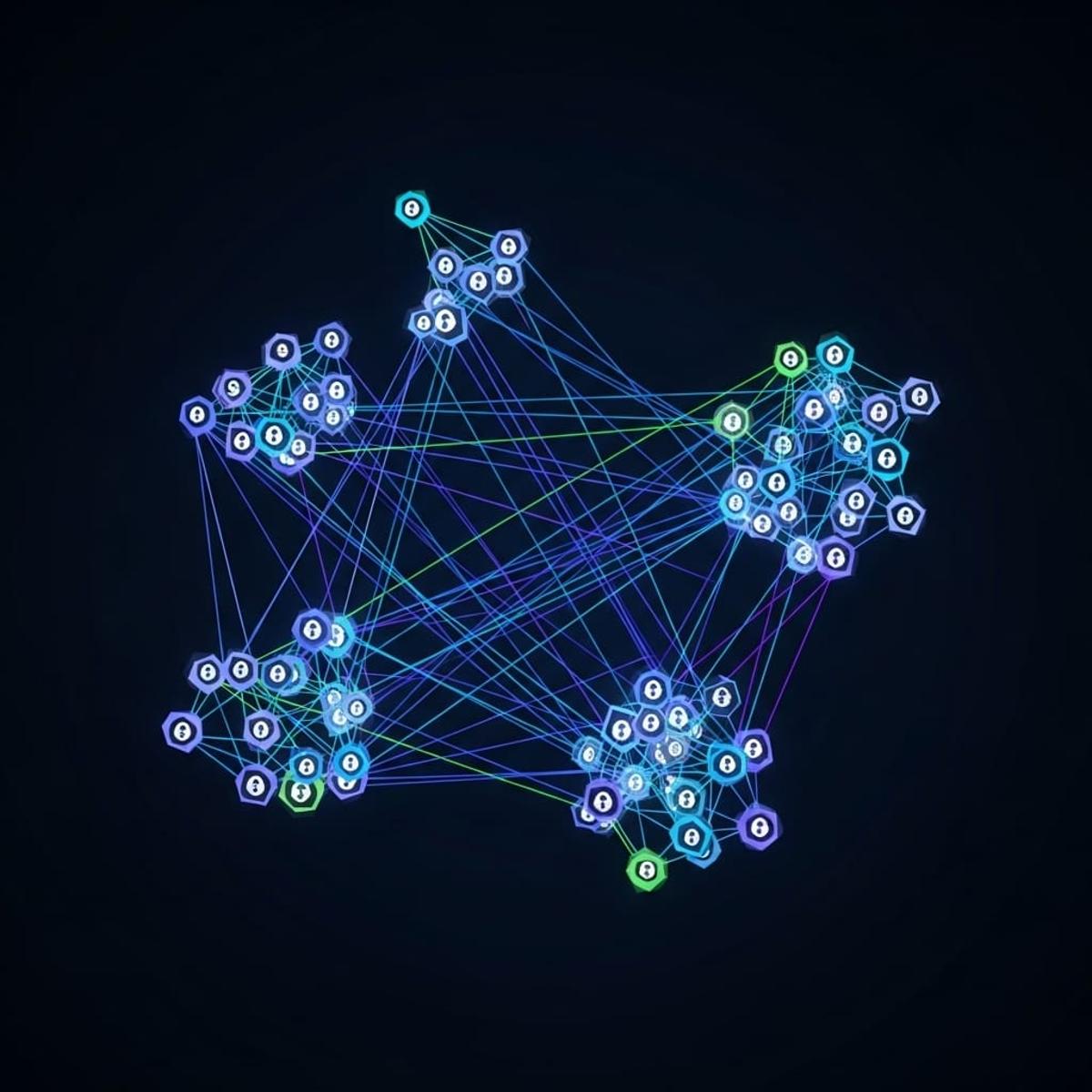
Fedgraph-Vasp Achieves 0.855 AML Accuracy with Post-Quantum Privacy Preservation
•February 3, 2026
0
Why It Matters
The approach reconciles regulatory AML obligations with user privacy, offering VASPs a compliant, future‑proof analytics tool. Its quantum‑resistant design safeguards the collaborative model against emerging cryptographic threats.
Key Takeaways
- •FedGraph-VASP reaches 0.855 AML accuracy
- •Uses Kyber-512 and AES-256-GCM for quantum resistance
- •Improves performance 12.1% on Bitcoin graph data
- •Embedding exchange works best on dense transaction graphs
- •Privacy audit shows embeddings low invertibility (R²=0.32)
Pulse Analysis
Anti‑money‑laundering compliance has become a strategic imperative for virtual asset service providers (VASPs) as regulators tighten the FATF Travel Rule. Traditional centralized analytics expose sensitive transaction histories, creating legal and competitive risks. Federated learning offers a way to pool insights across institutions while keeping raw data behind firewalls, but most implementations lack robust cryptographic guarantees, leaving them vulnerable to both data leakage and future quantum attacks.
FedGraph‑VASP advances the state of the art by marrying federated graph learning with post‑quantum security. The Boundary Embedding Exchange protocol transmits compressed graph embeddings rather than raw node features or model weights, dramatically reducing the attack surface. By encrypting these embeddings with the NIST‑standard Kyber‑512 KEM and AES‑256‑GCM, the framework achieves quantum‑resistant confidentiality and integrity. Empirical results on the Elliptic Bitcoin dataset show a 12.1% performance boost over prior methods and an AML detection accuracy of 0.855, while privacy audits reveal low invertibility (R² = 0.32), confirming strong data protection.
The broader impact extends beyond cryptocurrency AML. Financial institutions grappling with cross‑border data sovereignty can adopt similar privacy‑preserving federated models to share fraud signals without violating jurisdictional constraints. As quantum‑ready cryptography becomes a regulatory expectation, solutions like FedGraph‑VASP position VASPs to meet compliance today while future‑proofing against emerging threats. Ongoing research into differential‑privacy guarantees and multi‑chain graph integration promises to broaden applicability, potentially curbing the estimated $24.2 billion in illicit crypto flows recorded in 2023.
Fedgraph-Vasp Achieves 0.855 AML Accuracy with Post-Quantum Privacy Preservation
0
Comments
Want to join the conversation?
Loading comments...