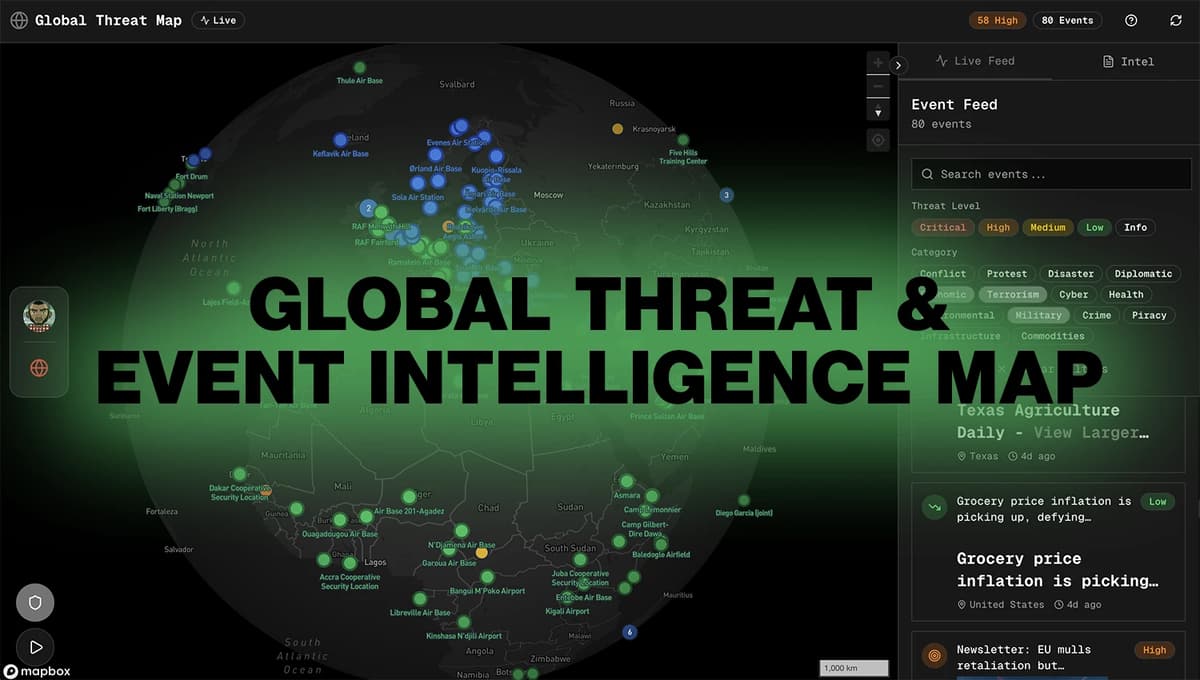
Global Threat Map: Open-Source Real-Time Situational Awareness Platform
•February 4, 2026
0
Companies Mentioned

Why It Matters
By providing real‑time, transparent visualization of worldwide threat activity, the map empowers security teams to quickly identify emerging hotspots without costly vendor solutions, enhancing overall cyber‑risk awareness.
Key Takeaways
- •Open-source map aggregates multiple threat‑intelligence feeds
- •Visualizes malware, phishing, botnet activity by geography
- •Transparent code lets users verify data sources and logic
- •Enables developers to add custom feeds or modify visualizations
- •Not a replacement for formal incident response tools
Pulse Analysis
The cybersecurity landscape increasingly demands instant visibility into hostile activity across borders. Global Threat Map answers that call by stitching together dozens of public threat‑intelligence feeds into a single, animated globe that updates by the second. Unlike commercial dashboards that hide their data pipelines, this platform openly publishes the APIs, parsing scripts, and rendering logic on GitHub, allowing analysts to see exactly which malicious IPs, domains, or phishing campaigns drive the arcs on the screen. The result is a real‑time situational awareness tool that runs in any web browser for security teams worldwide and analysts.
Transparency is the project's core value. By exposing feed URLs, attribution metadata, and filtering rules, teams can audit coverage and adjust for regional bias. Researchers and students gain a sandbox for experimenting with data‑fusion, adding custom sources such as honeypot logs without licensing hurdles. Community contributions accelerate inclusion of emerging indicators like ransomware command‑and‑control servers. In practice, the map serves as a visual front‑end for threat‑intel aggregation, complementing SIEM dashboards rather than replacing them for operational staff in daily workflows.
The map’s openness also introduces limitations. It mirrors only the data published by upstream feeds, so gaps or false positives can mislead if used as sole evidence for response. Organizations should treat it as a discovery layer, feeding highlighted IPs into deeper analysis or threat‑hunting playbooks. Integration is simple: Docker files and API hooks let SOCs embed the visualization into internal portals. Looking forward, the community can add machine‑learning anomaly scoring and new feed parsers, keeping the platform relevant as adversaries evolve and continuous improvement through community feedback.
Global Threat Map: Open-source real-time situational awareness platform
0
Comments
Want to join the conversation?
Loading comments...