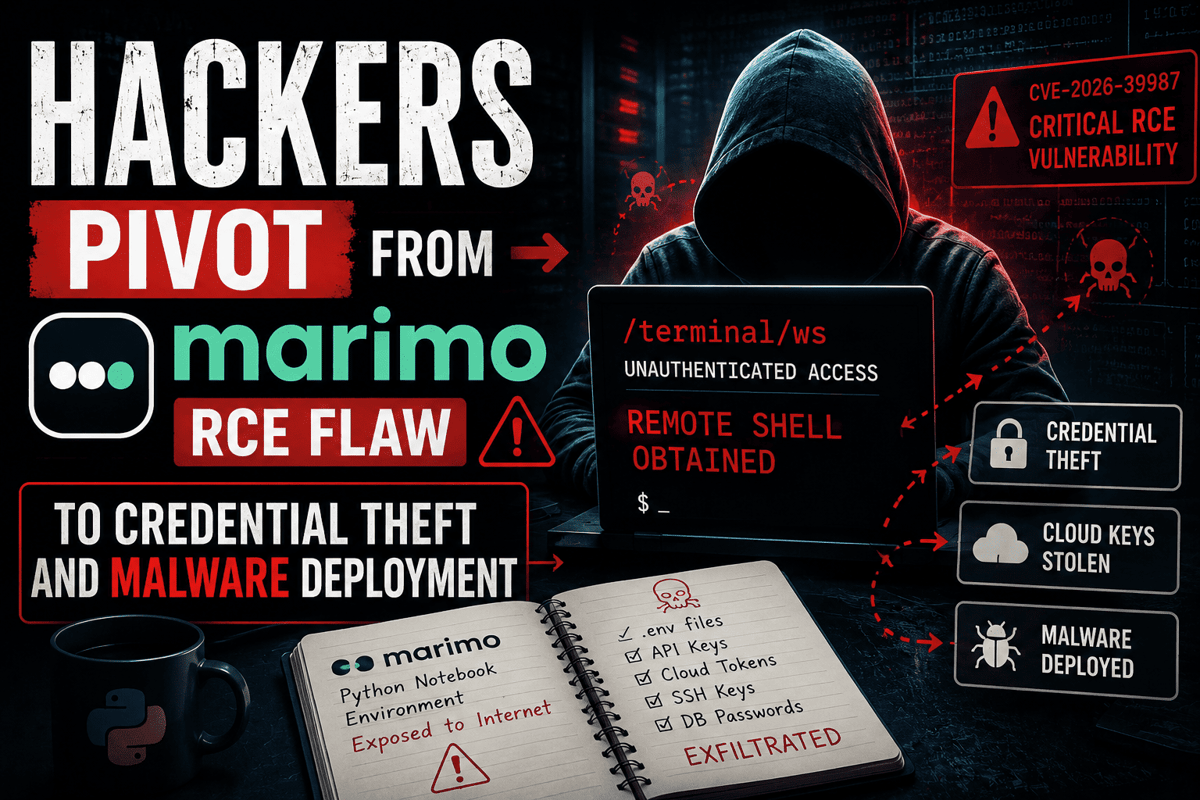
Hackers Pivot From Marimo RCE Flaw to Credential Theft and Malware Deployment
Companies Mentioned

Why It Matters
The vulnerability turns collaborative AI notebooks into open backdoors, exposing privileged cloud credentials that can fuel large‑scale data‑theft and ransomware campaigns across the tech sector.
Key Takeaways
- •Exploit observed within 10 hours of CVE disclosure
- •Vulnerability grants unauthenticated shell via Marimo /terminal/ws endpoint
- •Attackers harvest .env files, SSH keys, API tokens in minutes
- •Malware such as NKAbuse distributed through compromised notebooks
- •Patch to Marimo 0.23.0 stops authentication bypass
Pulse Analysis
The Marimo notebook framework, popular among data‑science and AI teams, has become a high‑value attack surface after the discovery of CVE‑2026‑39987. The flaw bypasses authentication on the /terminal/ws WebSocket, effectively exposing a live command shell to anyone on the internet. This mirrors a broader trend where developers expose cloud‑connected tools without sufficient hardening, turning productivity platforms into entry points for nation‑state and criminal actors. Rapid weaponization—within ten hours of public disclosure—underscores how threat actors now monitor advisory feeds in real time, ready to exploit any unpatched service.
Once inside a Marimo instance, adversaries pivot quickly to credential theft, scanning for .env files, SSH private keys, API tokens, and database connection strings. In observed campaigns, the entire credential‑harvesting phase completed in under three minutes, highlighting the efficiency of manual, human‑guided intrusions that complement automated scripts. The stolen secrets fuel further lateral movement, with attackers targeting PostgreSQL and Redis instances, and deploying NKAbuse variants hosted on Hugging Face Spaces. By chaining notebook compromise with cloud‑service abuse, threat actors can achieve persistent footholds and exfiltrate valuable AI model data or intellectual property.
Mitigation now centers on patching: Marimo version 0.23.0 resolves the authentication bypass. Organizations should rotate all exposed credentials, audit notebook server exposure, and enforce zero‑trust network controls—restricting inbound WebSocket traffic and requiring multi‑factor authentication. Continuous monitoring for anomalous /terminal/ws connections can provide early warning of exploitation attempts. The episode serves as a cautionary tale for the broader developer‑ops ecosystem: as AI and cloud‑native tools proliferate, rigorous security hygiene and rapid patch cycles become essential to prevent notebook platforms from becoming the next conduit for large‑scale cyber‑espionage.
Hackers Pivot From Marimo RCE Flaw to Credential Theft and Malware Deployment
Comments
Want to join the conversation?
Loading comments...