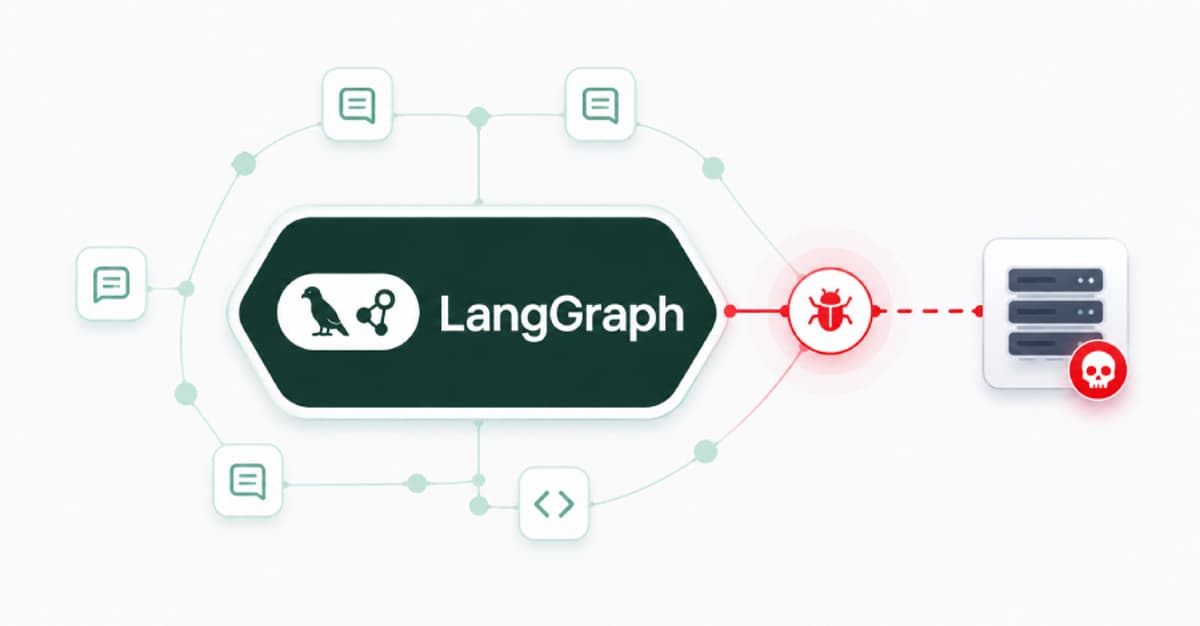
LangGraph Flaw Chain Exposes Self-Hosted AI Agents to Remote Code Execution
Companies Mentioned
Why It Matters
The chain gives attackers full control over self‑hosted AI agents, exposing sensitive data and critical infrastructure. Prompt remediation is essential to protect enterprises that rely on LangGraph for autonomous workflows.
Key Takeaways
- •SQL injection in SQLite checkpoint allows arbitrary query manipulation
- •Unsafe msgpack deserialization can lead to remote code execution
- •RediSearch query injection bypasses access controls in Redis checkpoint
- •Self‑hosted deployments must patch and enforce least‑privilege policies
Pulse Analysis
The recent disclosure of three critical CVEs in LangGraph highlights a growing attack surface in AI‑driven orchestration tools. While open‑source frameworks accelerate development of complex, stateful agents, they also inherit classic web‑application flaws such as SQL injection and unsafe deserialization. In LangGraph, the SQLite checkpoint module allowed crafted metadata filters to tamper with SQL queries, and the msgpack deserializer could reconstruct malicious objects, creating a potent escalation path that culminates in remote code execution. This chain is especially dangerous for self‑hosted environments where developers expose internal endpoints like get_state_history() without stringent access controls.
Technical analysts note that the vulnerability chain hinges on three steps: injecting a malicious filter to return a fabricated checkpoint row, delivering a crafted msgpack payload within that row, and triggering deserialization that executes arbitrary code. The Redis‑based checkpoint suffers a similar RediSearch injection, further widening the attack surface for deployments that rely on Redis for state persistence. Managed services such as LangSmith remain insulated because they enforce authentication, network isolation, and immutable checkpoint storage, underscoring the security advantage of vendor‑hosted solutions over DIY installations.
Mitigation guidance is straightforward: upgrade to langgraph-checkpoint-sqlite ≥ 3.0.1, langgraph ≥ 1.0.10, and @langchain/langgraph-checkpoint-redis ≥ 1.0.1. Organizations should also enforce authentication, rotate secrets regularly, segment networks, and treat AI agents as privileged identities with least‑privilege access. As AI agents become integral to business processes, security teams must embed traditional application hardening practices into the AI stack, ensuring that the convenience of autonomous agents does not become a vector for systemic compromise.
LangGraph Flaw Chain Exposes Self-Hosted AI Agents to Remote Code Execution
Comments
Want to join the conversation?
Loading comments...