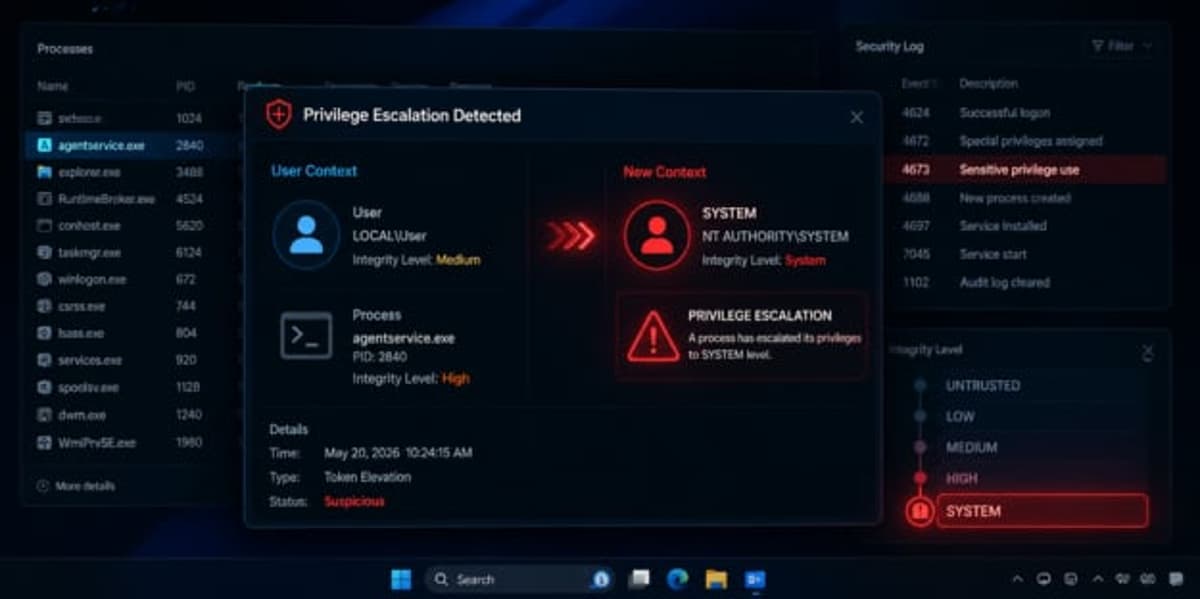
Nessus Agent Flaw Grants SYSTEM-Level Access on Windows
Why It Matters
The flaw gives attackers a direct path to SYSTEM‑level control, magnifying the impact of any breach and forcing organizations to reassess the security posture of their trusted scanning tools. Prompt remediation is essential to prevent privilege escalation across large Windows fleets.
Key Takeaways
- •CVE‑2026‑33694 scores 8.2, indicating high severity.
- •Nessus Agent runs with SYSTEM privileges on Windows endpoints.
- •Exploiting NTFS junctions lets attackers delete arbitrary files.
- •Tenable issued a patch; no active exploitation reported yet.
- •Apply least‑privilege, patch promptly, and monitor for junction abuse.
Pulse Analysis
The Nessus Agent vulnerability stems from a classic symlink‑or‑junction attack, where the agent’s routine file operations follow malicious NTFS junctions created by a local adversary. By tricking the privileged service into deleting or overwriting files outside its intended directory, attackers can gain SYSTEM‑level rights and plant malicious payloads. With a CVSS score of 8.2, the flaw is classified as high severity, highlighting how seemingly innocuous file‑system features can become powerful escalation vectors when combined with elevated privileges.
Beyond the technical specifics, this incident illustrates a broader challenge: security tools that operate with high privileges can become single points of failure. Organizations often deploy Nessus Agents for continuous vulnerability assessment, trusting them to safeguard the environment. When such tools harbor weaknesses, the attack surface expands dramatically. The episode reinforces the need for rigorous patch management, continuous monitoring, and a zero‑trust mindset that limits implicit trust in any component, even those designed for defense.
Mitigation strategies focus on rapid patch deployment, strict least‑privilege enforcement, and robust endpoint detection. Administrators should inventory all systems running Nessus Agents, prioritize critical and internet‑exposed assets, and employ EDR solutions to flag abnormal file deletions or junction creation. Hardening file‑path validation and restricting symlink creation further reduce exposure. By integrating these controls, enterprises can contain the blast radius of a potential compromise and maintain resilience against future privilege‑escalation threats.
Nessus Agent Flaw Grants SYSTEM-Level Access on Windows
Comments
Want to join the conversation?
Loading comments...