The SOAR Ceiling: Why Playbook Automation Has Hit Its Structural Limits
Why It Matters
If organizations continue to rely on brittle playbooks, they face rising operational costs and reduced incident response quality; shifting to autonomous triage could reshape SOC efficiency and talent requirements.
Key Takeaways
- •Playbook maintenance consumes growing engineering resources each quarter
- •Architect scarcity creates bottleneck and knowledge loss
- •Multi‑agent AI adds configuration sprawl and non‑deterministic failures
- •Autonomous triage promises context‑driven investigations without static playbooks
- •Silent integration failures jeopardize alert response reliability
Pulse Analysis
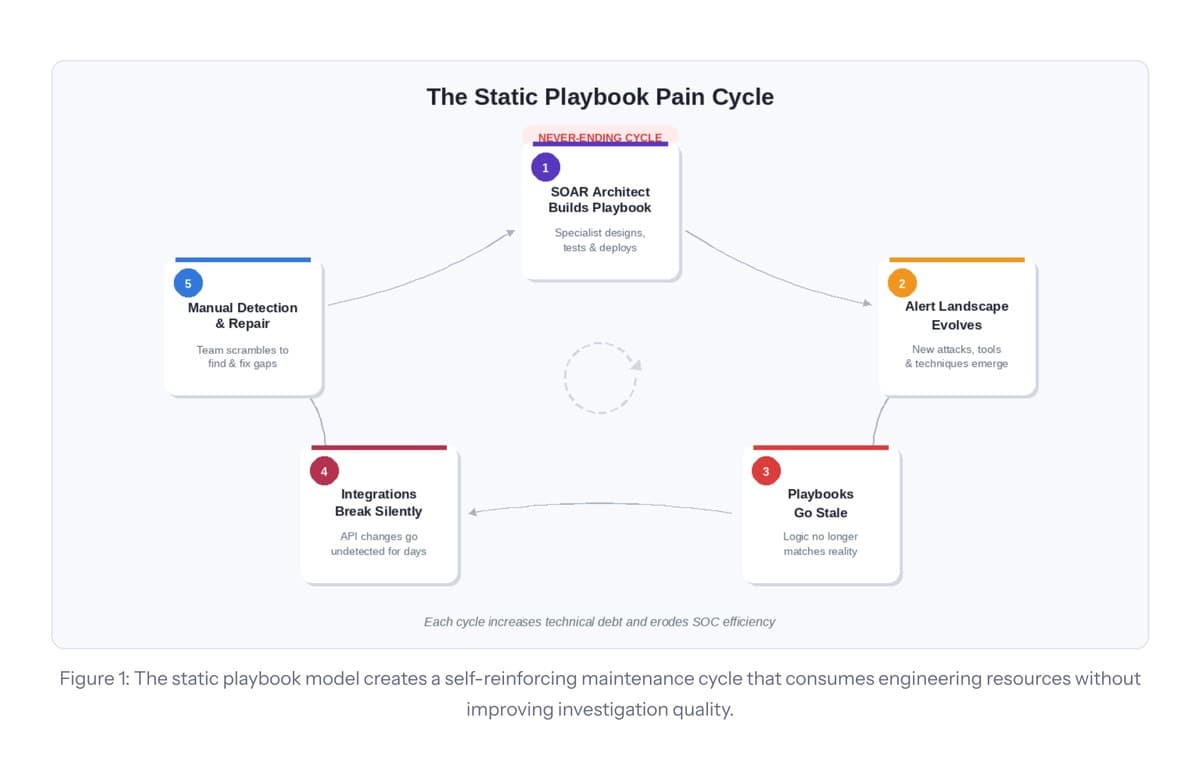
The SOAR playbook paradigm, once celebrated for delivering repeatable, fast incident response, now strains under the weight of hundreds of static workflows. Each alert triggers a pre‑written sequence that must be manually authored, tested, and continuously updated as threats evolve. This creates a maintenance vortex: architects are scarce, knowledge leaves with staff turnover, and integrations silently break, leaving analysts in the dark during critical windows. The five fractures identified—architect dependency, playbook sprawl, static logic, silent failures, and the L1 analyst gap—highlight why the model is no longer sustainable for modern, fast‑moving threat landscapes.
Vendors have responded by embedding large language models and multi‑agent orchestration into existing SOAR platforms, promising faster playbook creation and more intuitive querying. In practice, these AI copilots merely accelerate the same static logic, while multi‑agent systems shift the burden to prompt engineering, RAG pipelines, and agent configuration. The result is a new form of sprawl: each agent requires ongoing tuning, and non‑deterministic outputs erode testing, auditability, and compliance. Silent model upgrades can alter behavior across the entire chain, creating hidden failure modes that are harder to detect than a broken playbook.
Autonomous triage reimagines the workflow by moving intelligence from pre‑written playbooks to a runtime AI engine that ingests alerts, assembles full context, and generates bespoke investigation steps on the fly. This approach eliminates the need for dedicated SOAR architects, delivers L2‑level insights at L1 cost, and provides transparent, auditable reasoning for each action. While the shift introduces its own challenges—such as model governance and data quality—it offers a structural solution to the maintenance debt that has plagued traditional SOAR deployments, positioning organizations to scale security operations alongside an increasingly complex threat environment.
The SOAR Ceiling: Why Playbook Automation Has Hit Its Structural Limits
Comments
Want to join the conversation?
Loading comments...