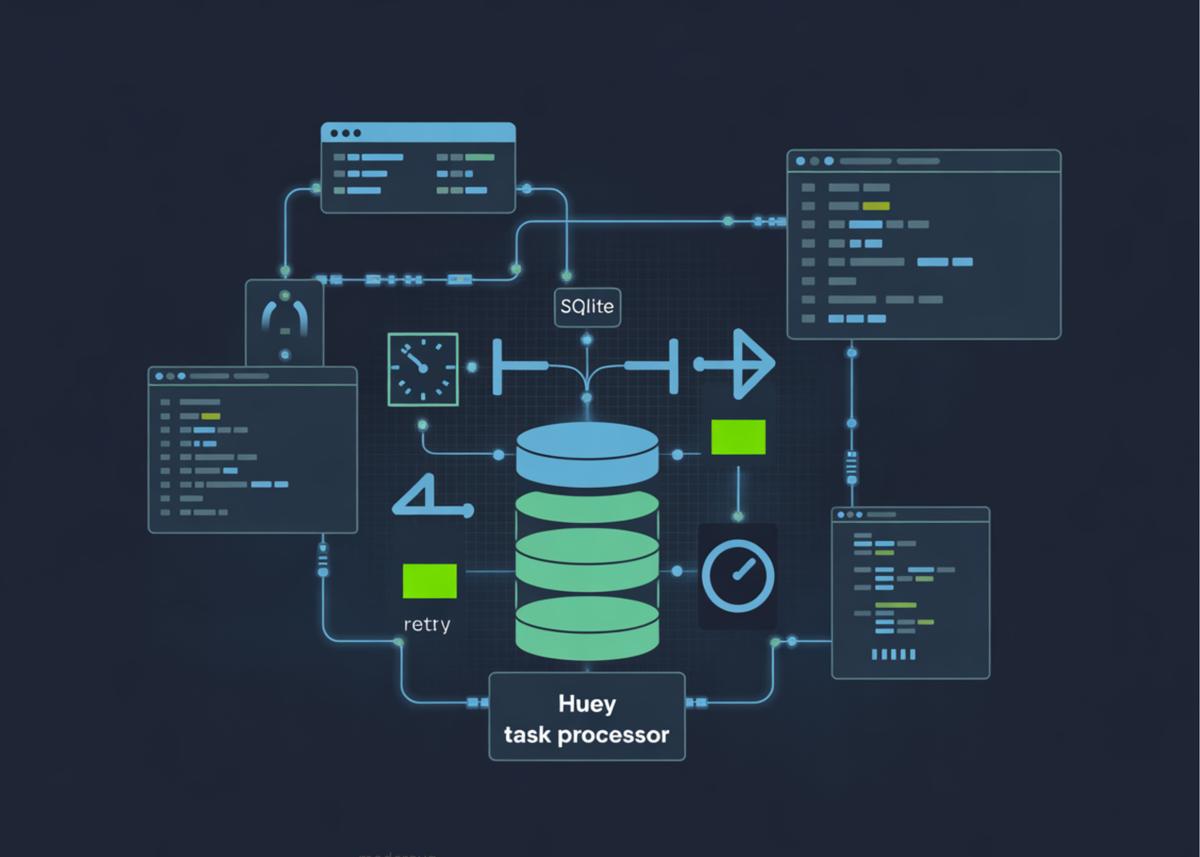
A Coding Guide to Build a Production-Grade Background Task Processing System Using Huey with SQLite, Scheduling, Retries, Pipelines, and Concurrency Control

Companies Mentioned

Why It Matters
By proving that Huey can deliver reliable, scalable async processing without heavyweight infrastructure, developers can reduce operational costs and simplify deployment pipelines. This lowers the barrier for small teams to adopt robust background job patterns.
Key Takeaways
- •Huey runs on SQLite, eliminating external Redis dependency
- •Task retries with configurable delay handle transient failures
- •Locking serializes critical jobs across multiple workers
- •Pipelines chain tasks for structured, multi‑step workflows
- •Crontab and timers enable periodic and scheduled execution
Pulse Analysis
Background task processing is a cornerstone of modern web services, yet many teams default to heavyweight queue systems that require dedicated servers and complex configuration. Huey offers a lightweight alternative, and this guide demonstrates that a simple SQLite file can serve as a durable broker, making it ideal for startups, prototypes, or edge deployments where resource constraints matter. By installing Huey in a notebook and launching a threaded consumer, developers gain a sandboxed environment to experiment with job orchestration without leaving their development workflow.
The tutorial dives into advanced patterns that elevate a basic queue into a production‑ready system. Tasks are assigned priorities to control execution order, while built‑in retry logic with configurable delays mitigates transient network or I/O errors. Locking mechanisms prevent concurrent runs of critical jobs, ensuring data integrity when multiple workers are active. Moreover, the pipeline API enables seamless chaining of tasks—fetching, transforming, and storing data—in a single declarative flow, reducing boilerplate and improving traceability. Periodic jobs are scheduled via crontab syntax, and custom timers illustrate sub‑minute intervals, covering a broad spectrum of scheduling needs.
Observability and operational hygiene round out the solution. Signal handlers capture lifecycle events, creating a structured log that can feed monitoring dashboards or alerting systems. The consumer’s health checks, back‑off strategies, and graceful shutdown procedures demonstrate best practices for reliability and clean resource management. Together, these features illustrate that a SQLite‑backed Huey setup can meet the robustness expectations of production environments while keeping infrastructure lean, cost‑effective, and easy to maintain.
A Coding Guide to Build a Production-Grade Background Task Processing System Using Huey with SQLite, Scheduling, Retries, Pipelines, and Concurrency Control
Comments
Want to join the conversation?
Loading comments...