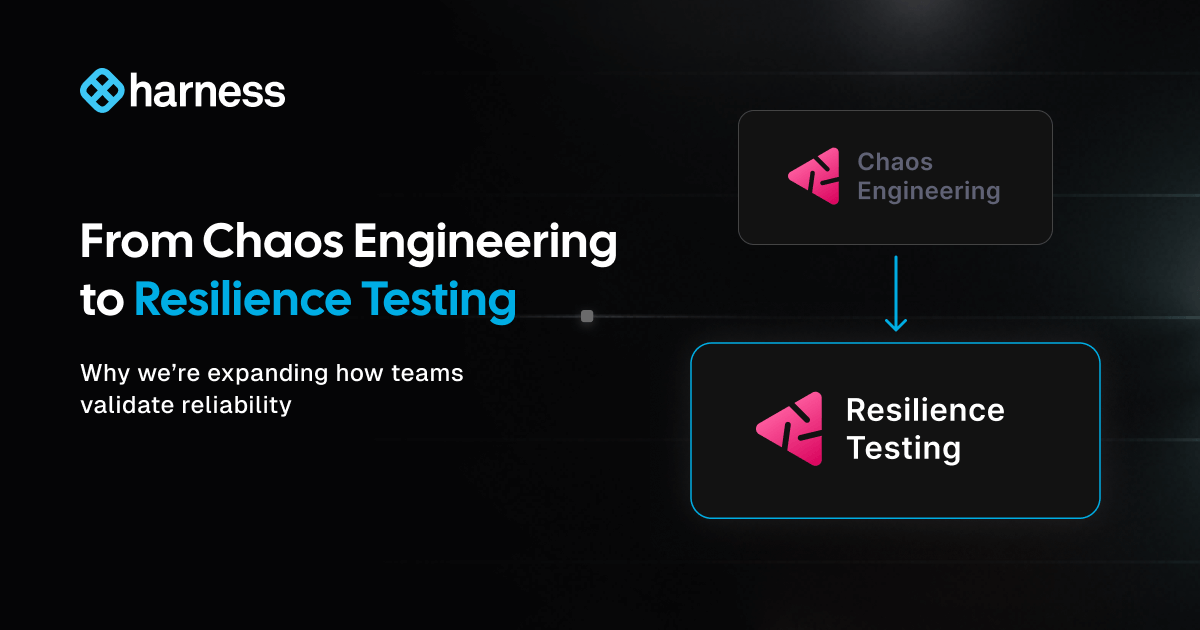
Harness Evolves Chaos Engineering to Resilience Testing
•February 27, 2026
0
Why It Matters
Resilience Testing gives enterprises a unified, continuous framework to validate reliability, reducing outage risk while accelerating delivery cycles. It signals a broader industry transition from isolated chaos experiments to integrated, data‑driven reliability engineering.
Key Takeaways
- •Harness rebrands Chaos Engineering as Resilience Testing platform
- •Includes load and disaster recovery testing alongside fault injection
- •Built on open‑source LitmusChaos, integrated with AI insights
- •Enables continuous, automated resilience validation across software delivery lifecycle
- •Targets SREs, DevOps, platform engineers for proactive risk mitigation
Pulse Analysis
The rise of cloud‑native architectures has exposed the limits of traditional testing, prompting a shift toward resilience‑focused practices. While chaos engineering introduced controlled failure injection, modern workloads demand a more comprehensive view that includes performance under load and systematic recovery verification. Industry analysts note that organizations adopting continuous resilience testing see faster incident detection and reduced mean time to recovery, positioning them ahead of competitors still relying on periodic checks.
Harness leverages its stewardship of LitmusChaos and the 2022 acquisition of Chaos Native to deliver a tightly integrated platform that blends fault injection, load testing, and disaster‑recovery simulations. AI‑driven recommendations guide teams on which scenarios to prioritize, while automated gamedays embed resilience checks directly into CI/CD pipelines. By exposing real‑time metrics and offering out‑of‑the‑box templates for Kubernetes, serverless, and hybrid environments, the solution reduces the operational overhead of building bespoke testing frameworks.
For enterprises, the strategic value lies in turning resilience from a reactive afterthought into a continuous, measurable capability. The unified approach shortens the feedback loop between development and operations, enabling faster iteration without compromising stability. As the resilience‑engineering community expands—evidenced by events like Chaos Carnival—tools that combine open‑source collaboration with enterprise‑grade automation, such as Harness’s Resilience Testing, are poised to become foundational components of modern DevOps toolchains.
Harness Evolves Chaos Engineering to Resilience Testing
0
Comments
Want to join the conversation?
Loading comments...