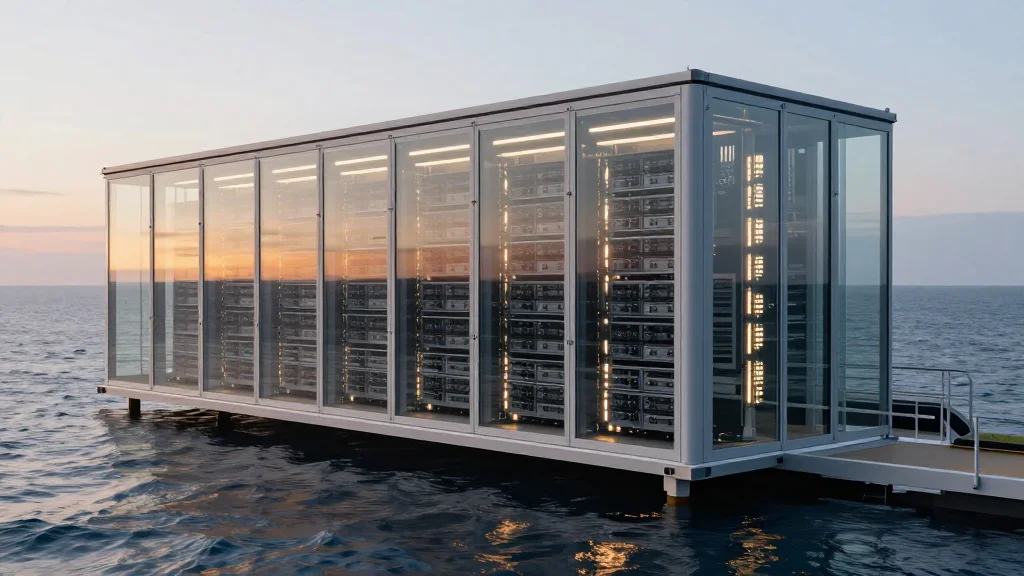
Hitachi Backs Floating Data Center, Targeting 54,000 M² Offshore Capacity by 2027

Companies Mentioned
Why It Matters
The floating data center tackles Japan’s acute land shortage while delivering the massive compute capacity demanded by AI and big‑data workloads. By compressing the build cycle to roughly a year, Hitachi offers a faster path to scale, which could reshape how enterprises plan capacity expansions and disaster‑recovery strategies. For the DevOps community, the project introduces a new class of infrastructure that blends on‑premises control with the fluidity of cloud resources. Managing workloads on a moving platform will test existing automation, monitoring, and security frameworks, likely accelerating the development of tools that can handle non‑static environments and reinforcing the importance of infrastructure‑as‑code practices.
Key Takeaways
- •Hitachi and Hitachi Systems sign MoU with Mitsui OSK Lines to convert a ship into a data center
- •Targeted operational start date: 2027
- •Planned capacity: ~54,000 m², comparable to large terrestrial data centers
- •Conversion could be completed in about one year, far faster than traditional builds
- •Cooling will use seawater or river water, reducing freshwater demand but adding corrosion challenges
Pulse Analysis
Hitachi’s floating data center is a strategic response to a structural bottleneck: Japan’s limited developable land near its economic hubs. By moving compute offshore, the company sidesteps years‑long zoning approvals and construction delays that have historically hampered capacity growth. This approach mirrors earlier experiments with underwater data farms, but the ship‑based model offers greater flexibility—vessels can be repositioned, retrofitted, or decommissioned with relative ease.
From a DevOps perspective, the initiative forces a rethink of the traditional dichotomy between on‑premises and cloud environments. Automation pipelines will need to incorporate maritime variables—such as variable power quality, salt‑induced corrosion, and dynamic network latency—into their reliability models. Existing CI/CD tools may require extensions to handle hardware health signals from shipboard systems, while observability stacks will have to ingest sensor data unique to marine operations. Vendors that can deliver seamless integration between shipboard infrastructure and standard cloud APIs will likely capture a new market niche.
Looking ahead, the success of Hitachi’s project could catalyze a wave of similar ventures in other densely populated coastal regions, from South Korea to the United Kingdom. If the floating data center proves economically viable and technically reliable, it may become a standard option in the infrastructure‑as‑code playbook, prompting cloud providers to offer specialized services for maritime deployments. The next few years will reveal whether the concept scales beyond a single flagship vessel or remains a niche solution for extreme land‑scarcity scenarios.
Hitachi backs floating data center, targeting 54,000 m² offshore capacity by 2027
Comments
Want to join the conversation?
Loading comments...