Survey: Few IT Teams Can Continuously Optimize Kubernetes Clusters
Why It Matters
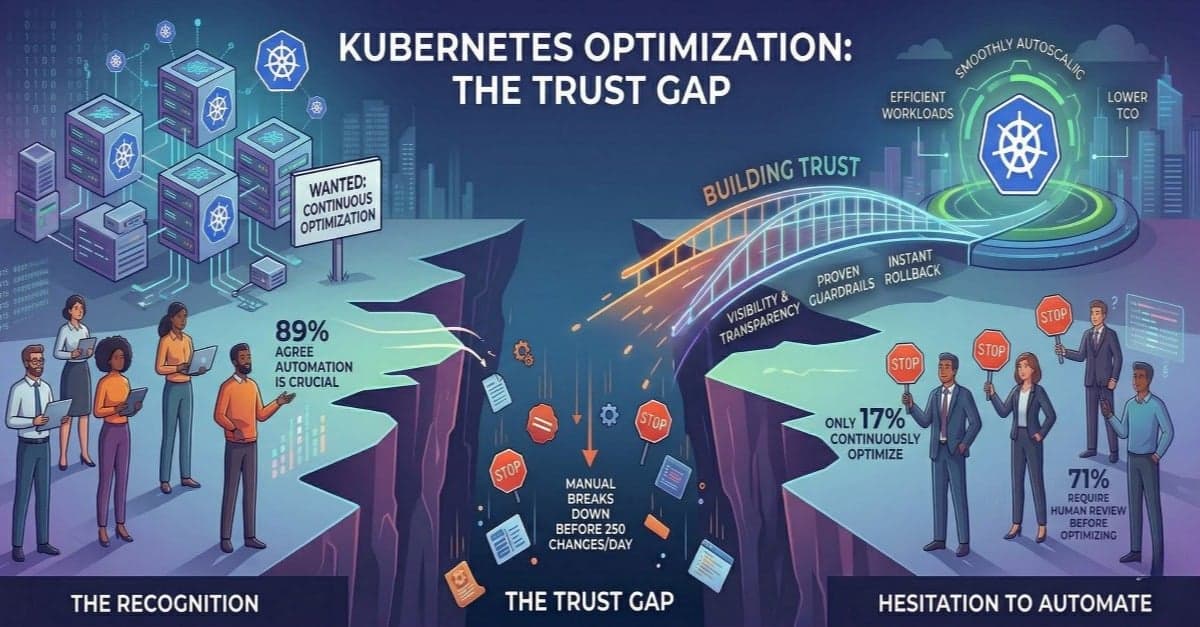
Without trusted automation, enterprises face rising total‑cost‑of‑ownership and limited ability to scale Kubernetes workloads efficiently. Closing the trust gap is critical for maintaining performance and controlling cloud spend.
Key Takeaways
- •Only 17% continuously optimize Kubernetes clusters.
- •71% still require human review for resource changes.
- •Visibility and guardrails are top trust factors.
- •Two‑thirds see manual optimization failing after 250 changes.
- •Over half manage more than 100 Kubernetes clusters.
Pulse Analysis
Enterprises are grappling with a paradox: they recognize automation as a strategic imperative for Kubernetes, yet most cannot sustain continuous optimization. Under‑utilized CPU and memory inflate the total cost of ownership, especially when organizations run hundreds of clusters and thousands of workloads. Manual tuning becomes a bottleneck, leading to missed performance gains and higher cloud bills. The survey highlights that only a fraction of teams have moved beyond ad‑hoc scripts to systematic, data‑driven optimization, underscoring a market‑wide efficiency gap.
Trust emerges as the primary barrier to broader automation adoption. Nearly half of respondents say greater visibility and transparent reporting would boost confidence, while a quarter demand proven guardrails and instant rollback capabilities. These requirements reflect a cultural shift: IT leaders must balance the speed of automated scaling with the safety nets traditionally provided by human oversight. Generative AI and predictive machine‑learning are beginning to address these concerns, offering chat‑driven interfaces and proactive anomaly detection, but the technology must prove reliability at scale before it can replace manual checks.
The implications for vendors and cloud providers are significant. Solutions that embed real‑time telemetry, policy‑based guardrails, and seamless rollback will likely capture market share among enterprises struggling with cluster sprawl. Moreover, as workloads diversify—from AI inference to edge services—the pressure to automate resource allocation will intensify. Companies that can demonstrate measurable cost reductions and risk mitigation through trusted automation will set the standard for the next generation of Kubernetes management.
Survey: Few IT Teams Can Continuously Optimize Kubernetes Clusters
Comments
Want to join the conversation?
Loading comments...