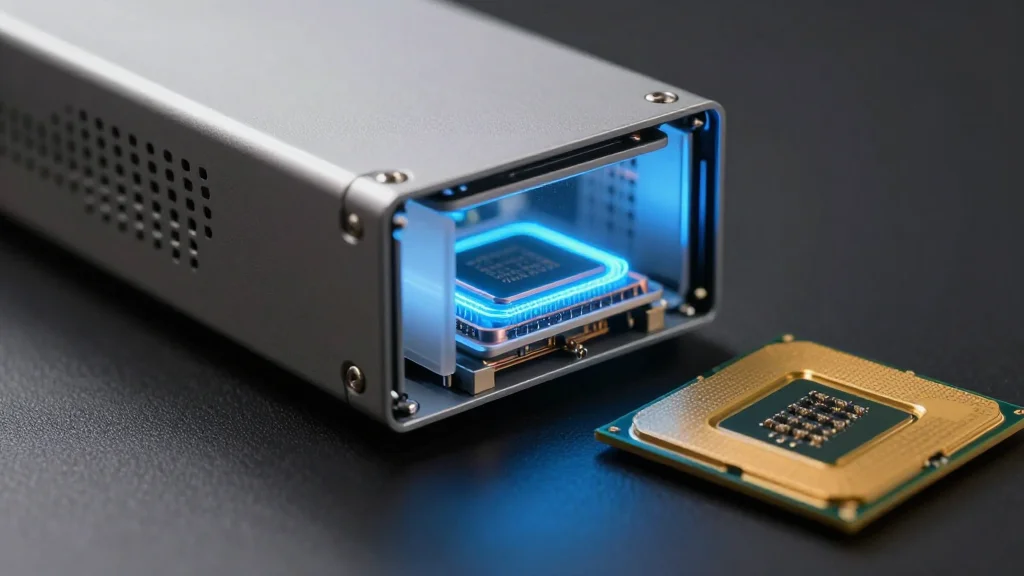
Sygaldry Secures $139 Million to Build Quantum‑Accelerated AI Data‑Center Servers

Companies Mentioned
Why It Matters
Sygaldry’s $139 million raise underscores a growing belief that quantum hardware can address the escalating energy and performance demands of AI models. For DevOps professionals, the prospect of hybrid quantum‑classical servers means re‑thinking deployment pipelines, monitoring, and scaling strategies to incorporate fundamentally different hardware characteristics. The move also pressures incumbent cloud providers to accelerate their own quantum roadmaps, potentially reshaping the competitive dynamics of high‑performance compute. Beyond operational concerns, the funding highlights a broader shift in capital allocation toward technologies that promise to break the current compute‑energy wall. If Sygaldry succeeds, it could catalyze a wave of quantum‑accelerated services, prompting standards bodies to develop new APIs and security frameworks tailored to quantum workloads, thereby influencing the entire DevOps ecosystem.
Key Takeaways
- •Sygaldry raised a total of $139 million, including a $105 million Series A led by Breakthrough Energy Ventures
- •Series A closed in March; $34 million seed round led by Initialized Capital closed in August 2024
- •Company aims to ship quantum‑enhanced AI servers for commercial use by the end of the decade (2030)
- •Rigetti says quantum hardware will be more energy‑efficient than GPUs for large language models
- •Investors cite unsustainable energy intensity of AI models as a key driver for the funding
Pulse Analysis
The infusion of $139 million into Sygaldry marks a decisive inflection point where venture capital is no longer content with speculative quantum research; it now seeks concrete, data‑center‑ready solutions that can be monetized within a decade. Historically, quantum startups have struggled to translate laboratory breakthroughs into scalable products, but Rigetti’s pedigree—having taken Rigetti Computing public via a SPAC—provides a rare blend of technical depth and market credibility. This credibility likely eased Breakthrough Energy Ventures’ willingness to commit $105 million, a bet that the energy‑efficiency narrative will resonate with hyperscale operators facing mounting power costs.
From a DevOps perspective, the emergence of quantum‑augmented servers forces a re‑evaluation of the abstraction layers that have insulated operators from hardware complexity for years. Existing orchestration platforms will need to expose quantum‑specific parameters such as qubit coherence time, error rates, and cryogenic cooling requirements. Early adopters will probably be large cloud providers that can amortize the cost of specialized infrastructure, but niche AI firms may also experiment with on‑premise quantum racks to gain a competitive edge in model latency.
Looking ahead, the success of Sygaldry could trigger a cascade of similar funding rounds, prompting hardware vendors to embed quantum accelerators alongside CPUs and GPUs in standard rack units. This convergence would blur the lines between traditional HPC and emerging quantum workloads, compelling the DevOps community to develop unified toolchains that can schedule, monitor, and secure heterogeneous compute stacks. If the 2030 commercialization target is met, the industry may witness a new tier of performance‑critical services—real‑time AI inference, scientific simulations, and cryptographic workloads—running on hybrid quantum‑classical platforms, fundamentally reshaping the compute economics that have dominated the past decade.
Sygaldry Secures $139 Million to Build Quantum‑Accelerated AI Data‑Center Servers
Comments
Want to join the conversation?
Loading comments...