Insider Threat Cited in $22M Iowa Bank Fraud Case
•February 4, 2026
0
Companies Mentioned


Why It Matters
The case underscores how insider access can bypass traditional controls, raising systemic risk for financial institutions and prompting tighter compliance oversight.
Key Takeaways
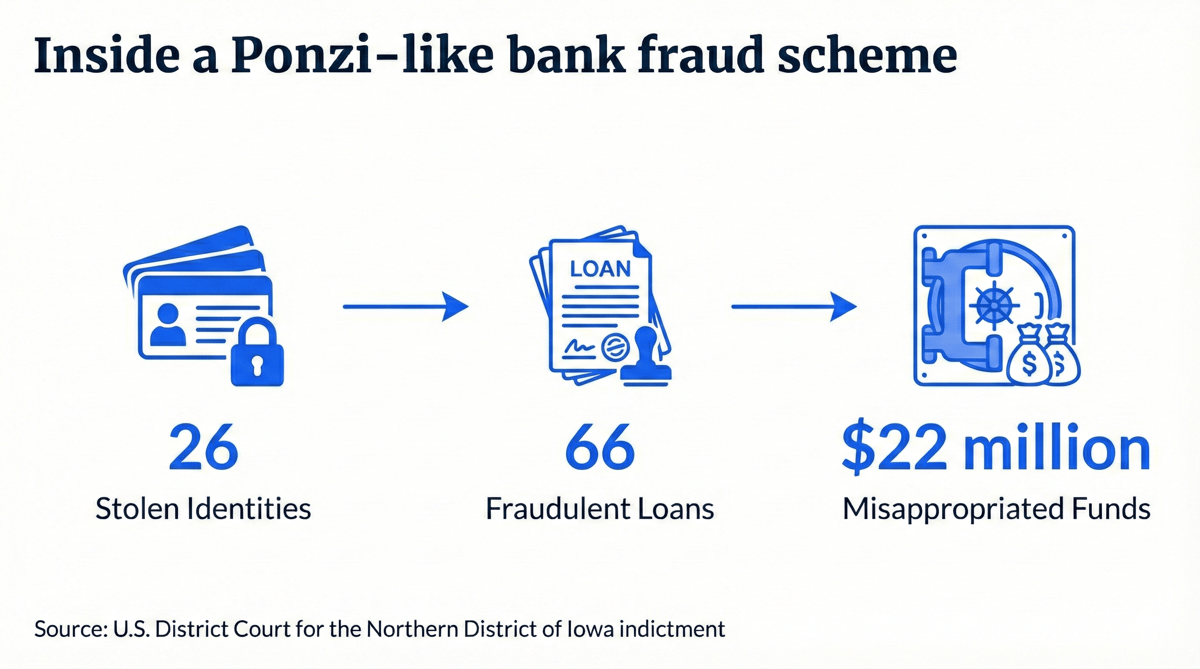
- •66 fraudulent loans totalling $22 million.
- •Loans issued using 26 stolen identities.
- •Insider leveraged prior bank’s customer data.
- •Funds cycled through multiple banks to hide fraud.
- •Trial set for March 30, likely delayed.
Pulse Analysis
The Iowa fraud case illustrates a growing trend where insiders weaponize privileged data to orchestrate large‑scale financial crimes. By tapping knowledge of customers from a former employer, the bank employee bypassed standard due‑diligence checks, creating a pipeline of illegitimate loans. Such insider‑driven schemes erode trust in the banking system and attract heightened scrutiny from regulators, who are increasingly demanding robust governance frameworks to prevent abuse of internal access.
Detecting these schemes is challenging because the perpetrators embed illicit transactions within legitimate workflows. In this instance, the conspirators used internal wire transfers and a series of churning loans to obscure the money trail, moving funds across three additional banks before landing in an online brokerage. Effective mitigation requires real‑time transaction monitoring, segregation of duties, and advanced analytics that flag anomalous loan patterns, especially when employee activity deviates from historical norms. Strengthening anti‑money‑laundering (AML) controls and conducting regular insider‑risk assessments are essential to uncover hidden digital footprints before losses mount.
For compliance officers, the indictment serves as a cautionary tale about the need for cross‑institution data sharing and continuous employee vetting. Organizations must implement stringent onboarding and off‑boarding procedures, ensuring that former customer relationships are not exploitable in new roles. Training programs that emphasize ethical conduct and the legal repercussions of fraud can deter potential insiders. As courts evaluate the case, the outcome will likely influence future regulatory guidance, pushing banks to adopt more granular access controls and to invest in technologies that detect insider threats early, protecting both assets and reputation.
Insider threat cited in $22M Iowa bank fraud case
0
Comments
Want to join the conversation?
Loading comments...