From Rule of Thumb to Mechanistic Formula: An AI-Assisted Model for Individualizing Shuttle Run Distance in HIIT
Key Takeaways
- •AI‑driven formula replaces 0.7 s COD rule with individualized t_cod
- •t_cod = v / A0 links speed, acceleration, and distance loss
- •Model adjusts shuttle distance up to 8 % for low‑braking athletes
- •Works with MAS/MSS or vIFT reference speeds, no protocol change
- •Free spreadsheet and web app enable instant squad‑level prescriptions
Pulse Analysis
For two decades, strength and conditioning professionals have relied on a simple 0.7‑second subtraction per change of direction to prescribe shuttle‑run distances in HIIT sessions. While easy to apply, the rule ignores critical variables such as an athlete’s acceleration capacity, running speed, and the number of turns inherent in shorter shuttle lengths. As a result, training prescriptions can be off by as much as 15 percentage points for high‑intensity, short‑shuttle drills, potentially compromising both performance gains and injury prevention.
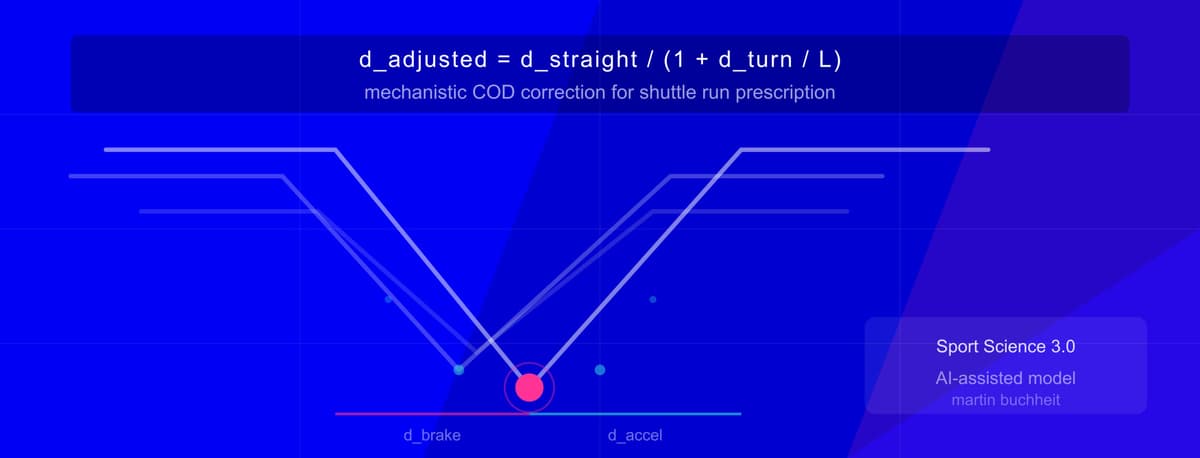
The newly released mechanistic model, co‑developed with AI partners Claude and Anthropic, reframes COD penalties as a function of physics and individual biomechanics. By defining t_cod = v / A0, where v is the athlete’s reference speed and A0 represents their maximal acceleration/deceleration capability (default 7.5 m/s²), the formula delivers a speed‑dependent, player‑specific correction. Faster athletes lose more time per turn, and those with lower braking capacity see corrections rise up to eight percentage points. The model integrates seamlessly with either MAS/MSS or vIFT metrics, preserving the integrity of the 30‑15 IFT test while delivering more accurate training distances.
Practically, the innovation arrives as a ready‑to‑use spreadsheet and a companion web application, allowing coaches to generate squad‑level prescriptions in seconds. No changes to existing testing protocols are required, and the tools are freely available, encouraging rapid adoption across professional, collegiate, and elite youth programs. By aligning training loads with each player’s physiological profile, the model promises more efficient conditioning, reduced injury risk, and clearer performance analytics—key advantages in today’s data‑driven sports environment.
From Rule of Thumb to Mechanistic Formula: An AI-Assisted Model for Individualizing Shuttle Run Distance in HIIT
Comments
Want to join the conversation?