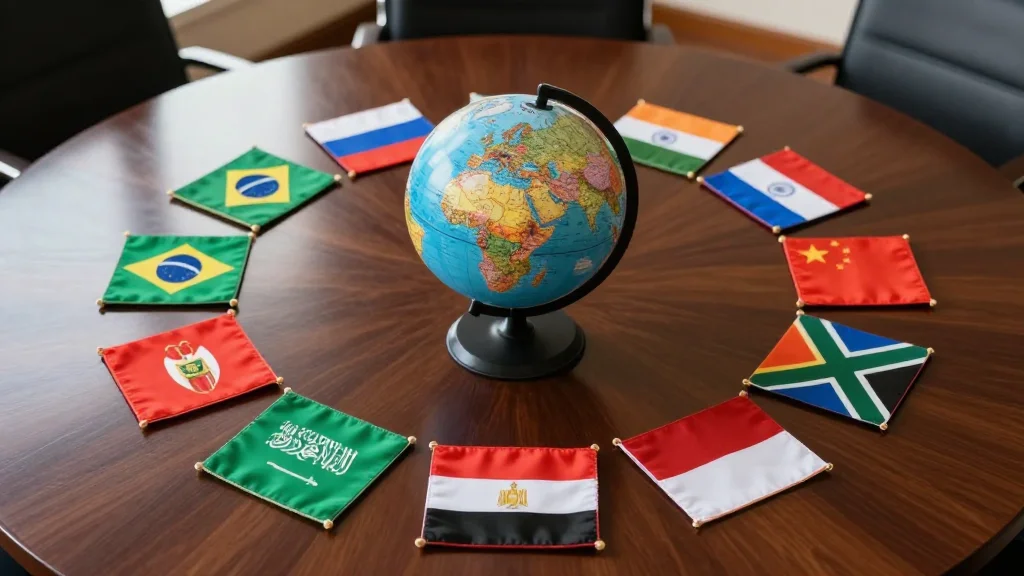
BRICS Grows to Ten Members Ahead of New Delhi Summit, Challenging Western Economic Order

Companies Mentioned
Why It Matters
The expansion of BRICS to ten members and its upcoming summit represent a concrete challenge to the U.S. dollar’s hegemony in international trade and finance. By aggregating nearly half of the world’s population and a sizable share of global output, the bloc can leverage its collective market size to negotiate more favorable terms with multinational firms and push for reforms in institutions that have traditionally been dominated by Western powers. If BRICS succeeds in scaling its alternative payment systems and securing broader acceptance of the “Unit” token, it could lower transaction costs for member economies, reduce exposure to dollar‑related volatility, and inspire other emerging markets to adopt similar frameworks. The ripple effects would be felt across capital markets, commodity pricing and sovereign debt issuance, potentially reshaping the architecture of the global economy.
Key Takeaways
- •Indonesia joins as the tenth full BRICS member, bringing the bloc to 45% of world population.
- •BRICS now accounts for over 35% of global GDP on a purchasing‑power basis, surpassing the G7.
- •Intra‑BRICS trade hit $1.17 trillion in 2024, a 13‑fold increase since 2003.
- •mBridge processed $55.49 billion in cross‑border transactions by Nov 2025, up from $22 million in 2022.
- •NDB President Dilma Rousseff confirmed “agreement in principle” to use the gold‑backed “Unit” token for settlement.
Pulse Analysis
BRICS’ rapid expansion reflects a broader geopolitical realignment where emerging economies are no longer content to be peripheral players in a dollar‑centric system. The bloc’s ability to marshal a combined GDP that eclipses the G7 on a PPP basis gives it leverage that extends beyond symbolic political statements. However, the true test lies in operationalizing its financial infrastructure. The mBridge and BRICS Pay initiatives demonstrate technical progress, yet their impact will be limited unless private sector participants—global banks, multinational corporations and fintech firms—adopt them at scale.
The “Unit” token, while still in pilot mode, signals a willingness to experiment with hybrid reserve assets that blend commodity backing with currency baskets. If successful, it could serve as a template for a new class of settlement instruments that reduce reliance on the dollar without requiring a single, unified BRICS currency. This approach sidesteps the political friction that stalled earlier attempts at a common monetary unit while still delivering tangible de‑dollarisation benefits.
Looking ahead, the New Delhi summit will be a litmus test for BRICS’ cohesion. A unified stance on IMF and World Bank reforms could force Western institutions to reconsider voting structures and quota allocations. Conversely, divergent national interests—particularly between China’s push for yuan dominance and Russia’s focus on the ruble—could fracture consensus. The bloc’s next moves will therefore shape not only trade flows but also the strategic calculus of investors, policymakers and corporations worldwide.
BRICS Grows to Ten Members Ahead of New Delhi Summit, Challenging Western Economic Order
Comments
Want to join the conversation?
Loading comments...