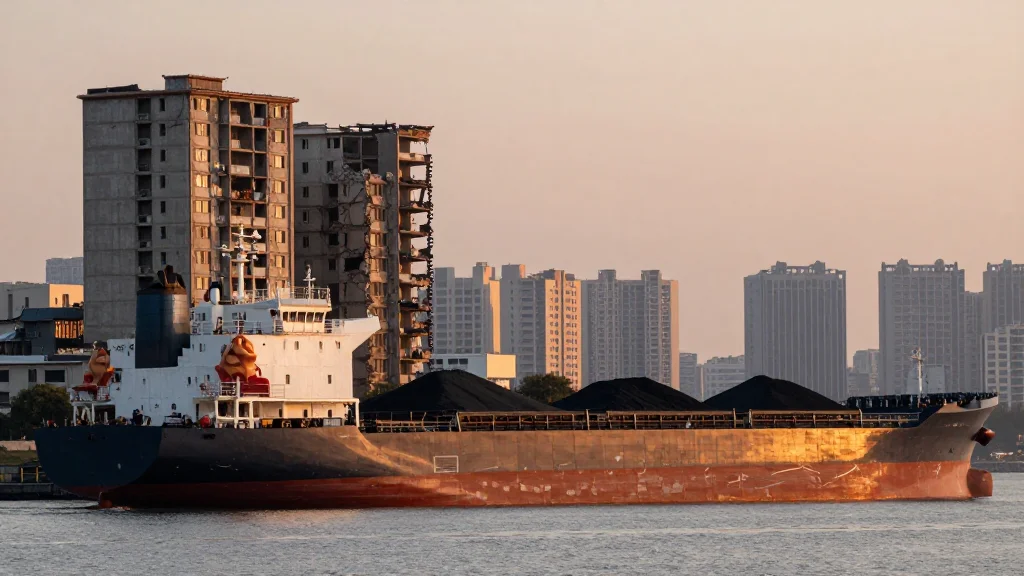
China’s Housing Price Collapse Threatens Australia’s Iron Ore Revenues, Forecasts $9 Bn Cut

Companies Mentioned
Why It Matters
The Chinese housing collapse is not a isolated real‑estate issue; it directly trims demand for iron‑ore, a cornerstone of Australia’s export earnings and fiscal health. A $9 bn reduction in export revenue translates into lower corporate tax receipts, potentially constraining public spending and amplifying budget deficits. Moreover, the shift in China’s sourcing strategy could accelerate a re‑configuration of global commodity supply chains, prompting other resource‑rich nations to vie for market share. For the broader global economy, the episode illustrates how asset‑price corrections in one major economy can cascade through trade‑linked sectors, affecting growth, employment, and government finances in distant markets. It also highlights the vulnerability of economies heavily reliant on a single commodity export, underscoring the strategic importance of diversification and the need for policy buffers against external demand shocks.
Key Takeaways
- •China’s residential prices have fallen 23% since Q3 2021, the deepest decline since 2005.
- •Australian iron‑ore export earnings are forecast to drop from $116 bn AUD ($76 bn USD) in 2024‑25 to $107 bn AUD ($71 bn USD) in 2026‑27.
- •Each USD 10 fall in iron‑ore price wipes out roughly AUD 500 million in Australian tax revenue.
- •Singapore Exchange iron‑ore futures trade around USD 107/tonne, down >50% from the 2021 peak.
- •China is consolidating purchases under state‑owned CMRG and eyeing alternative sources like Simandou, West Africa.
Pulse Analysis
China’s property implosion is reshaping the commodity landscape in a way that mirrors the 2008 financial crisis, but with a different transmission channel. Whereas the 2008 shock originated in mortgage‑backed securities and spread through banking, today the shock travels through physical demand for steel, a downstream effect of stalled construction. Australia’s reliance on iron‑ore mirrors the classic ‘resource curse’ dynamic: windfall gains have funded public coffers, yet the economy remains exposed to external demand cycles.
Historically, Australia’s iron‑ore boom insulated it from domestic downturns, but the current environment forces a strategic pivot. The country must accelerate value‑addition—such as domestic steel production and green‑energy technologies—to capture more of the supply chain margin. Simultaneously, fiscal policy should consider counter‑cyclical measures to offset the projected tax shortfall, perhaps by reallocating surplus from the mining sector into infrastructure that can stimulate domestic demand.
Looking ahead, the trajectory of China’s housing market will be the key barometer. If Beijing introduces aggressive stimulus or relaxes credit constraints, the iron‑ore demand dip could be mitigated. Conversely, a prolonged slump would likely accelerate China’s diversification away from Australian ore, compelling Australia to seek new markets in Southeast Asia and Europe. The next 12‑18 months will therefore be a litmus test for how resilient Australia’s resource‑dependent economy can be in the face of a major external shock.
China’s Housing Price Collapse Threatens Australia’s Iron Ore Revenues, Forecasts $9 bn Cut
Comments
Want to join the conversation?
Loading comments...