Global Economy News and Headlines
  • All Technology
  • AI
  • Autonomy
  • B2B Growth
  • Big Data
  • BioTech
  • ClimateTech
  • Consumer Tech
  • Crypto
  • Cybersecurity
  • DevOps
  • Digital Marketing
  • Ecommerce
  • EdTech
  • Enterprise
  • FinTech
  • GovTech
  • Hardware
  • HealthTech
  • HRTech
  • LegalTech
  • Nanotech
  • PropTech
  • Quantum
  • Robotics
  • SaaS
  • SpaceTech
AllNewsDealsSocialBlogsVideosPodcastsDigests

Global Economy Pulse

EMAIL DIGESTS

Daily

Every morning

Weekly

Sunday recap

NewsDealsSocialBlogsVideosPodcasts
Global EconomyNewsNearshoring and Logistics Upgrades Position the Caribbean as a New Regional Hub
Nearshoring and Logistics Upgrades Position the Caribbean as a New Regional Hub
Emerging MarketsGlobal EconomyManufacturing

Nearshoring and Logistics Upgrades Position the Caribbean as a New Regional Hub

•February 16, 2026
0
fDi Intelligence (FT)
fDi Intelligence (FT)•Feb 16, 2026

Why It Matters

These developments lower trade barriers, attract foreign direct investment, and give the Caribbean a competitive edge in diversified, resilient supply chains.

Key Takeaways

  • •Logistics costs 16‑25% of Caribbean GDP, above OECD average
  • •Dominican Republic leads with 20 of 28 greenfield FDI projects
  • •$760 mn DP World port expansion boosts Caucedo competitiveness
  • •Jamaica, Guyana, Belize invest $80‑250 mn in port upgrades
  • •Arajet and FL Technics drive air hub jobs growth

Pulse Analysis

The Caribbean’s geographic midpoint between North and South America makes it a natural conduit for reshaped global trade, especially after the United States imposed reciprocal tariffs in 2025. Companies seeking to shorten supply‑chain distances are eyeing nearshoring opportunities, yet the region’s logistics costs—up to 25 percent of GDP—have historically eroded competitiveness. By addressing regulatory bottlenecks and modernizing infrastructure, Caribbean nations aim to align with the broader shift toward regionalized, risk‑aware sourcing strategies.

Significant capital is flowing into port and maritime upgrades. The Dominican Republic’s $760 million partnership with DP World to expand the Port of Caucedo, alongside Jamaica’s $80 million Kingston Freeport Terminal expansion and Guyana’s deep‑water Berbice project, are poised to cut freight rates that were previously four times higher than routes to Argentina or China. These investments also incorporate digitalisation and automation, promising faster turnaround times and greater cargo capacity, which in turn attract high‑value manufacturers in life sciences, electronics and apparel.

Beyond seaports, air connectivity is accelerating. Budget carrier Arajet has turned Santo Domingo into a regional hub, while FL Technics is establishing the Dominican Republic’s first independent MRO centre, projected to create over 2,000 jobs. Together with the expansion of special economic zones, these initiatives diversify the Caribbean’s economic base, enhance export potential—evidenced by a record $1.9 billion in medical‑device shipments in 2025—and position the region as a resilient node in the evolving global supply‑chain network.

Nearshoring and logistics upgrades position the Caribbean as a new regional hub

Alex Irwin‑Hunt · February 16 2026

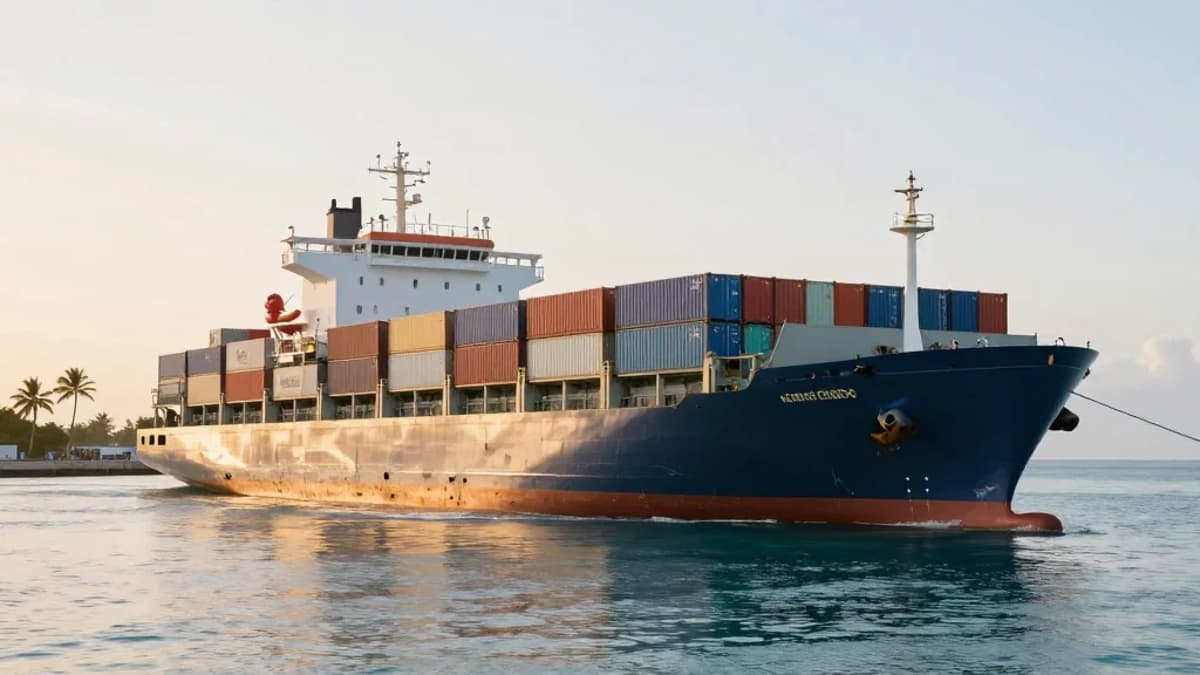
Central importance: Trinidad & Tobago (pictured) serves as a regional hub for Caribbean shipping © Bloomberg Finance LP

The Caribbean’s location in the heart of the Americas positions it well to benefit from shifting global trade flows and supply chains, offering potential nearshoring opportunities for companies aiming to build resilience in their global production networks.

Donald Trump’s announcement of so‑called “reciprocal” US import tariffs in April 2025 jolted the global trading system. Caribbean countries, which have varied levels of trade intensity with the US, have been on a push to diversify their exports and sources of investment.

But infrastructure and regulation are a challenge and uneven between countries in the region. Logistics costs represented 16 to 25 percent of GDP in the region, well above the 9 percent OECD average, according to the OECD’s Caribbean Development Dynamics 2025 report. This is mainly due to regulatory hurdles, including taxes, insufficient airport and port infrastructure, and limited competition in the transport sector.

Trinidad & Tobago serves as a regional hub, while Jamaica and the Dominican Republic capture containerised traffic. But small‑island developing states faced a 9 percent decline in maritime connectivity in the decade to 2023, according to the UN’s 2024 Review of Maritime Transport.

Freight rates reflect these bottlenecks. Shipping a 40‑foot container from Miami to small‑island states of the Caribbean in June 2024 was four times higher than the same container to Argentina, Uruguay or even China, according to the UN Economic Commission for Latin America and the Caribbean.

“It’s really challenging to move goods and people across the Caribbean region from a competitive point of view, because it’s so expensive and the small nature of the islands,” says Damie Sinanan, executive director of the Caribbean Export Development Agency.

With multiple Caribbean countries on a growth trajectory, several major projects currently underway promise a major upgrade of the regional port infrastructure, with foreign investors playing a prominent role.

Positioning for future growth

Pérez y Cía, a maritime and logistics group headquartered in Spain, opened new offices in Barbados, Belize, Guyana and Suriname in recent years to align with structural shifts in Caribbean trade.

“We are seeing clear signals that supply chains are becoming more regional, more diversified and more risk‑aware,” says Evelyn Murphy‑Pouchet, eastern Caribbean manager for Pérez y Cía.

Not everything has been plain sailing in certain countries. Haiti, for example, has seen its textile industry wiped out by the country’s political upheaval as gang violence has gripped the country since the 2021 murder of President Jovenel Moïse.

But in politically stable countries, some industries have gone from strength to strength. The Dominican Republic has secured 20 of the 28 greenfield manufacturing FDI projects tracked across Caipa countries between 2020 and 2025, according to fDi Markets.

US–CAFTA

A free‑trade agreement between the US, five Central American countries and the Dominican Republic (US–CAFTA), implemented in stages from 2006, has attracted a host of multinationals to the Caribbean island.

The DR’s network of 92 special economic zones has helped the growth of sectors ranging from life sciences to electronics, apparel and footwear industries.

“The cost to operate in the DR through a free‑trade zone is extremely advantageous,” says Anthony Ali, managing director of Barbados‑based conglomerate Goddard Enterprises, which operates a sticker manufacturing plant in the Hispaniola Industrial Park.

In the DR’s standout industries, impacts on trade have been muted. Its exports of medical devices hit a record high of $1.9 bn in 2025, up by 3.6 percent on the previous year, according to the Dominican Republic National Bureau of Statistics via Trade Data Monitor. The majority (75 percent) of these 2025 exports were bound for the US, down from 80 percent in 2024.

Operations of major medical‑device multinationals in the DR include giants like Baxter, Medtronic and Germany’s Braun. Existing firms have continued to grow amid the dynamic trade‑policy shifts, including Costa Rica’s Itek, a manufacturing‑service provider for the medical‑devices and technology industries.

“The expansion to the Dominican Republic not only expands our capacity but also offers our clients unparalleled flexibility, supply‑chain resilience, and access to another excellent talent ecosystem,” said Bernal Rodríguez, founder and CEO of Itek in a statement in September 2025.

Testament to its flourishing foreign‑trade profile, the country signed a memorandum of understanding with the UAE’s DP World in May 2025 for a $760 mn expansion of the Port of Caucedo and its free‑trade zone. Simon Sonoo, DP World’s senior vice‑president of parks and economic zones, wrote in fDi Intelligence in October 2025 that the “investment is not just serving overseas companies”, but strengthening the Dominican Republic’s competitiveness and helping diversify its economy.

Regional trade boost

Ports are not only expanding in the DR. Jamaica is significantly expanding its storage capacity by over 25 percent through an $80 mn expansion at the Kingston Freeport Terminal. Guyana is also building the new Parika port to support regional trade, and advancing the Berbice deep‑water port for large cargo and trade with Brazil. In Belize, the Port of Belize is undergoing a $200 mn expansion, whereas Turkish GPH is investing $250 mn to upgrade several cruise terminals around the region.

Darwin Telemaque, chairman of the Port Management Association of the Caribbean, which represents 27 ports and 41 associate members, argues there is scope for infrastructure expansions.

“If you look at all of our ports, therein lies massive opportunities for investments, at the infrastructure level, digitalisation, automation and even at the human‑resource development,” he said at an FT Locations’ Investing in Caribbean event in January 2025.

Infrastructure expansion

Regional air connectivity is also on the rise, also thanks to the rapid growth of Dominican budget airline Arajet, which has turned Santo Domingo into a hub for flights bound to the rest of the Caribbean and the Americas as a whole. Foreign investors have taken notice.

Lithuania’s FL Technics is also set to open the Dominican Republic’s first independent aircraft maintenance, repair and overhaul centre at the Punta Cana International Airport, where it expects to create more than 2,000 jobs.

“The Dominican Republic has never been an aircraft MRO hub — and that’s exactly why we see such incredible potential here,” Žilvinas Lapinskas, CEO of FL Technics Group, said in a statement.

This article is part of the Special Report: Caribbean charts a new path.

Read Original Article
0

Comments

Want to join the conversation?

Loading comments...