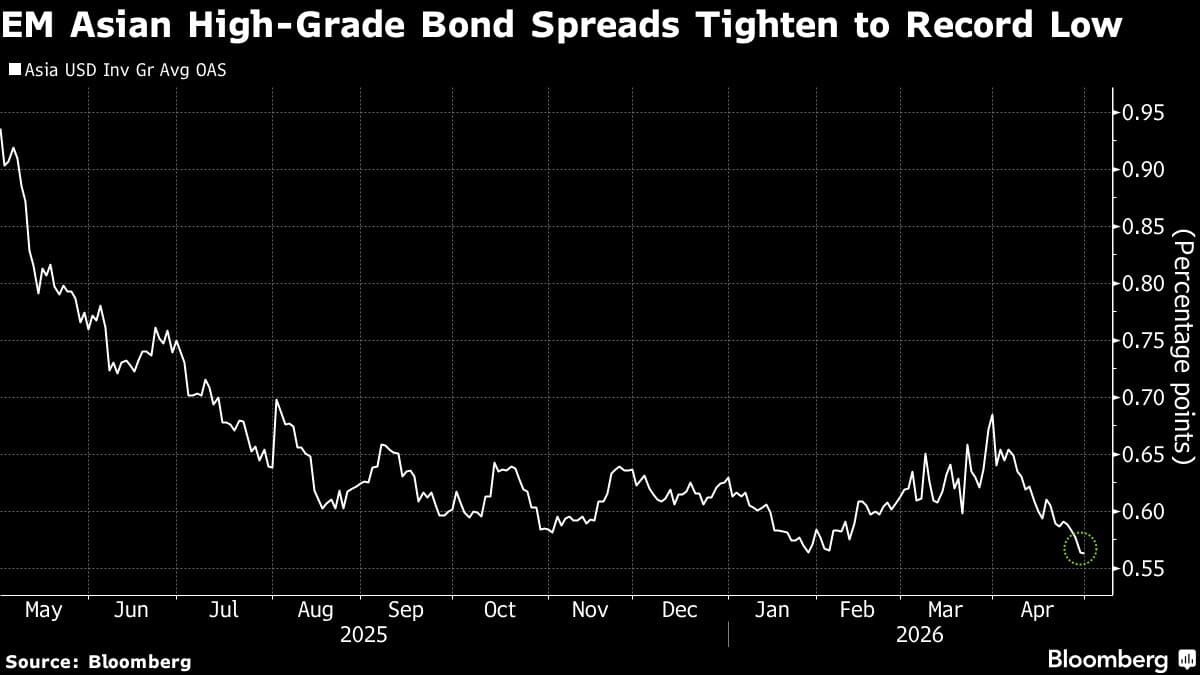
Record-Low Spreads on EM Asia High-Grade Debt Show Resilience
Companies Mentioned

Bloomberg
Why It Matters
The tighter spreads lower borrowing costs for Asian sovereigns and corporates, signaling strong demand and resilience in a volatile macro environment. This benchmark shift influences global portfolio allocations toward emerging‑market credit.
Key Takeaways
- •Asian investment‑grade spreads fell to 56 bps, record low
- •Reduced new issuance drove tighter pricing across EM Asia bonds
- •China’s economy steadied, offsetting Iran‑war market stress
- •Bloomberg index records narrowest spread since 2009 inception
Pulse Analysis
The Asian high‑grade dollar bond market has entered an unprecedented phase of compression, with spreads narrowing to 56 basis points—well below the historical average of 80‑90 bps. This milestone, the tightest since Bloomberg launched its index in 2009, underscores a rare alignment of supply constraints and robust demand. Investors are rewarding the perceived safety of sovereign and quasi‑sovereign issuers in the region, driving yields down to levels typically reserved for developed‑market credit. The trend also reflects a broader shift as fund managers seek yield in a low‑interest‑rate global backdrop.
Two primary forces are behind the spread tightening. First, the pipeline of new issuance has thinned dramatically due to fiscal prudence and tighter monetary conditions in several Asian economies, limiting the amount of fresh debt available for investors. Second, China’s economy has shown unexpected resilience, with GDP growth holding above expectations despite lingering supply‑chain disruptions and the fallout from the Iran‑war conflict. This steadiness has bolstered confidence in the region’s credit profile, allowing investors to overlook geopolitical headwinds and focus on the relative value of Asian high‑grade bonds.
For market participants, the record‑low spreads translate into cheaper financing for issuers, potentially spurring infrastructure projects and corporate expansions that rely on external funding. However, the compressed pricing leaves little margin for error; any deterioration in China’s growth trajectory or escalation of regional tensions could prompt a rapid repricing. Asset managers will likely monitor issuance calendars and macro indicators closely, balancing the lure of high‑yield returns against the risk of a sudden spread widening. Overall, the current environment offers both opportunity and caution for those navigating emerging‑market credit.
Record-Low Spreads on EM Asia High-Grade Debt Show Resilience
Comments
Want to join the conversation?
Loading comments...